


10 Days in Sri Lanka: A Family Journey Through Heritage, Hills & Coastline
- Amy

- Nov 16, 2025
- 26 min read
Updated: Nov 17, 2025
It was a sweltering 36 degrees when we stepped out of Bandaranaike International Airport (CMB), located in Katunayake that April afternoon. A hot gust of air hit us instantly, and within minutes I could see beads of sweat trickling down Kiu’s neck as he sat strapped into his stroller. Michael, our driver, hurried us towards his large spotless car. The black leather seats were warm, but the air conditioning was on full blast, and soon enough we were speeding away from the busy terminal onto Colombo’s wide city roads.
I had no real picture of Sri Lanka in mind before arriving. I imagined endless coconut palms lining the coast, platters of fresh fish and prawns, elephants roaming freely, grand temples narrating stories from the Ramayana, and somewhere in the far north, lands once scarred by conflict that we knew we would not be venturing into. The heat felt overwhelming at first, and for a moment we wondered if choosing April had been a mistake.
10 Days in Sri Lanka
What unfolded over the next ten days was nothing short of extraordinary. A journey across this island shaped by mythology and history, filled with culture, warmth, and landscapes that left us in awe.
What I cherish most is how much ground we covered. We did not make it to Jaffna, but from Colombo to Pinnawala, Polonnaruwa to Sigiriya, Dambulla to Kandy, through the tea-covered highlands of Nuwara Eliya and the cool slopes of Ella, pausing for birdlife at Bundala National Park and later driving into Yala National Park, and finally down to the beaches of Bentota and Mirissa, with a quiet golden evening at Galle Fort, we journeyed almost the entire length of this island. With Kiu just two years old, it was a trip that blended exploration with gentle pauses, teaching us to travel slowly and absorb deeply.
Sri Lanka turned out to be far more layered, beautiful, and meaningful than I had imagined. It exceeded every expectation and left us with memories that will stay with us for a lifetime.

You can book these tours through my links below — they offer some of the best rates and trusted experiences!
|
Planning the Trip: Securing the Right Vehicle & Driver
Before even arriving, one of our top priorities was arranging a reliable, spacious vehicle. With three suitcases and Kiu’s stroller on board, a standard car was out of the question. We specifically arranged for an SUV or minivan to ensure comfort on our long drives.
Back in 2018, I had negotiated a rate of $450 for nine days, about $50 a day, which matched what friends had paid at the time. However, in 2025, rental rates have shifted noticeably upward:
Basic car with driver and fuel: around $60–80 per day
SUVs or vans with driver: typically $80–100 per day
Luxury options: start from $120 per day
Sri Lanka Private Driver
We went with Shiyan Fazool who appointed Michael as our driver.
If you’re planning a multi-day road trip in Sri Lanka and want comfort, flexibility and reliable local insight, drop Shiyan an email with your travel dates, group size and preferred stops. He offers private car and driver services, airport transfers and tailor-made tours across the island, and usually replies with a quote plus a suggested route. Just confirm what’s included in the price and check recent reviews before booking.
Contact Details • Name: Sri Lanka Private Driver (Contact: Shiyan Fazool) • Email: shiyanfazool@gmail.com • Phone: +94 77 035 1030 • Landline: +94 38 225 6976 • Address: No 35, Thakkiya Road, Thalapitiya, Galle 80000, Sri Lanka • Website: srilankaprivatedriver.com |
Rickshaw Travel (Sri Lanka Specialist: David)A UK-based travel company offering tailor-made Sri Lanka holidays. If you prefer a fully planned itinerary with hotels, activities and a trusted local driver, David can organise everything once you share your travel window and interests. Contact Details • Email: srilanka@rickshawtravel.co.uk • Website: rickshawtravel.co.uk/sri-lanka |
Sri Lankan Personal Drivers (Sangeeth & Saman)A dependable option for private car and driver services across Sri Lanka. Travellers often praise their safe driving, friendly service and flexibility. Share your dates, group size and preferred route, and they’ll respond with a quote. Contact Details • Email: info@srilankanpersonaldrivers.com • Website: srilankanpersonaldrivers.com |
The rise reflects higher fuel prices and demand, but the value is still excellent, especially with the assurance of a safe, experienced driver. Our driver, Michael, not only drove with great care but also knew the best little stops along the way in those 10 Days in Sri Lanka, from hole-in-the-wall eateries to scenic lookouts.
From the airport, you may conveniently book a taxi to the destination of your choice using EASY AIRPORT TAXIS BOOKINGS. You can also opt to rent a car and drive yourself, which can be easily arranged by BOOKING HERE. |
Day 1
Elephant Orphanage at Pinnawala
We arrived from Dubai and spent the night in a small guesthouse in Colombo. The next morning, after breakfast, we began our drive to Pinnawala, which is about 85 km from Colombo and takes roughly 2 to 2.5 hours.
The road started off busy near the city, but soon opened into countryside. We passed paddy fields, coconut groves, banana plantations, fruit stalls, and small temples along the way. Michael pointed out the King Coconut, which Sri Lankans drink for refreshment. He stopped by a roadside vendor for us to try it. The coconut water was cold and very sweet, exactly what we needed in the heat.
At the Pinnawala Elephant Orphanage, we first saw a small group of elephants gathered near the entrance, large, gentle, slow-moving. Some elephants had chains around their feet, which made us feel unsure about how we felt about the place. The orphanage was set up to care for injured and rescued elephants, but seeing them restrained reminded us that animal tourism is always complicated. Still, there were keepers who seemed to know the elephants well, calling each one by name, and the animals responding in quiet, familiar ways.

Every day, the elephants are taken down to the river for their bath, and we were lucky to be there at the right time. We stood on the side of the street and watched as a whole herd walked past, huge shapes filling the narrow road, feet thudding slowly against the ground. The keepers walked alongside them, guiding them gently. Tourists stepped aside, cameras came out, and suddenly the whole street felt alive with movement.

The river scene was the most memorable part. The elephants waded into the shallow rocky water, some splashing, some lying down completely, others spraying water from their trunks. They looked free there, unrestrained, playful, and peaceful. People stand by the river or sit on the terrace of the café-cum-restaurant called Elephant Bay Hotel Restaurant (but Pinnalanda is the local and commonly used name) overlooking the river, just watching, quietly.

Kiu enjoyed this part the most, watching the elephants bathe, stomp, play, and spray water everywhere. His eyes were wide the entire time. For him, it was simply magical. For us, it was a mix of feelings, beauty and sadness together. The elephants seemed happiest in the water. We really hope they are treated well behind the scenes too.

By late afternoon, we reached Cassandra Culture Resort in Sigiriya. The property is large, with spacious gardens and open green areas. It is peaceful and beautifully laid out, but the mosquitoes come out in the evening, so mosquito repellent is necessary. It’s reasonably priced and conveniently located for visiting nearby UNESCO heritage sites like Sigiriya and Dambulla. The only downside is that you’ll need a tuk-tuk or car to get to restaurants and shops.

Overnight at Cassandra Culture Resort in Sigiriya.
Day 2
Dambulla’s Ancient Cave Temples
We started our day early at the Dambulla Cave Temples, to beat the afternoon heat. The drive was about 30 minutes from our resort. The entrance begins with a walk uphill, and then you reach a row of white temple structures built directly into the rock face. Kiu walked (and sometimes ran) barefoot along the stone floors, curious about everything. The caves were calm and not too crowded in the morning, which made it easy to move slowly and take our time.
It’s a sacred place, so shoulders and knees need to be covered, and footwear must be left outside. We carried socks just for the hot ground, a small but very helpful tip.

Inside, the caves open up into dim, cool chambers filled with gold-painted Buddha statues, carved figures, and colorful mural paintings that cover the ceilings. There are five cave temples in total, each one slightly different in size and atmosphere. The most striking are the large reclining Buddha statues, lying peacefully along the walls. The caves feel ancient and quiet, lit just enough to see the details, the folds of robes, the serene facial expressions, and the patterns on the ceilings.

Entry fee is USD 10 per adult (children under 12 usually free) Open daily from 7 AM to 7 PM, with the best time to visit in the early morning before the heat. |
Hiriwadunna Village Life
After spending some quiet time inside the caves, we made our way back down the hill and drove towards Hiriwadunna for a village experience. Hiriwadunna is a small rural community just outside Sigiriya. Life here moves slowly. Houses are built with mud walls, palm-leaf roofs, and open verandas, everything connected to the land and rhythm of the day.
We arrived in the afternoon when the sunlight was strong. The experience began with a bullock cart ride, the wooden cart moving steadily along sandy paths. We passed fields of banana, jackfruit, and paddy, where farmers worked quietly. The slow pace made us notice the little things, the sound of birds, children waving shyly from their doorsteps, and the earthy smell rising from the warm ground. For travelers coming from faraway countries, I can imagine this being something truly new and eye-opening.
We then crossed a small lake in a wooden canoe, paddled calmly by our village guide. The water was still, reflecting the trees and the broad green lotus leaves floating across the surface. Time felt slower there. No noise. No hurry. Just water, wind, and stillness.

For us, being from India, rural scenes like this are not unfamiliar. We have grown up around similar simplicity and landscapes. Yet, there was something quietly beautiful about experiencing it in another country, one that shares so many cultural threads with our own. The gestures, the smiles, the way life here felt familiar, yet unique.
On the other side of the lake, we walked into a traditional village home. The women welcomed us with big smiles, their clothes colorful, their presence warm and confident. They showed us the open kitchen, where food was being cooked in clay pots over a wood-fire stove. There were no utensils of steel or modern cookware, just earthen pots, wooden ladles, and coconut shell spoons.
They prepared a simple, hearty local Rice & Curry meal, served on a banana leaf with Maalu Baduma (spicy fried fish), Polos Curry (young jackfruit cooked soft with spices), Bonchi Mallum (green beans with coconut), and Kadala Curry (chickpeas in turmeric and coconut milk), Gotukola sambol (a fresh herbal coconut salad), Pol sambol (coconut relish with chilli and lime), plus something like crisp papad for crunch.
The meal tasted earthy and heavenly, fresh, and full of flavor, the kind of food that comes straight from the garden to the stove. We ate sitting on woven mats, the table made of palm leaves, barefoot and relaxed.

After the meal, one of the women brought out a wooden spice box, a beautiful grid filled with dried seeds, roots, bark, and pods. She explained how each spice was used in daily cooking, and how they also form the base of Ayurvedic remedies. It felt like a small, intimate cooking class tucked inside a real home.
We took a picture together before leaving, all of us smiling. There was no rush, no performance, no tourist polish. Just kind people welcoming us into their everyday world. It was one of the most genuine, grounded experiences of the trip, slow, simple, and full of heart. It was already evening by the time we finished here, so we decided to head back to our resort to take a refreshing dip in the swimming pool.
Overnight at Cassandra Culture Resort in Sigiriya.
Day 3
Sigiriya Rock Fortress
We began our day with an early climb up the Sigiriya Rock Fortress, a UNESCO World Heritage Site and one of Sri Lanka’s most famous ancient landmarks. Sigiriya was once the royal palace of King Kashyapa in the 5th century, built right on top of a giant rock that rises about 200 meters above the plains.

We drove to the Sigiriya Archaeological Site and parked near the ticket office. From there, we walked about 10–15 minutes through wide gardens, water canals, and shady trees until we reached the base of the rock. I stayed back with Kiu in the gardens. It was the perfect place for him with open grass, butterflies, ponds, small birds, and plenty of space to play without crowds. From where we stood, the rock rose straight into the sky, huge and commanding. You don’t need to climb it to feel its presence.
Bunty decided to climb the 1,200 steps to the top. The path winds past the Sigiriya frescoes, the Mirror Wall, and the massive Lion’s Paw Terrace carved into the rock. At the summit, he said the view was endless. The outline of the ancient palace still visible in stone and earth. We experienced Sigiriya differently, one from the ground, one from the sky, but both moments felt powerful in their own way.
After climbing down, we stopped at a small family-run café along the Sigiriya–Minneriya road, the kind of place with wooden benches, a hammock stretched between two trees, and a view that opens straight onto the Minneriya plains (If I remember correctly, the restaurant was called Rithu Restaurant). We could see elephants grazing far out in the distance while we sipped tea. In India, they say that seeing an elephant in the wild brings good luck, and at that moment it truly felt special. We sat there quietly with tea and a few biscuits, letting our legs rest and our breath settle, before continuing our journey onward to Polonnaruwa.

Exploring Polonnaruwa
In the afternoon, we drove to Polonnaruwa, the ancient capital of Sri Lanka, to marvel at the Gal Viharaya’s colossal Buddha carvings. The city is spread across a large archaeological park, dotted with ruins from the time when Sinhala kings ruled here over a thousand years ago. It is a UNESCO World Heritage Site and once the proud capital of Sri Lanka under King Parakramabahu I in the 12th century. The ruins here narrate stories of kings, monks, and temples that once flourished with art and devotion. It was eerily quiet, absolutely noone, and this whole open-air museum felt like a private viewing session of history which is not behind glass, but right under your feet!

We wandered through old palace walls, meeting halls, and temples, all carved from stone. Kiu climbed up and down the worn steps as if they were playground steps, while we moved slowly from one site to another, taking shade under trees whenever we could. The sun was strong, but the place had a calm, old-world silence to it.
The most beautiful part was the Gal Vihara, which Bunty missed! It was so scorching that Bunty didn’t step out of the car, while I made a quick dash up to catch a glimpse of the centuries-old cave murals and Buddha statues. It was a group of four serene Buddha statues, a seated Buddha, a standing one, a reclining one, and a smaller seated figure carved directly from one long slab of granite. These statues, nearly 900 years old, were created during the reign of King Parakramabahu I and are considered masterpieces of Sinhalese stone sculpture. They have such grace and stillness, even after centuries of sun, rain, and wind.

|
Ayurvedic Massage at Ayurveda Isiwara Paura
After a long, hot morning exploring Polonnaruwa, I treated myself to a luxurious Ayurvedic spa experience at Ayurveda Isiwara Paura - Healthy side of your life. The moment I entered, I was welcomed with a namaste by graceful women dressed in bright sarongs. The spa was set in a lush garden, peaceful and beautifully kept, with the faint scent of herbs and sandalwood in the air. It is a large, quiet, professional wellness center with meditation gardens, relaxation areas, and private rooms with attached changing spaces.
Once I booked my treatment, one of the therapists led me to a softly lit room filled with the aroma of essential oils. They provide clothing and towels and guide you through the experience calmly. The massage began with a gentle foot scrub and foot massage, followed by a full-body oil treatment known as Abhyanga, one of Sri Lanka’s signature Ayurvedic therapies. The therapist used warm herbal oils in slow, flowing strokes that melted away every bit of exhaustion.

In Sri Lanka, Ayurvedic massages are more than just relaxation, they are part of an ancient healing tradition meant to balance body and mind, improve circulation, and restore natural energy. These centers are common across Sri Lanka’s Cultural Triangle, especially around Sigiriya and Polonnaruwa, and most operate daily from 8 AM to 6 PM. Treatments typically cost between USD 25–60, depending on duration and type, and advance booking is recommended during the busy season.
Ask your driver or hotel to call ahead and book a time slot. Best in the late afternoon or early evening. Here are three highly-rated spa options across Sri Lanka, one in each of your key locales:
|
After this soul-enriching experience, we headed back to our beautiful resort Cassandra Culture to unwind.
Overnight at Cassandra Culture Resort in Sigiriya.
Day 4
Matale Aluvihara Temple
Today we set off for Kandy, about 90 kilometers from Sigiriya. The drive took us through small villages, spice gardens, and the beautiful Matale countryside. It is one of the most scenic routes in Sri Lanka’s Cultural Triangle. On the way, Michael told us we’d stop at the Matale Aluvihara Temple.
This bright red-and-gold temple stands against a backdrop of forested hills and is believed to date back to the 3rd century BC. It holds great importance in Sri Lankan Buddhism because this is where the Pali Canon (Tripitaka), the teachings of the Buddha, was first written down on palm leaves. The word “Aluvihara” means “temple in the caves”, and the site includes several rock caves filled with old murals and Buddha statues.

The Matale Aluvihara Temple doesn’t take more than 30–45 minutes to explore, and it’s right by the main road, so you don’t need a big detour. You can walk through the painted cave shrines and see the old palm-leaf manuscripts, worth a stop!
Kandy
We reached Kandy around noon and stopped for lunch at a small meals restaurant in the city centre on Colombo street, walking distance from the Tooth Relic Temple, called Balaji Dosai. What a treat that was! Their rice and curry thali, masala dosa, and string hoppers with sambol are so rich in flavor and taste! It was exactly what we needed after the 3 hours drive from Sigiriya.
After lunch, we took a slow walk along Kandy Lake. The lake is right in the middle of the city and has a walking path all around it. It was peaceful, with big old trees providing shade. We sat by the water, just taking in the view.

Kandyan Cultural Dance Show
In the evening, we went for the Kandyan Cultural Dance Show, which takes place near the Kandy Lake Club Cultural Center, close to the lake. The show usually starts around 5:30 PM. Michael booked our seats earlier in the day and got us seats in the front row, which made the experience much better.

The performance included traditional dances such as Udekki Dance, Ves Dance (the most traditional Kandyan dance), Naiyandi Dance, Peacock Dance, Mayura Dance, Fire Dance and Fire Walking at the end. There was drumming, colorful costumes, and a lot of energy. The fire dance at the end was exciting. The performers actually walk on burning coals.
Temple of the Tooth Relic
After the show, we went straight to the Temple of the Sacred Tooth Relic, which is only a short walk away. The Temple of the Tooth Relic in Kandy is one of Sri Lanka’s holiest places because it holds a sacred tooth of the Buddha. The tooth is kept safely inside a golden casket, and every day there are prayer ceremonies at 5:30 AM, 9:30 AM, and 6:30 PM, when people come to offer flowers and light lamps.
Priests wore white, as is customary, but we wore colorful clothing but covered ourselves. Shoes must be removed before entering. The evening Aarti (known locally as Thevava) usually starts around 6:30 PM. This is the time when the drummers play, lamps are lit, and the inner chamber is opened briefly for people to see the shrine where the relic is kept.

It can get crowded during this time, so it’s good to arrive a little early and move slowly with the flow of people. The atmosphere is peaceful, devotional and calming, the sound of drums echoing through the temple, the smell of incense, and people offering white lotus flowers.
It was a simple but very beautiful experience.
Dinner at Amaya Hills Kandy
After immersing ourselves in the spectacular cultural dance show in Kandy, we were famished and ready to eat, I had already made a reservation at Amaya Hills Kandy. It is the resort whose lights and terraces are visible from across the Kandy lake, especially at night. The hotel is located on a ride of the Heerassagala hills, about 10 minutes drive from the city center. It is famous for its open-air restaurant with sweeping views of the city from atop. The restaurant I reserved was Rasawasala Restaurant. It serves Sri Lankan and international buffets. Its a popular dinner spot with a touch of luxury and elegance if you feel like a special night in Kandy.
Overnight in Kandy.
Day 5
Nuwara Eliya
Leaving Kandy, the road slowly climbed into the Hill Country. The scenery changed completely. The air became cooler and the views turned into layers and layers of green tea plantations spread out across the hills. Women were working on the slopes, hand-plucking tea leaves with small baskets on their backs, the same way it’s been done for generations.

We made a short stop in Nuwara Eliya, which is known as Sri Lanka’s tea town. The town has an old colonial feel to it, with cool weather and English-style cottages. We went to a local tea shop here (you will find plenty along the main street, Mlesna Tea Center and Damro Tea are both reliable). We bought a few packets of Ceylon tea to take back home, black tea, green tea, and some flavored blends. The staff explained the differences in taste depending on which elevation the tea is grown, which was interesting to learn.

We didn’t do a full tea factory tour, but just driving through the tea hills was refreshing on its own. The landscape is soft and rolling, and the drive feels slow and calming.
Ella
Along the way, Michael surprised us with a pit stop in Ella at Café Chill. A hippie-style café, a place which was a relaxed, with reggae music, backpacker vibe, full of travellers, and good food. You will find rice and curry, falafels, smoothie bowls, pancakes, fresh juices. Everything is unhurried, and people sit for hours without watching the clock. Its open from 9 AM until 11 PM and you spend approximately USD 6 to 8 for a meal here.

Ella is a small mountain town in the Hill Country, surrounded by waterfalls and endless tea estates. The air is cool and fresh, and life moves gently. The whole town has that slow, easy mountain pace.It was a refreshing contrast to the temples and ruins.
Nine Arch Bridge or Bridge in the Sky
One of the most popular things to do here is the scenic train ride. This is the iconic blue train that winds through green hills, tea plantations, misty valleys, and old stone bridges.
If you have time, you can take the train all the way from Kandy to Ella, which takes about 6–7 hours. But if you want the scenic part without the long journey, take the shorter Nanu Oya to Ella stretch (around 3 hours). The views here are the most beautiful. You can book the 1st Class Observation Car for about USD 12–20 for comfort and big windows or the 2nd class reserved seats for cheaper. Or, if you take 3rd class (non-reserved) for USD 2-4, you can simply sit by the open train doors with your legs dangling, which is what many people do for the experience.

If you don’t have time for the train ride, you can still get the famous Ella moment. The bridge in the photo is the Nine Arch Bridge, also called the Bridge in the Sky. It’s just outside Ella town and is one of the most photographed places in Sri Lanka. It reminded us of Glenfinnan Viaduct in Scotland, where the Hogwarts Express passes and where people gather to watch and take photos. Similar feeling here, everyone waiting for the blue train, cameras ready.
To visit, you'll have to walk 20–30 minutes from Ella through a shaded scenic path, or take a tuk-tuk to the viewpoint above the bridge. Trains pass several times a day. Best time to be there is either Morning (9–11 AM) or late afternoon when the light is soft.
If you have the time, you can also make a stop at Rawana Waterfalls for a quick break in the cool mist, and continue further to see the Buduruwagala Rock Carvings, a set of ancient Buddha figures carved into a cliffside. It’s quiet, slightly remote, and very peaceful. |

By evening, we checked into Gaga Bees Yala. Gaga Bees Yala is a charming and rustic eco-lodge, just the way I like it, located just a short drive from Yala National Park. The cottages are built from clay and thatch, designed to stay cool naturally. Each one opens onto a small porch with wooden chairs where you can relax and listen to the sounds of birds at sunrise. Inside, the rooms are simple yet cozy with clean beds, earthy walls, and open-air bathrooms that add a touch of adventure without compromising comfort. The property has a swimming pool, restaurant, and wide green lawns where kids can play freely. The staff are friendly and often help guests plan safaris to Yala National Park, which is only about 20 minutes away. you can enjoy a Sri Lankan dinner under the stars while fireflies flicker in the garden.

Overnight in Gaga Bees Yala.
Day 6
Safari Adventure at Yala National Park
The night before our safari, poor Kiu fell sick. There was no medical help nearby, so we had to call our doctor in Dubai to assist with the right medication. I was worried, but when we woke him up at 4:30 a.m. for the safari, he sat up instantly, eyes sparkling, all excited. That’s my boy! Adrenaline-fueled and ever the wildlife enthusiast!
Yala National Park’s main zone, Block 1, was about a 45-minute drive from Gaga Bees. This is the heart of the park, known for its incredible wildlife and thrilling leopard sightings. The icy morning wind hit our faces as we drove through the dark, but the thrill of the adventure kept us warm. We went on in a private jeep, just the three of us. Once we reached the park gate, we grabbed some steaming hot chai, the perfect start before setting off into the wild.

Yala National Park is Sri Lanka’s most famous wildlife reserve, spanning over 900 square kilometers and home to leopards, elephants, sloth bears, and an incredible variety of birds. The thrill of spotting animals in their natural habitat, with the golden sunrise lighting up the savannah, was simply unforgettable.
We saw elephants, crocodiles, spotted deer, monkeys, eagles, peacocks, and many smaller birds. The leopard did not show itself, but the landscape and wildlife made the experience exciting. After an exciting morning safari filled with sightings and snapshots, we returned to Gaga Bees for a hearty breakfast and a much-needed nap. In the afternoon at 2 pm, we did a second safari.

By evening, upon our return, we had a sumptous dinner. We were tired but happy, already excited for what awaited us the next day: birdwatching at the beautiful Bundala National Park, a paradise for nature lovers and bird enthusiasts alike.
Overnight in Gaga Bees Yala.
Day 7
Bird Watching at Bundala National Park
The next morning, we were up early again, this time for our much-awaited trip to Bundala National Park, a hidden gem often overshadowed by its famous neighbour, Yala. Kiu was feeling much better, his energy back and excitement shining through. Seeing him cheerful again made my morning instantly brighter!
Bundala is about an hour’s drive from Gaga Bees, and as we got closer, the landscape began to change, from dense forests to serene lagoons and shimmering salt pans. Instead of chasing leopards or elephants, here it’s all about slowing down and spotting the beautiful birds of nature.
Bundala is a UNESCO Biosphere Reserve, spread across nearly 6,000 hectares, and it’s a true haven for bird lovers. Over 200 bird species call it home, including migratory visitors from as far as Siberia. Our first spotting was of a flamboyance of flamingos wading gracefully in the shallow waters and the sight was simply breathtaking. We spotted painted storks, pelicans, herons, and even a few peacocks proudly strutting by the roadside.

Our guide pointed out crocodiles basking in the sun near the lagoons, and every now and then, a troop of monkeys swung across the trees, getting excited jumps from Kiu. The best part? The park wasn’t crowded at all. It felt like we had the whole place to ourselves, just us, the birds, and the sound of the wind moving through the reeds. By late morning, the sun had turned warm, and we stopped for some chai and biscuits near one of the lagoons.

As we drove back to Gaga Bees, Kiu couldn’t stop talking about the birds he’d spotted, and I couldn’t help but smile, my little energy bunny surely was having the time of his life so far in Sri Lanka!
Everything You Need To Know Upon much research we had shortlisted two safari companies for Yala and Bundala: 1. Bundala & Yala Safari Service Contact: Randika SrimalPhone / WhatsApp: +94 77 959 9397 A local, on-ground operator, usually very flexible with pickup times and safari schedule. Easy to communicate with over WhatsApp.Good option if you prefer a simple, friendly, locally-run experience, especially for Bundala bird watching safaris. 2. Yala Kings Safari / Sasindu Safari Jeep ToursContact: TharinduEmail: eco.safari@yahoo.com / info@yalakingssafari.com (You can request his WhatsApp Contact Number when emailing) This operator is known for comfortable, well-maintained jeeps, experienced wildlife spotters, clear communication and advance booking support A good choice if you want a smooth, well-organized safari with a focus on sightings, especially in Yala Block 1.
3. Independent Safari Jeep Association (Tissamaharama)Location: Tissamaharama Town Safari Stand This is not one company, but a cooperative of licensed jeep drivers.You’ll find many jeeps ready to hire on the same day. Ask your hotel to recommend a specific driver by name. This option works well if you prefer last-minute decisions or want to compare jeep conditions in person. We booked a private jeep with a safari company that provided everything: a 4WD vehicle, driver-guide, binoculars, water, fruits, and even hotel transfers. Full-Day Safari (Yala): A full-day safari runs roughly 6:00 AM to 6:00 PM and costs about USD 140–180 per jeep (2–4 people), including park entry tickets, private jeep, tracker-driver, hotel pickup/drop-off, breakfast stop, lunch, and refreshments.
7-Hour Safari (Yala): A 7-hour safari (either 6:00 AM–11:00 AM or 2:00 PM–6:00 PM) costs about USD 90–120 per jeep (2–4 people), including park entry fees, private jeep, pickup/drop-off, and light refreshments.
5-Hour Safari (Yala): A shorter 5-hour safari (morning 6:00–9:30 AM or afternoon 2:30–6:00 PM) costs about USD 70–100 per jeep (2–4 people), including entrance tickets, private jeep, pickup/drop-off, and water/snacks. Families benefit from kids under 5 being free, which was perfect for us with Kiu. |
Day 8 – Galle Fort
We then drove to Galle Fort, which took around 3 hours. We explored the fort walls, old Dutch streets, small cafés, and shops. It takes about 2 hours to walk the fort comfortably.

By evening, we reached Mirissa. Our guesthouse was a 10-minute walk from the beach. This part of the trip was a delight. We stayed at a guesthouse called Pearl, which was charmingly laidback. The funniest memory: the host came running out to greet us with just a towel tied around his waist! Sidd was absolutely shocked, and even more appalled when he saw the size of the room. He’s definitely not the backpacker type, and his reaction had us laughing for days.
For those wanting something more upscale and right on the water, Lantern Boutique Hotel, Ubuntu Beach Villas, or Paradise Beach Club are all lovely beachfront options. And if you’re looking for a true luxury escape, Cape Weligama, just a short drive away, is incredible for sunset tea or dinner with breathtaking ocean views.
Day 9
Whale Watching in Mirissa
We set out early from Mirissa’s harbor for a whale-watching tour. Mirissa, on Sri Lanka’s south coast is one of the best places in the world to spot blue whales and dolphins in the wild. We joined an early morning whale-watching tour with Raja & the Whales, a well-known, eco-friendly operator that runs responsible ocean safaris from Mirissa Harbour.
The day started before sunrise as we boarded the boat with a small group of travelers. Once out at sea, the water turned a deep shade of blue, and within an hour, we spotted pods of dolphins playfully leaping alongside the boat. A little later, the crew pointed out the massive blow of a blue whale, the largest animal on Earth, a breathtaking sight against the vast ocean.
The ride lasted about 4–5 hours, with breakfast and refreshments served on board. Even if you don’t spot whales every time, the experience of being out at sea is unforgettable. The tour costs around USD 50–60 per person, and November to April is the best season for sightings.

After returning from the whale-watching tour, we spent the rest of the day unwinding by the coast. We strolled through the little beachside shops selling colorful sarongs, trinkets, and the famous Sri Lankan wooden masks. I couldn’t resist trying one on! Later in the afternoon, we headed to Bentota Beach, where the golden sands and rolling waves were the perfect setting for some playtime. Watching Bunty and Kiu laugh and splash in the waves as the sun dipped low was the best way to end the day, carefree, happy, and full of salt and sunshine.

Day 10
Colombo and Farewell Sri Lanka
We reached Colombo and spent a relaxed half day in the city. In our short half-day in Colombo, we explored a mix of culture, history, and local life. We began at the Gangaramaya Temple, one of the city’s most important Buddhist temples, filled with golden Buddha statues, old relics, and a peaceful lakeside setting by Beira Lake. From there, we stopped at the striking Red Mosque (Jami Ul-Alfar Mosque) in Pettah, its red-and-white candy-striped façade is one of Colombo’s most photographed landmarks.
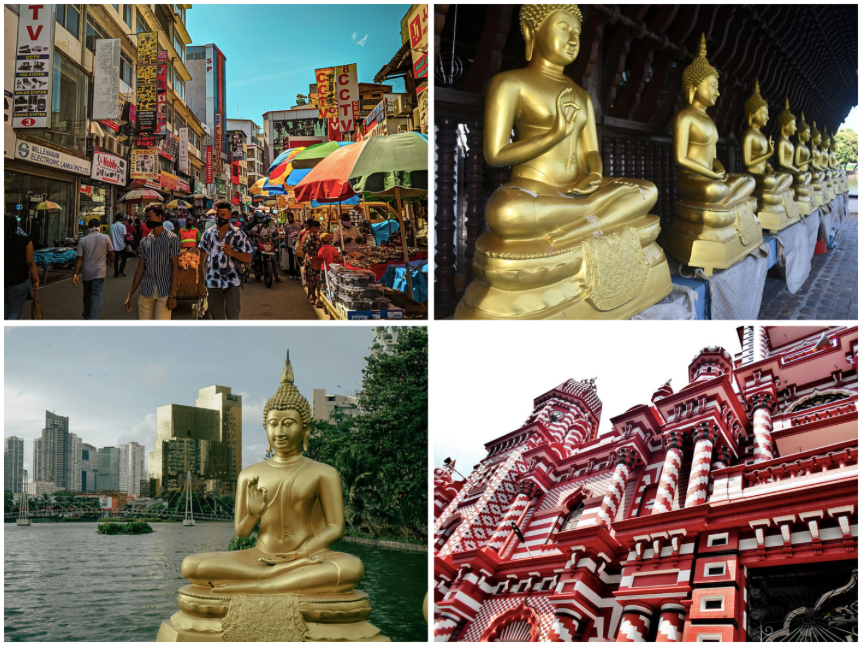
We also walked through the Pettah Market, a lively maze of shops selling spices, textiles, electronics, and souvenirs, chaotic but full of color and character. If time allows, you can end the visit with a cup of Ceylon tea or a meal at a rooftop café overlooking the city’s skyline.
📍 All these spots are within 15–20 minutes of each other in central Colombo. A nice way to end the trip before catching our evening flight back to Dubai. |
Closing Thoughts
Traveling in April meant contending with the scorching sun, but the warmth of the people, the food, and the sheer diversity of experiences made every challenge worth it. It’s easy to plan, easy to travel around, and the food is absolutely delicious. Just make sure you visit in the right season!
What Stood Out to Me in Sri Lanka
It is a land of Buddhas and blessings, where golden temples and rhythmic drumming fill the air.
Elephants rule the roads and rivers, wandering freely from Pinnawala to the wild plains of Yala.
The King Coconut is pure island gold, sweeter than any bottled drink.
Up in the hills, tea blankets Nuwara Eliya and Ella in endless green.
Down south, beaches, whales, and golden sunsets remind you why this island is pure magic.


Comments