


Bishnoi Villages of Jodhpur

A quick note before you read on: this post is based on my personal experience visiting the Bishnoi villages, along with what I learned from conversations with local people during the trip. I've tried to be accurate, but some details, especially historical or cultural nuances, may not be fully precise or complete. If you spot something off, I apologize in advance and welcome the correction.
You may have heard of the Bishnoi community because of a famous case involving Bollywood actor Salman Khan, who was accused of hunting two protected blackbucks and a chinkara during a film shoot in Rajasthan in 1998. The case became a major controversy in India, partly because blackbucks and other wildlife hold a special place in Bishnoi culture, and the community is known for fiercely protecting animals. But there is much more to the Bishnois than this incident, their connection with nature goes back centuries and is deeply woven into their way of life.

But first, what is 'Bishnoi' Villages of Jodhpur?
The word Bishnoi comes from bish, meaning 20, and noi, meaning 9, referring to the 29 principles laid down by their spiritual leader, Guru Jambheshwar, or Jambhoji, in the 15th century. These principles shaped a way of life based on compassion, simplicity and, most importantly, respect for nature.

The Bishnoi villages of Jodhpur are the rural desert settlements, just outside the city, where this community still lives by those very principles today. Villages like Guda Bishnoi and Khejarli are among the most visited, offering a glimpse into a way of life where wildlife roams freely alongside people, traditional crafts are still practiced by hand, centuries-old customs continue in everyday life and most importantly 'respect for nature'.
A Way of Life Built Around Nature
The Bishnois are a distinct religious community with their own traditions and way of life. They follow a strict vegetarian diet, discourage superstition, and believe in treating all living beings with compassion.
But what really stands out is their relationship with nature. They traditionally do not cut living trees and are known for protecting animals, even when it comes at a personal cost. Among all the trees here, none is more sacred to the Bishnois than the khejri tree. It's a tough little desert tree that survives where almost nothing else can, and it means so much to the Bishnois that it's actually the state tree of Rajasthan. Its pods, called sangri, are dried and cooked into ker sangri (mixed with ker, tangy berries from another desert shrub), a dish you'll find on pretty much every Bishnoi lunch table. And this isn't just about taste or tradition, the Bishnois have literally given their lives to protect this tree, as you'll read further down.

And you can actually see this while visiting their villages. Blackbucks, chinkaras and peacocks are often seen moving around freely, sometimes surprisingly close to people’s homes. There is no clear line between the village and the wildlife.
History: The Khejarli Sacrifice
Before visiting the Bishnoi villages, it is worth knowing the story behind their deep connection with nature.
In 1730, a remarkable act of sacrifice took place in Khejarli village near Jodhpur. The Bishnoi community has always considered trees and animals sacred and believed in protecting them at all costs. At the centre of this story is the khejri tree, a hardy desert tree that is incredibly important to Rajasthan. It is also the state tree of Rajasthan, and its pods are used in the traditional Rajasthani dish ker sangri.
At the time, Maharaja Abhai Singh of Jodhpur sent his soldiers to Khejarli to cut down khejri trees, the wood was needed to burn lime for construction material for his new palace.
When the soldiers arrived, the Bishnoi villagers refused to let them cut the trees. Amrita Devi Bishnoiwas the first to step forward. She hugged a khejri tree and refused to move. Her three daughters, Asu, Ratni and Bhagu Bai,stood by her and did the same.
The soldiers continued cutting, and Amrita Devi, her daughters, and eventually hundreds of other Bishnois were killed while trying to protect the trees. In total, 363 Bishnois lost their lives in the Khejarli sacrifice.
When the news reached the Maharaja, he was deeply affected by what had happened. He ordered the killing to stop and issued a royal decree prohibiting the cutting of trees and hunting of animals in and around Bishnoi villages.
More than 290 years later, the story of Amrita Devi and the people of Khejarli remains one of the most powerful examples of environmental conservation in India.
For the Bishnois, protecting nature was never simply a movement or a protest. It was, and still is, a way of life.
Traditions Around Women and Childbirth
Spend even a little time in a Bishnoi village and you quickly realise how much the women hold together. Beyond running the kitchen and cooking those incredible meals, they're involved in almost everything: tending to farm animals, carrying water and firewood, looking after the children, and keeping traditional arts and crafts alive, from block printing to weaving to pottery. Many of the skills and handicrafts we saw demonstrated during our visit are passed down through the women of the family just as much as the men, and a lot of the daily running of the household and the land falls on their shoulders too.
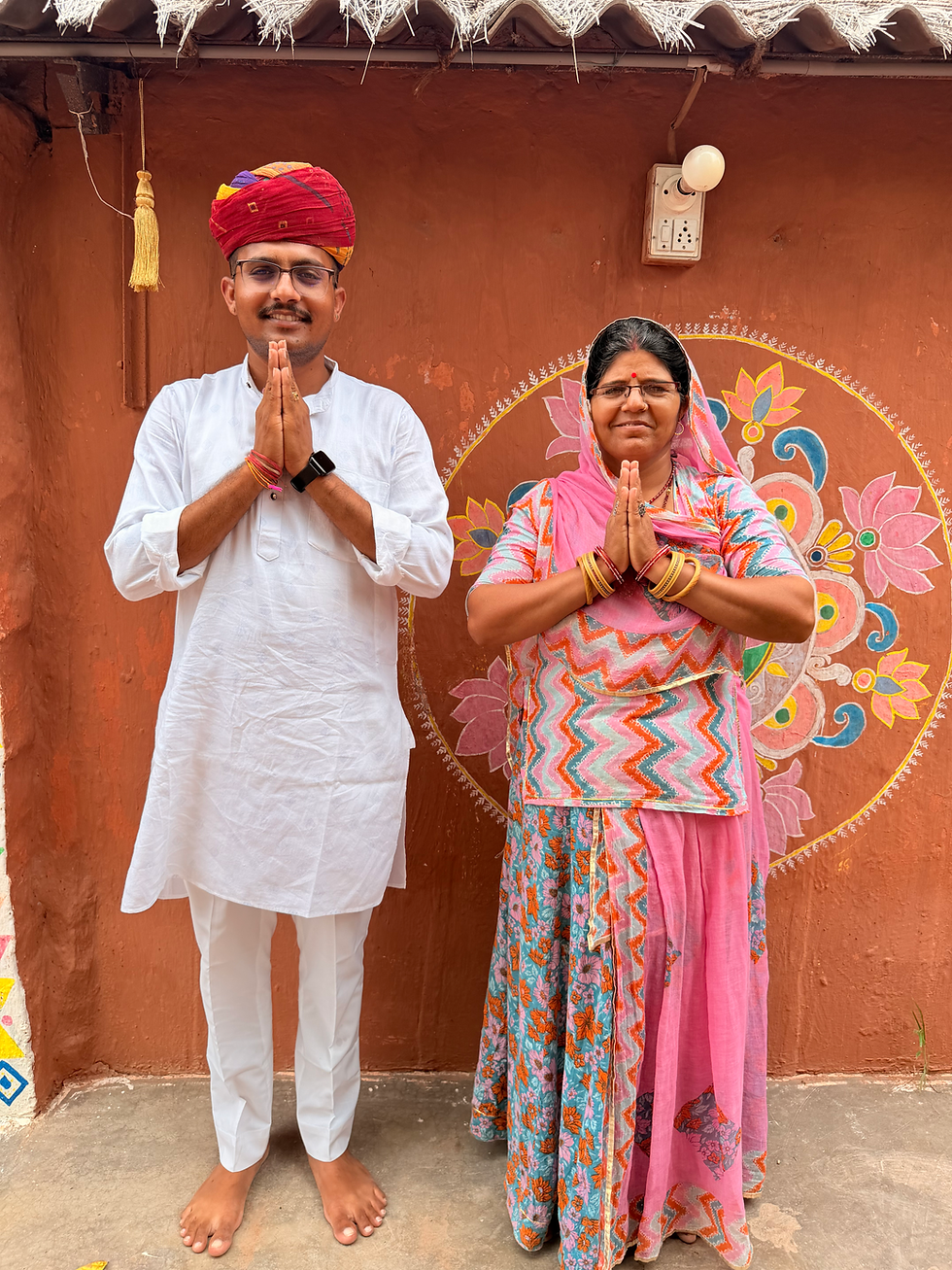
This is what made the community's traditions around childbirth stand out even more. Traditionally, a new mother would rest for around 30 days after giving birth, a period called sutak, staying away from household chores and fieldwork during this time.
There's a practical side to this too. Back when women spent most of their day working in the fields, this rest period gave new mothers real time to heal, and it helped protect both mother and baby from infections in those first fragile weeks. So what looks like just a ritual is really just good old common sense, wrapped in tradition.
I found this whole topic fascinating because these aren't just old customs for the sake of ritual; they're deeply tied to real life, health, and how much this community values and looks after its own, especially the women who quietly keep it all running.
Visiting a Bishnoi Village
The Bishnoi villages around Jodhpur are about 25 km from Taj Hari Mahal, making them an easy addition to a Jodhpur itinerary. Once you reach the entrance, you can take a jeep into the surrounding villages and countryside. It is often called a Bishnoi village safari, but don't expect a typical wildlife safari. The way it typically works is that you're first picked up from your hotel in a car and driven to the entrance point of the safari area. From there, a jeep is hailed, and that's what takes you further into the villages and countryside for the actual safari experience.

The experience is more about seeing how people, animals and nature coexist. You pass through village landscapes, spot wildlife along the way, and get a glimpse into traditional Bishnoi life.
One of the highlights of the Bishnoi Village Safari was seeing dozens of peacocks just going about their day. There was something really special about seeing them here around Jodhpur, especially because the last time we had seen so many peacocks was in Nagarhole National Park in Coorg. Seeing them again, this time against the dry, desert landscape of Rajasthan, felt completely different.
We also stopped by the Luni River, Rajasthan’s largest river system. The name is associated with salt, which makes sense because the river becomes increasingly saline as it flows through the desert. It is a seasonal river and can be largely dry outside the monsoon, when the river fills with water.
During the winter months, the wetlands and water bodies around the Bishnoi villages attract a wonderful variety of migratory birds. The area is particularly known for Demoiselle Cranes, along with many other resident and migratory species. We also spotted three kinds of kingfishers, the Common Kingfisher, White-throated Kingfisher and Pied Kingfisher.

And then came some of the animals we had been hoping to see: Chinkaras, Greater Flamingos and Blackbucks. The Blackbucks were further inland, and we spotted the males from a distance. Their beautiful spiral horns and dark colouring made them especially striking. The females, which are brown and generally hornless, are often seen in groups.
What I loved most about the safari was that the wildlife here isn’t separated from everyday village life. The Bishnoi communities have traditionally lived alongside nature and protected the animals and trees around them. Seeing peacocks, gazelles and blackbucks moving through this landscape made that relationship feel very real.
Guda Bishnoi and Kakani are among the villages and areas associated with these experiences. Depending on the visit, you may see local crafts, traditional homes, village life and, of course, plenty of wildlife.
Every Community Has Its Craft
One of the loveliest things about visiting the Bishnoi villages around Jodhpur is seeing how different communities have kept their traditional skills and crafts alive through generations.
This is based on what I learnt from the people I met during my visits to the Bishnoi villages around Jodhpur, so there may be some discrepancies or variations from village to village. But I think it gives a good general idea of the different communities and the crafts they are traditionally associated with.
The Bishnois are perhaps best known for their deep connection with nature and wildlife, but the villages are also home to several other communities, each with their own unique skills and traditions.
The Chhipas are traditionally associated with block printing, and if you’re visiting the Bishnoi villages around Jodhpur, I’d definitely recommend stopping by Jilani Hand Block Print. The ladies give a live demonstration of the printing process, showing how block printing is done entirely by hand and is a labour-intensive process. It starts with preparing and dyeing the fabric, followed by carefully placing hand-carved wooden blocks and stamping each colour onto the cloth, one layer at a time. The fabric then needs to be dried before the next stage, making the whole process remarkably time-consuming.

It was fascinating to watch this traditional craft up close and see the patience and precision that goes into every piece. After the demonstration, you can browse through their beautiful collection of hand-block-printed fabrics, bedspreads, bags and other textiles.
Right opposite it is a pottery workshop run by a family from the Kumhar community. You can watch them work with clay, browse through their handmade wares, and even try your hand at pottery yourself.

The Mochi community is traditionally known for their leatherwork and handmade juttis, the Rabaris have a long-standing tradition of sheep herding, and the Suthars are known for their skilled woodwork. Another wonderful demonstration we experienced was by the Prajapati community, who specialise in traditional rug weaving.
We met a gentleman from the Prajapati community, who patiently explained the intricacies of the rug-weaving technique that his family has mastered and practised for generations. He was incredibly passionate about this traditional art and spoke about his hope that future generations will continue to appreciate and preserve it.
I even tried my hand at weaving and quickly realised how difficult it is! Understanding which thread goes where, while keeping up with the speed and rhythm of the weaving, was far harder than it looks. Watching him work so effortlessly made me appreciate the skill and years of practice behind every rug.
Along with the demonstration, he also showed us the different types of rugs they make using materials such as cotton, sheep wool, camel wool and goat hair. It was fascinating to see how a simple thread is transformed into beautiful, intricate rugs through a craft that has been passed down through generations.

What I loved most was seeing that these crafts are so much more than just souvenirs. They are living traditions, skills, techniques and knowledge that have been passed down through generations and continue to be part of everyday life. And that, for me, is what makes visiting these villages so special. You’re not just buying something handmade; you’re getting a glimpse into a way of life and, hopefully, supporting the people who are keeping these traditions alive.
A small note before you visit
The Bishnoi villages are a lovely experience, especially if you’re genuinely interested in understanding the crafts, traditions and way of life of the communities here. That said, be prepared for a little bit of selling along the way. At almost every stop, there is a demonstration of the craft, followed by an opportunity, and sometimes a fairly persistent invitation, to buy the wares.
We actually got quite carried away with the shopping, but for us, it came from a genuine appreciation for the work. We found ourselves comparing these handmade, authentic pieces with the mass-produced, machine-made versions we see everywhere today, including in large lifestyle brands and home stores.
There’s something special about knowing that the piece you’re holding has been made by an artisan using a skill that has been passed down through generations, rather than produced on a large scale in a factory. And when you see the amount of time, patience and handwork that goes into these crafts, the price starts to feel very different.
So my suggestion would be: don’t feel obligated to buy something at every stop. Take your time, enjoy the demonstrations, ask questions, and if you genuinely love something, buy it directly from the artisans. It’s a lovely way of taking home something meaningful while also supporting the people and traditional crafts that make these villages so special.

If you want to get carried away, then go ahead and get carried away by their food. Trust me, you wouldn't want to miss the experience of eating their locally made Bajri ki roti (millet flatbread, yes, different from Bajra, though both refer to pearl millet), gud (jaggery), kadhi (a yogurt-based curry), chawal (rice), dal (lentils), and ker sangri sabzi (a dish made with wild desert berries and dried beans), all with lots of ghee and a big glass of chaas (spiced buttermilk). What a perfect end to our visit to Guda Bishnoi village!

The local women there treat you generously to a hearty portion of the same humble lunch eaten by the villagers themselves, served in their own courtyard, and nothing can beat that experience. This simple, home-cooked meal, shared amid the quiet of the desert and the warmth of the Bishnoi community at Guda Bishnoi, just outside Jodhpur, ends up being one of the most memorable parts of the whole trip, often more so than any fort or palace on the itinerary.
A Final Word
If you're heading to Jodhpur, don't let the Bishnoi villages be an afterthought on your itinerary. This isn't just a stop for wildlife or a nice photo op, it's a chance to spend a few hours with a community whose respect for nature, deep sense of tradition, and quiet resilience have shaped the desert around Jodhpur for centuries. From the sacrifice at Khejarli to the crafts still being kept alive today, there's a richness here that goes far beyond what you'll read in a guidebook.
If you'd like to arrange a visit, I'd recommend getting in touch with Bhagirath Bishnoi & Mahendra Bishnoi of Guda Bishnoi Village Safari, a locally owned and operated safari run by Bishnoi families themselves. You can reach them at +91 82098 53190 (call or WhatsApp) or check out their website, www.gudabishnoivillagesafari.com, for more details. They'll help you plan the safari, the village visits, and that unforgettable local lunch.
If you enjoyed reading my blog post and like to support my blog, I’d love it if you gave it a ❤️ and hit SUBSCRIBE for more updates. Feel free to share it with your friends and family too! If you have any questions or want to chat about travel or anything else you'd like to know more about, I’m just a message away.


Comments