


A Morning of Family Memories in Perge - Half-Day Tour in Turkiye

We kicked off our guided tour of Perge Ancient City bright and early. We had booked the experience through GetYourGuide, and our guide had asked us to be ready in the hotel lobby by 8:00 am. That meant alarms set for 6:00 am so we could get dressed and finish breakfast by 7:00.

Half-Day Tour of Perge in Turkiye
The kids weren’t exactly thrilled about the early wake-up call the night before, but we had already prepared them for one long day of exploring, with the promise of a full day of fun at The Land of Legends Theme Park as their reward the next day. Kiu, who enjoys historical walking tours, was easy to convince. My little one, however, usually needs her beauty sleep to function, but to my surprise, she woke up cheerful and ready for the adventure.
Recommended Guided Experience: If you want to explore Perge without worrying about transport or missing important details. This half-day guided tour of Perge Ancient City lasts around 3–4 hours and costs about $32 per person, making it a great value for families or first-time visitors to Antalya. BOOKING LINK HERE. Book Your Accomodation Here: If you’re planning to visit Perge, it’s best to stay in nearby resort areas where you’ll find plenty of hotels, restaurants, and easy transport to the ruins. Antalya is the closest major city, located about 18 km from Perge, making it a convenient base for exploring the ancient site. You can also stay in Belek, a popular beach resort about 30 km away, known for its luxury hotels and golf resorts, or in Kadriye, a smaller resort town near Belek that is home to The Land of Legends theme park and many family-friendly resorts. BOOKING LINK HERE. |
After about an hour’s drive from our hotel in Antalya, we arrived at Perge. Thankfully, we managed to squeeze in a short nap on the minibus that picked us up, making the early start feel a little less daunting. With this, we commenced our half-day tour of Perge in the beautiful countryside of Turkiye.
Introduction - Five Major Ancient Cities of Turkey
Before we could explore Perge, the guide threw light on five of the biggest ancient cities in Turkey:
1. Ephesus – Famous for its library, theater, and Roman streets. (Check out my blog post This is Ephesus, Turkiye for all the deets on this amazing Greco-Roman marvel)
2. Pergamon – Known for its hilltop Acropolis and temples.
3. Sardis – Capital of Lydia, with markets and temples.
4. Miletus – Famous for its theater, harbor, and philosophers.
5. Perge – Known for its stadium, Roman baths, and marketplace. Located in Southern Türkiye, about 18 km from Antalya on the Mediterranean coast.
All these cities were important centres for trade, culture and daily life in ancient times. Today, we were going to focus on Perge, one of the most impressive Roman cities in Turkey.
While reading this post, you’ll come across several words that might sound unfamiliar. These are ancient Roman and Greek terms that our guide explained while we explored the ruins of Perge. Learning these words helped us better understand how the city worked and what daily life was like thousands of years ago.
Knowing these words beforehand will make the stories and places below feel much richer and easier to picture. And the fun part? Many of them sound surprisingly familiar. Gladiator is exactly what it sounds like. Frigidarium sounds like "fridge" (and yes, it was the cold room!). Tabernae sounds a lot like "taverns". Aqueduct is still well, an aqueduct. Turns out, the Romans have been influencing our vocabulary for centuries and you didn’t even realize it.
Agora – The central marketplace where people gathered to trade, socialize, and discuss politics.
Acropolis – The upper fortified part of an ancient city, usually built on a hill for protection.
Aqueduct – A Roman engineering system that carried water from rivers or springs into the city.
Amphitheater – A large open-air arena used for public events and gladiator fights.
Cavea – The tiered seating area in a Roman theatre where spectators sat.
Scaenae Frons – The decorated stage building at the back of a Roman theatre.
Hypocaust – Ancient Roman heating system that circulated hot air under floors and through walls.
Natatio – The large open-air swimming pool found in Roman bath complexes.
Caldarium – The hot room in Roman baths.
Tepidarium – The warm room in Roman baths used for relaxation between hot and cold baths.
Frigidarium – The cold room or cold-water pool in Roman baths.
Nymphaeum – A large decorative public fountain dedicated to water nymphs.
Tabernae – Small Roman shops or stalls that sold goods and food.
Macellum (Makellum) – A Roman market building where meat, fish, and fresh food were sold.
Denarius – A common silver coin used as Roman currency.
Gladius – The short sword used by Roman soldiers and gladiators.
Gladiator – A trained fighter who battled in arenas for public entertainment.
Doric Columns – Simple, strong column style used in classical architecture.
Ionic Columns – Columns with decorative spiral scrolls at the top.
Corinthian Columns – Highly decorative columns with carved acanthus leaves.
Region and History - Pamphylia and Antalya
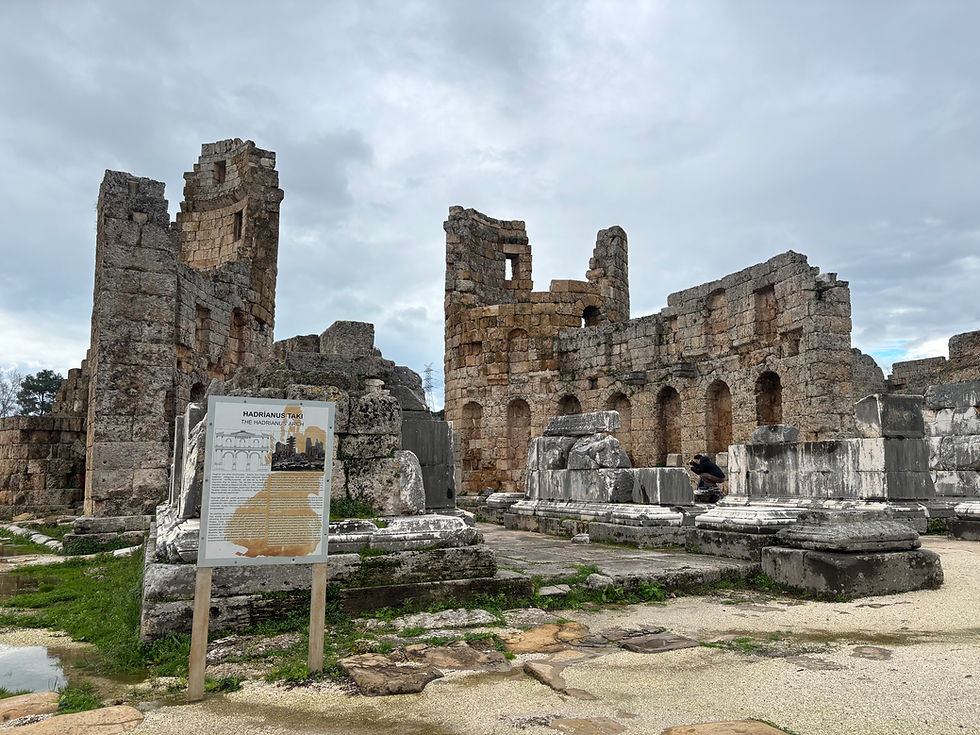
Soon, our bus pulled into a site decorated with ancient ruins which instantly caught our interest and intrigue.
This ancient city was called Perge in Türkiye.
Perge is in the Mediterranean region, which was called Pamphylia in ancient times. Pamphylia means "land of all tribes", because many different people lived here. Modern Antalya is still very diverse, with Turks, Kurds, Russians, Germans, and many others.

The city of Antalya was founded by Attalos II Philadelphus, the king of Pergamon. Legend says he sent his soldiers to find the most beautiful land, and they discovered this site. The city’s name changed over time: Attaleia → Adalia → Antalya.
Just after entering Perge, our guide pointed out the remains of the Roman aqueduct that carried water from the Aksu River into the city, explaining that this river supply was essential for drinking water, irrigating the surrounding plain, and feeding Perge’s baths and fountains.
Early Settlement - Greek and Roman Periods
The first settlement of Perge was in the 7th century BC, built on the acropolis (upper hill) for defense. Greek heroes Mopsus and Calchas are said to have founded the city. Evidence of the Greek period can be seen in the city walls, the layout of the acropolis, and early temples.
In the 1st century AD, the Romans took control. They built impressive structures, including the Late Roman Gate, built around 155 AD. The city had five main entrances, with watchtowers for protection.

The Roman presence is also evident in the marble decorations, mosaics, and advanced water systems. So in Perge, the Greek foundations and Roman developments together describe how this city evolved over centuries.
Roman Baths - Heating and Pools
The Roman baths at Perge were very advanced for their time. They used a hypocaust system that sent hot air under the floors and inside the walls to heat the rooms and pools, similar to modern underfloor heating used in many homes today. There was a large open-air swimming pool (natatio), while the hot room (caldarium) and warm room (tepidarium) were covered with wooden roofs. Unusually, Perge also had two cold-water pools (frigidaria), which made perfect sense because summers in this part of Turkey can be extremely hot. The baths were once covered in beautiful marble on the floors and walls, though sadly most of it was taken away during invasions in the 5th and 13th centuries.
Honestly, imagine having this kind of setup at home today, a hot room, warm room, cold plunge, and a swimming pool! Instead, we pay for spa days, thermal baths, and gym memberships just to experience what the Romans casually had as part of their daily routine. 😄

Social Life
The baths at Perge were not just for bathing, they were also lively social spaces where people relaxed, talked, and played games. Stone game boards carved into the floors can still be seen today, showing where visitors passed the time between visits to the hot (caldarium), warm (tepidarium), and cold (frigidarium) pools. These scenes of bathing, chatting, and gaming reminded me of moments from Gladiator, where Roman bath culture appears as part of everyday social life.

Gladiators and Currency
Gladiators were an important part of Perge’s entertainment. They fought in the amphitheater, sometimes in mock battles or shows for the public. The word "gladiator" comes from gladius, the short sword they used. Gladiators were paid partly in gold and partly in salt, which was highly valuable at the time. Salt was used for preserving food and was even considered a form of currency. The Roman currency used in Perge was called a denarius, so gladiators earned both money and salt for their services.

Drainage and Water System
Perge also had a very advanced drainage and water system. Fresh water came from a nearby lake and traveled through underground and above-ground pipes to supply baths, fountains, and homes. Some water was even brought from the Mediterranean Sea. This shows how skilled the Romans were in engineering.

Agora and Shops - Tabernae
The city’s market square is another highlight. The shops, called tabernae, were about 79 square meters each. Most had single entrances, but a few had double entrances. These shops were like the big brands of the ancient world, selling leather, meat, and other valuable goods. In the center of the square stood the Tisha Temple, dedicated to the god of money and fortune. People sacrificed animals here to seek prosperity. Next to the tabernae was the Makellum, a street bazaar where local farmers sold fruits and vegetables, while merchants sold other daily goods.

Store Signs and Symbols
We were asked to look closely at the symbols carved above the shops and guess what they signified:
Dolphins represented Demeter, the goddess of agriculture, symbolising abundance.
Lions and other animals symbolised the power of the Roman Empire.
Butchers often had daggers and hooks carved above their shops to show their trade.
The agora and the shops were decorated with beautiful columns in three main styles. The Doric columns were plain and strong in design. The Ionic columns were more detailed, with curled, scroll-like shapes at the top. The Corinthian columns were the most decorative, covered with carved acanthus leaves and designed to show wealth and importance.
Many areas had mosaic floors, adding color and beauty to the city.
Closing Thoughts
Perge was more than a city. It was like an ancient cosmopolitan center with baths, stadiums, markets, temples, and social spaces. After the tour, we had free time to explore the baths, the agora, and the tabernae. We took our time, clicked pictures, and enjoyed the atmosphere. After our visit, we were to meet back at the entrance where the mini buses were parked. The vicinity also includes a museum shop and toilets.
As we walked back toward the entrance, tired but inspired, all I could think of was how little people know about such places. Honestly, you can read all you want about history, but you only truly understand places like this when you visit and explore them yourself. Walking through the ruins, touching the stones, and standing where civilizations once thrived makes the past feel real in a way no book ever can.


Comments