


This is Ephesus, Türkiye.

Hey there! As you read through this post, feel free to click on the affiliate links highlighted in BLUE. If you decide to book a hotel or purchase something through them, I’ll earn a small commission, at no extra cost to you. These commissions help keep The Morning Brew running and allow me to create more awesome content. Thanks for your support!

Before coming here, whenever I thought about ancient Greco-Roman history, my mind always went straight to Rome, Athens and Delphi. Those were the places I had visited. I didn’t know that millions of people visit Ephesus every year, especially during the summer months when cruise ships arrive through Kusadasi (a port city 20 mins away from Ephesus). A large proportion of visitors come from the United States, and before the COVID-19 pandemic, Chinese tourists also formed a substantial percentage of arrivals. Exact figures vary depending on the year and season, but the global pull of this place is undeniable.
I genuinely had no idea. Step into ancient Ephesus, Türkiye with me.
Firstly, I was in Türkiye for the very first time. While researching things to do in Izmir, I came across the magnificent Greco Roman ruins of Ephesus, a designated UNESCO World Heritage Site. That immediately caught my attention.
I was intrigued enough to arrange a private guide almost instantly. I knew it would be a long, history rich tour and, with kids in tow, I wanted the flexibility to move at our own pace rather than be bound to a large group schedule. Interestingly, the total cost of hiring a private guide including entrance tickets and lunch worked out to be approximately the same as joining a group tour. I have shared the details of our guide Ezgi’s company. Check the reviews and book below.
For a truly personal and memorable visit to Ephesus, I highly recommend Ephesus Travel Guide – Private Ephesus Tours, a family-run business led by Ezgi, a guide with over 12 years of experience. She was attentive to my kids, flexible, and incredibly friendly, going far beyond a standard tour. Ezgi answered all our questions, providing fascinating insights into the history of Turkey, current events, geography, and even recent reforms. The private full-day tour for our family of four cost 110 euros (excluding lunch and entrance tickets), offering excellent value for the personalized experience. Their warmth, knowledge, and attention to detail made our visit unforgettable, bringing both the ancient ruins and the region’s story vividly to life. |

There were two meeting points for the tour. One option was Selçuk, pronounced "Sel-chook", a quiet town about an hour by road from Izmir. The other option was Kuşadası, pronounced "Koo-sha-dah-suh" also roughly an hour away, and the main pickup point for cruise passengers visiting the region. We chose to drive to Selçuk since the ancient site of Ephesus is located there, making it the most convenient and logical starting point for our visit.
Selçuk - A Quiet Town
Selçuk is a small town in İzmir Province with a population of around 36,000 people. It is considered a pleasant and peaceful place to live. After the COVID-19 pandemic, many people moved from large metropolitan cities such as Bursa, Ankara, and Istanbul to smaller towns like Selçuk.

This internal migration happened because big cities often come with heavy traffic, air pollution, crowded living conditions, and a higher cost of living. In contrast, Selçuk offers a quieter lifestyle, more green areas, more affordable living costs, and easy access to nearby beaches, some only about 10 minutes away, making it an attractive alternative for many families.
It felt calm and grounded, but apparently costs had shot up so it was difficult for locals to manage rents around the area now.
Our First Stop: Basilica of St. John
What if a 6th-century emperor built a church that still tells stories 1,500 years later? That’s exactly what we found at the Basilica of St. John.
We paid €6 per adult at the entrance. Arya was free because she is below 8 years of age. The Basilica of St. John in Selçuk is generally open 08:00–19:00 in summer and 08:00–17:30 in winter.

The basilica was built in the 6th century AD by Byzantine Emperor Justinian I over what is traditionally believed to be the tomb of John the Apostle. It is certainly one of the most important Byzantine churches in Asia Minor, the ancient term for Anatolia, the Asian part of modern day Turkey, and it was among the largest churches constructed in the region during the Byzantine era.

Later, on July 26, 1967, Pope Paul VI celebrated Mass here during the first official papal visit to the site. That visit formally acknowledged the spiritual importance of the region, especially in connection with the tradition that the Virgin Mary spent her final years near Ephesus. Since then, the area, particularly the House of the Virgin Mary, has become a significant pilgrimage destination visited by millions.
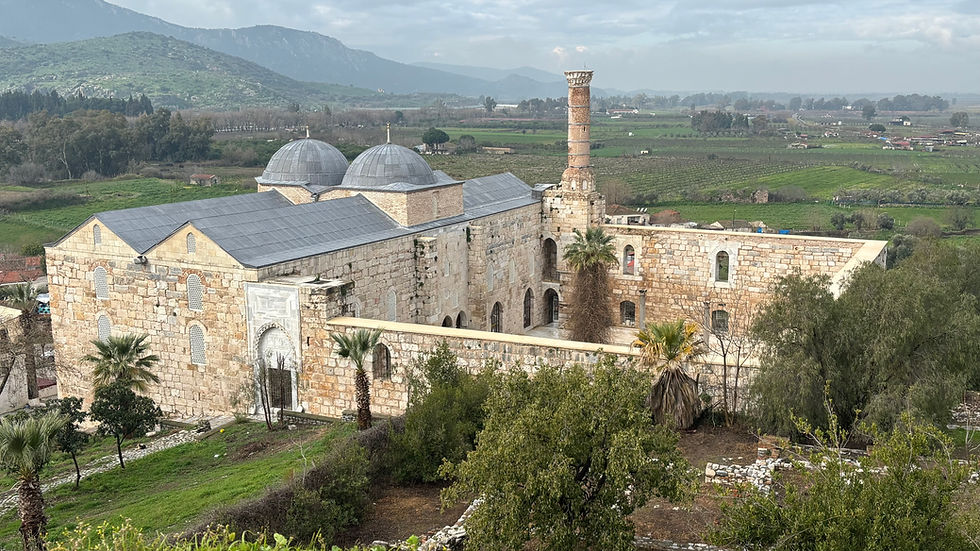
From the hilltop, we could see the valley stretching out below. In the distance stood the single reconstructed column marking what remains of the Temple of Artemis. Not far from it, the İsa Bey Mosque stood tall and magnificent. Interestingly, this mosque, built in 1375, was constructed using many of the stones and marble taken from the ruins of the Temple of Artemis. And then we drove toward the main archaeological site.
Before we explore the main archaeological site of Ephesus, it’s fun to look at some of the myths and stories that make the city so fascinating. Legend says the area was once home to the Amazons, a tribe of warrior women who worshiped a powerful mother goddess later linked to Artemis. While there’s no proof they actually founded the city around 3000 BC, the story became an important part of Ephesus’ identity. Historically, Greek settlers arrived around the 10th century BC, led by Androklos, the son of King Codrus of Athens. Androclus consulted the Oracle of Delphi about where to found a city. The oracle told him he would be guided by a fish and a boar. Later, while cooking fish, one flipped from the pan and started a fire in nearby bushes. A wild boar ran out of the flames. They took it as a signal from the gods. Androclus killed the boar and after defeating the local inhabitants, they founded the city that would become the Ephesus we visit today. |
Entering the Ancient City of Ephesus, Türkiye
One thing I was convinced about by now was that Ephesus wasn’t just a ruin, it was an entire civilization layered in stone. As we reached the parking area of the archaeological site, it was clear we’d be here at least 2–3 hours. Tickets were €40 per adult, and kids under 7 entered free. The Ephesus archaeological site is open 08:00–19:00 in summer and 08:30–17:00 in winter, with ticket offices closing about an hour before site closing.
The Ephesus we see today wasn’t originally built here. The earlier settlement lay closer to the coast, but in the 3rd century BC, after the death of Alexander the Great, his general Lysimachus relocated the city to a more defensible position between two hills. That move during the Hellenistic period (the time after Alexander the Great, when Greek culture spread across the region) basically created the Ephesus we walk through today, with its grand ruins and massive theater still standing.
What you see today represents only about 20% of the ruins excavated by archaeologists over many decades. There is still a vast portion of the city waiting to be uncovered.
One of the main reasons Ephesus is so hard to fully excavate is that it was built in layers over thousands of years. People have lived here since around 6000 BC, long before the Greeks arrived. Over time, prehistoric communities, early Anatolian settlers, Greek colonists, the Hellenistic city, the Roman metropolis, and later the Byzantine town all added their own roads, temples, walls, and homes. Earthquakes damaged buildings, silt from the nearby river buried parts, and later construction, including parts of the modern town, now sits on top of the ancient remains. Digging deeper means carefully going through each layer without harming what’s underneath.

Why Ephesus is so hard to excavate?
This region has always been prone to earthquakes because of its location in western Anatolia. Ancient quakes repeatedly damaged major buildings, which over time contributed to the decline of Ephesus. Today, Turkey still experiences earthquakes, including the devastating ones in southern Turkey in 2023, though Ephesus wasn’t directly affected. The area’s long history of seismic activity is also why so many statues and fragile artifacts have been moved to museums for safekeeping.
At its peak, Ephesus was protected by strong city walls. We stood near where the Magnesian Gate once stood in the upper part of the city. The gate is gone now, lost to earthquakes and time, but it was once a main entrance. From there, the city extended all the way down to the harbor. Back then, it was a busy port connected to the sea, but over the centuries, silt from the river filled in the harbor, turning what was once waterfront into land.
Roman Engineering at its peak!
At its peak during the Roman period, Ephesus was a bustling city with an estimated 250,000–300,000 people, including enslaved residents. The Romans, famous for their engineering, brought fresh water to the city through large aqueducts from distant springs and stored it in massive cisterns, including one in the city center to protect it from contamination. From there, a network of terracotta pipes carried water to homes, public baths, and fountains. We couldnt believe our eyes! The pipes still remain after all these years!

Basilica Structures and Civic Administration
Near the site, we saw the remains of a basilica-style building, with several columns still standing. In ancient Roman cities, a basilica wasn’t always a religious building, it served as a public space for administration and commerce. Courts were held here, business disputes were settled, and trade conflicts among merchants were resolved. Basilicas were at the heart of civic life. Later, their design inspired Christian churches, including the Basilica of St. John that we visited.

Roman Baths and Social Life
The Roman baths near the agora were more than just places to bathe, they were social and cultural hubs where people (mostly men) met, relaxed, and discussed business. The bath complex included the frigidarium (cold room), tepidarium (warm room), and caldarium (hot room), showcasing advanced heating and water circulation systems.

What if I told you this small hall was where Roman politicians debated laws and citizens enjoyed music performances?
Welcome to the Odeon!
In the 2nd century AD, this building served as an Odeon, or bouleuterion, a semi-public indoor hall where Romans held music performances, cultural events, and official meetings. Local politicians gathered here to conduct private discussions, make decisions on laws, and hold small-scale voting sessions. The structure was originally covered by a roof, supported by a backstage structural wall. Strong earthquakes over centuries caused the complete collapse of the roof. Today some upper seating areas have been restored.
The lower marble seats remain original (the ones on which we are sitting). The estimated seating capacity is 1,400 people. Today, many cultural performances are hosted here. The Odeon is situated in the upper district, signified as the political and adminsitrative district of Ephesus.

The upper section of Ephesus was paved with marble, and the shops here were luxurious. They sold statues, jewelry, ceramics, carpets, and leather goods, high-end items for those who could afford prestige. Commerce wasn’t just survival; it was a statement of status.

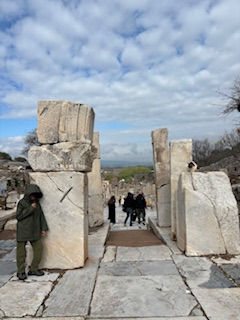
From here, we walked along a long marble-tiled street into the main city of Ephesus. There, we saw the an entrance gate, which used to be a monumental gate back in the day, that divided the upper administrative and political areas from the lower residential and commercial districts.
Statue of Heracles
As we walked down this area of Ephesus, we turned back to see the statue of Heracles. It is a statue holding the Nemean lion’s head and wearing its skin, a symbol of strength and heroic victory. Its placement marked the boundary between the upper administrative and political areas and the lower residential and commercial districts, reflecting the careful urban planning common in Greek and Roman cities.

Further along, we saw bases and inscriptions of statues honoring politicians, artists, philosophers, and doctors. Today, only one statue remains, that of Doctor Alexandros, known for developing treatments for malaria. Ancient Greek inscriptions on the bases let you literally read the history and meet the people who once shaped the city.

The Fountain of Trajan
We visited the Fountain of Trajan, built in the early 2nd century AD in honor of the emperor. Water flowed into a pool below, supplied by the Roman aqueduct system. The Roman aqueduct-style fountains we saw were part of a larger water system supplying the city. It showed how the Romans combined function with display. Controlling water meant controlling life in the city.

Public Latrines
Ephesus had some of the largest public latrines of the ancient world, and they were unlike anything we see today. The stone seats were placed side by side with no partitions or walls, so people literally sat next to each other while using them, a truly communal experience! Instead of toilet paper, they used a xylospongium, a sponge on a stick, which was rinsed in a channel of running water. That water constantly flowed from the city’s aqueduct system, washing away waste and keeping the latrines surprisingly hygienic for their time. It’s fascinating glimpse how practical, yet communal, Roman hygiene really was!

Ever wondered how the richest Romans lived thousands of years ago?
The Terrace Houses, sometimes called the "houses of the rich", were multi-level residences with mosaic floors, fresco-painted walls, indoor plumbing, and private baths. They give a glimpse of how comfortable and architecturally advanced life was for wealthy Romans in Ephesus.
The Terrace Houses in Ephesus are currently being covered by a big modern roof built by the Austrian Archaeological Institute together with the Turkish Ministry of Culture and Tourism. This roof protects the ancient houses from rain, sun, and damage so they stay safe until (and while) tourists can visit them.

Monuments of Emperor Hadrian and Emperor Domitian
Some buildings in Ephesus are connected to Emperor Hadrian (117–138 AD), who strengthened the Roman Empire. Hadrian’s Gate in Antalya was also constructed during his reign. The photo below shows the Temple of Hadrian in Ephesus, built in honor of the emperor.

One must definitely notice the beautiful Corinthian columns and bilingual inscriptions on a huge plaque closeby.

Medicine and Medical Discoveries
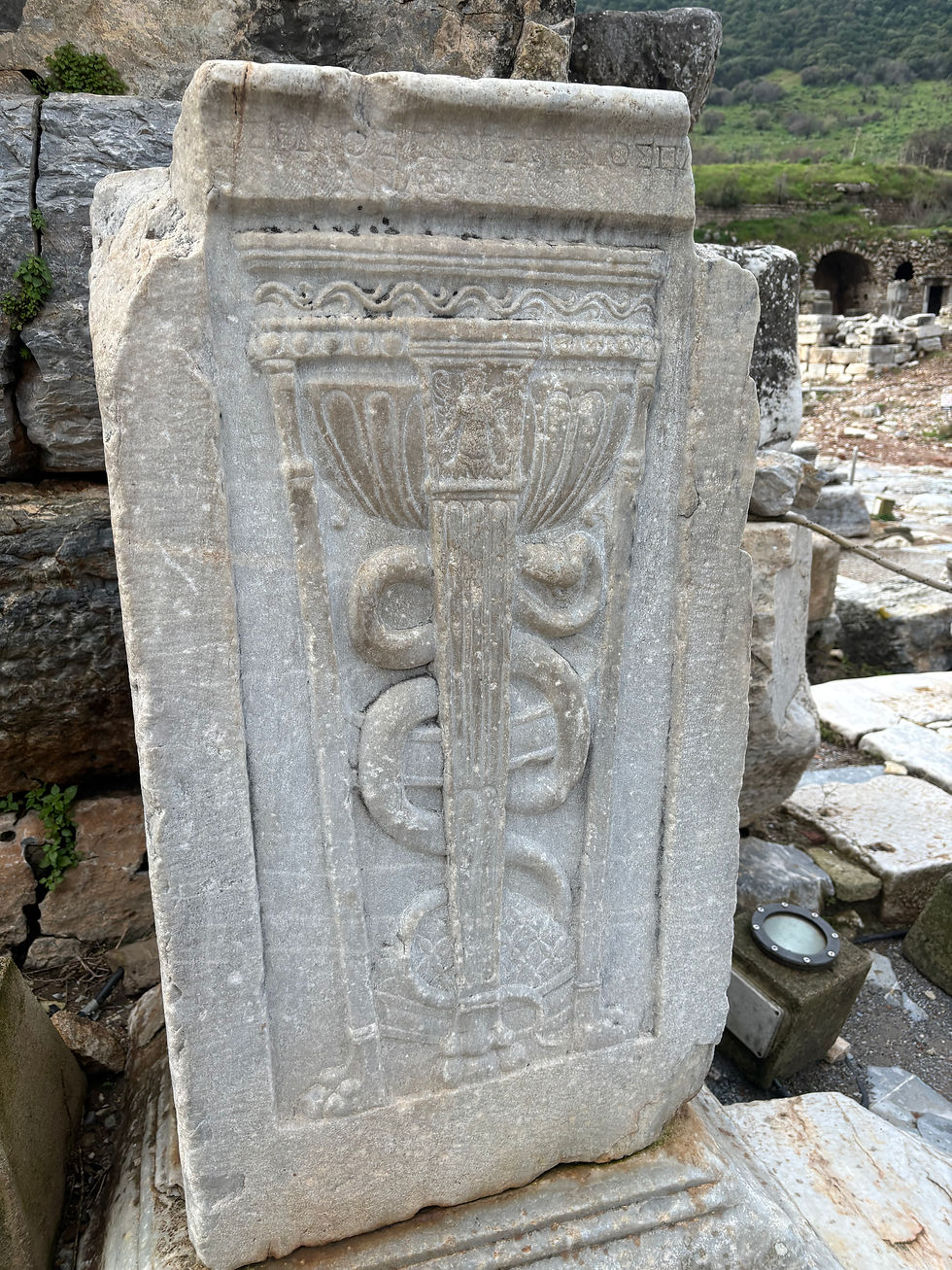
Some buildings in Ephesus still show original Greek stonework. Our guide Ezgi pointed out a carved snake symbol on one of the stones, a sign of healing and medicine that still represents pharmacies today. Ephesus also had a strong connection to medicine. Ancient doctors treated diseases like malaria and women’s health issues. Historical records mention famous physicians such as Galen, who was one of the most influential medical scientists of antiquity, although he did not specifically work in an Ephesus hospital.Archaeologists have found medical tools, surgical instruments, and small glass bottles that were likely used to store medicines. Many of these are now in the Ephesus Archaeological Museum, showing how advanced medicine was back in the Hellenistic and Roman times.
Library of Celsus
This isn’t just a pretty façade. It’s a tomb, a library, and a marvel of Roman engineering. Ready to see why it’s so famous?
This is the most important structure inside the Ephesus archeological site. This grand structure, The Library of Celsus was built between 110 and 135 AD by the son of Roman senator Tiberius Julius Celsus Polemaeanus, both as a library and as a monumental tomb for his father. Its facade, carefully reconstructed from original fragments, is one of the most beautiful surviving examples of Roman library architecture. It looks yellowish like limestone, however the entire structure is pure marble.

The Great Library Rivalries The most famous library of the ancient world was the Library of Alexandria in Alexandria. Ancient writers exaggerated its size. Modern historians estimate it may have held anywhere from about 40,000 to several hundred thousand scrolls, but there is no confirmed exact number. Another major cultural rival was the library in Pergamon. It is sometimes traditionally said to have held around 50,000 scrolls, though this figure is not historically verified. According to ancient sources, when Alexandria restricted the export of papyrus, Pergamon developed parchment, writing material made from animal skin. While sometimes casually described as “leather scrolls,” the correct historical term is parchment. It was more durable than papyrus. The library of Ephesus, associated with the Library of Celsus, was smaller in comparison. It may have held thousands of scrolls, sometimes estimated around 12,000, but like other ancient libraries, exact numbers are not documented historical facts. |

Ephesus AI Experience
From there, we were taken to the Ephesus AI Experience, held inside a modern, theatre-style space. It was an immersive show that brought ancient Ephesus back to life using lights, sound, and digital visuals. The kids absolutely loved this experience. You will be transported into the ancient world of Ephesus in its ancient glory days, seeing the buildings, streets, and inhabitants as they once were. It’s engaging, easy to follow, and really helps you imagine how grand Ephesus used to be. Definitely not something to miss.
The private tour includes this experience, however the group tours normally skip this experience. The ticket cost of this experience is included in the price of your ticket.

The Agora, the main Marketplace.
As I mentioned at the beginning, Ephesus used to have a busy sea port, but over time earthquakes and silt from nearby rivers caused the sea to recede and new land to form. This port was the main trading hub for Ephesus. The agora was the city’s central marketplace, where merchants from across the Mediterranean came to trade. Like many ancient cities, enslaved people worked here too, which was common in Greek and Roman times, not just in Ephesus. At the agora in Ephesus, merchants sold everything from food, spices, and wine to pottery, textiles, jewelry, and luxury goods from across the Mediterranean. It was not just a marketplace but also a social and business hub, where people met, traded, and even settled disputes.

The Grand Theatre
One of Ephesus’ most impressive features is the Grand Theater, one of the largest in Asia Minor. Originally built by the Greeks during the Hellenistic period and later expanded by the Romans, it could seat around 25,000 people. It was even larger than the Aspendos Theatre, which held about 12,000 spectators.

Nearby, archaeologists have also identified the location of the ancient stadium, believed to have had a capacity of over 30,000 people, making it one of the largest stadiums in Anatolia, although parts of it remain unexcavated.
Inspiration for the Nike Logo?
Our guide Ezgi mentioned that the Nike “swoosh” logo was inspired by this statue of Victoria, the goddess of victory. While it’s a popular idea, the truth is that the swoosh, designed in 1971 by Carolyn Davidson, wasn’t actually based on any ancient symbol. It was simply created to represent movement and speed. Quite a story there, I must say!

Our Last Stop: Temple of Artemis
Our last visit after lunch was to the Temple of Artemis which was free entry because honestly only one Column stood standing. The Greeks continued the worship of Artemis and constructed the magnificent Temple of Artemis, which became one of the Seven Wonders of the Ancient World.

Built entirely of marble and surrounded by over one hundred towering columns, the temple was larger than a football field. It symbolized wealth, devotion, and civic pride. Over centuries, it was destroyed and rebuilt several times due to fires, invasions, and earthquakes. When Christianity spread through the region in the 2nd century AD, worship of Artemis declined, and the temple eventually fell into ruin.
In ancient times, the temple was right by the coast, but over the centuries, silt from the Kaystros River slowly filled in the harbor. Earthquakes sped up the process, and today the Aegean Sea is about six kilometers from where ships once docked.
Final Reflection
Standing there, surrounded by all this history and beauty, I realized Ephesus is not just another ruin. It’s layered, Greek, Roman, Byzantine, Christian, mythical, and practical. I’ll never forget standing at the Library of Celsus, staring at its colossal structure, much like I did when I visited Petra! Ephesus was eye-opening and a must-visit if you enjoy Greco-Roman history.
Next up, we explore the hidden gems of Cappadocia and Pammukkale 🙂 I can’t wait to share the fairy chimneys, hot-air balloon magic of Cappadocia and stunning white travertine terraces and thermal pools of Pammukkale with you!
If you enjoyed reading my blog post, I’d love it if you gave it a thumbs-up 👍🏼 and hit subscribe for more updates. Feel free to share it with your friends and family too! If you have any questions or want to chat about travel or anything else you'd like to know more about, I’m just a message away.


Amys tips are so amazing, with so many details. I'm really looking forward to visit Turkey.