


Experiences to not miss in Yogyakarta, Indonesia

Hey there! As you read through this post, feel free to click on the affiliate links highlighted in BLUE. If you decide to book a hotel or purchase something through them, I’ll earn a small commission, at no extra cost to you. These commissions help keep The Morning Brew running and allow me to create more awesome content. Thanks for your support!
We found ourselves back in Indonesia just two years later. That's something we've never done before (apart from returning to India, of course). But that's the effect Bali had on us during our last trip. We left promising ourselves that we'd be back soon, and this time for longer.

Only this time, we weren't limiting ourselves to Bali. We decided to explore another side of Indonesia by spending three days in Yogyakarta, a cultural city in Central Java that's often considered the heart of Javanese heritage. Many travellers find Yogyakarta far more authentic than Bali. It's where you'll experience Indonesia's royal heritage, watch traditional performances, explore UNESCO-listed temples, wander bustling batik markets, and enjoy incredibly affordable food and accommodation. It may not have Bali's beaches, but it offers something equally memorable: a genuine glimpse into Javanese culture.
Before heading to Bali, we spent three wonderful days discovering everything Yogyakarta had to offer. Yogyakarta (also known as Jogya or Jogjakarta) is a unique part of Indonesia because it has the status of a Special Region. It is the only place in Indonesia where a royal family still plays an official role in government. The Sultan of Yogyakarta is not only the traditional ruler but also automatically serves as the Governor of the Special Region of Yogyakarta. In this travel blog post, I'll share exactly what we did, the best places to visit, where we stayed, what we ate, and plenty of practical tips to help you plan your own trip.
Prelude
It was one of those journeys that felt never-ending. We flew from Mumbai to one of our favourite countries, Indonesia, with Singapore Airlines, stopping over in Singapore before boarding a Scoot flight to Yogyakarta. It was our first time visiting this part of Indonesia, and I was incredibly excited. Since both flights were overnight, sleep was almost impossible, so by the time we landed, we were completely exhausted.
Day 1 – Discovering the Soul of Yogyakarta
As soon as we arrived at Yogyakarta International Airport located about 45–50 km from the city centre (around 1–1.5 hours by car, depending on traffic), we booked a taxi through Gojek, one of the easiest and most affordable ways to get around Indonesia. Our hotel was about an hour and a half away, which turned out to be the perfect opportunity to catch up on some much-needed sleep before our adventure officially began. Stay with me as I detail out the Experiences to not miss in Yogyakarta, Indonesia.
Experiences to not miss in Yogyakarta, Indonesia
Melia Purosani Yogyakarta - A Family-Friendly Resort in the Heart of the City
We checked into Melia Purosani Yogyakarta, a beautiful resort located just 450 metres from the lively Malioboro Street. Its central location, spacious rooms and excellent facilities make it one of the most popular hotels among international travellers visiting Yogyakarta.

The rooms are generously sized at around 50 square metres, giving families plenty of space to spread out after a long day of sightseeing. The hotel also has two swimming pools, one for adults and another for children, making it a great choice if you're travelling with kids. There are two restaurants on-site, one serving Chinese cuisine and the other offering a mix of Indonesian and international dishes. If you're looking to unwind, there's also a spa with massages and other treatments, along with a beauty salon.
We checked into our room, drew the curtains and completely crashed. After travelling through the night, we slept right through until the evening. When we finally woke up, we were absolutely starving, so room service was the obvious choice. Once we'd eaten and freshened up, it was time to head out and explore Yogyakarta's most famous neighbourhood, Malioboro.
Malioboro Street
Malioboro is the beating heart of Yogyakarta and easily one of the city's liveliest streets. It has been the city's centre of trade and culture since the 18th century. It was originally built as an important road connecting the Sultan's Palace (Kraton) with Mount Merapi. The wide pedestrian walkway is lined with countless shops selling colourful batik fabrics, handmade souvenirs, clothing and local handicrafts. It's the kind of place where you can easily spend hours browsing, bargaining and soaking up the atmosphere.

Restaurants spill out onto the sidewalks, inviting visitors to sample traditional Indonesian dishes, while horse-drawn carriages and electric rickshaws wait patiently to take tourists around the city. As we wandered along the street, we also came across several local musicians performing on traditional Indonesian instruments, adding even more charm to the already vibrant atmosphere.
Insider Tip: If you're spending a Friday or Saturday evening in Yogyakarta, don't miss the Raminten Cabaret Show. The ground floor houses a boutique selling beautiful batik clothing, and if you're lucky, you may even see local artisans hand-painting batik patterns. Upstairs is a cosy cabaret theatre where lively performances combine music, dance and comedy, creating a fun and uniquely Indonesian cultural experience. |
Raminten Kitchen
After shopping along Malioboro, we even found some beautiful clothes for just €2 each, we decided to end the evening with dinner at the famous Raminten Kitchen.
Rather than taking one of the electric carts waiting outside, we booked another Gojek, which cost us only Rp. 24,000 (€1.25). The cart drivers were asking around Rp. 60,000 for the same journey, so using Gojek was an easy decision.
The moment we arrived, I understood why this restaurant is so popular. The atmosphere was warm, lively and unmistakably Javanese. The restaurant is spread across two levels with a beautiful open-air setting, while musicians performed traditional Indonesian songs on a stage downstairs. The staff, dressed in elegant traditional Indonesian attire, made the entire experience feel even more authentic.

The food was every bit as impressive as the ambience. Every dish we ordered was packed with flavour, and it ended up being one of our favourite meals in Yogyakarta. I highly recommend ordering:
Bakmie Godog Pakualaman – Javanese boiled egg noodles served in a rich, savoury broth.
Sop Nyiroro Kidul – Traditional Indonesian beef soup served without rice.
Ayam Tertusuk – Perfectly grilled chicken skewers.
Bakwan Jagung – Crispy sweetcorn fritters that are dangerously addictive.
Ginger Lemonade – Refreshing lemonade with a lovely kick of ginger.
Bir Jawa – A traditional non-alcoholic Javanese drink made with warming spices and ginger.
If you're looking for a restaurant that combines authentic Javanese flavours, cultural performances and a fantastic atmosphere, Raminten Kitchen deserves a spot on your Yogyakarta itinerary.
Insider Tip: Head to Taman Sari, the former royal water palace. Wander through its centuries-old pools, hidden tunnels and underground mosque. Beyond the palace walls, the surrounding kampung offers a glimpse into everyday life, with batik artisans carefully creating their intricate works and cosy cafés tucked into quiet streets. |

Day 2 – Exploring the UNESCO Heritage Temples of Borobudur & Prambanan
After a delicious breakfast at Melia, we set off for one of the most anticipated days of our Yogyakarta trip, visiting the magnificent UNESCO World Heritage temples of Borobudur and Prambanan.
For the day, we hired Asmaradhana Borobudur Tours for a private family tour, which included hotel transfers, a comfortable private vehicle, an English-speaking driver/guide, entrance tickets, and visits to Borobudur Temple (with climb-to-the-top access), Mendut Temple, and Prambanan Temple. For foreign visitors, the current entrance fee to climb Borobudur is IDR 455,000 (approximately €24) per adult and IDR 305,000 (approximately €16) per child (3–10 years). The climb-up ticket includes a certified guide and a pair of traditional woven Upanat slippers.
Borobudur Temple
Borobudur is the largest Buddhist temple in the world and one of Indonesia’s most famous UNESCO World Heritage Sites. Located in Magelang, Central Java, about 40 km northwest of Yogyakarta, this incredible temple was built in the 8th and 9th centuries by the Sailendra Dynasty. The entire monument was built using approximately two million blocks of volcanic andesite stone, covering a base of about 15,000 square metres. Considering it was constructed over 1,200 years ago without modern engineering, the scale and precision are simply astounding.
Before entering Borobudur, every visitor is given a pair of handcrafted slippers made from natural fibres. These are worn instead of regular footwear to help preserve the centuries-old volcanic stone, keep the monument clean, and show respect for this sacred Buddhist site. The slippers are included in the ticket price and make for a lovely souvenir to take home after your visit.
The monument consists of nine stacked platforms, six square terraces topped by three circular ones, symbolising the Buddhist path from the earthly world to enlightenment. We walked through the galleries in the scorching heat of July but we were mesmerized by the 2,600+ beautifully carved relief panels depicting stories from the life of Buddha, Buddhist teachings, and everyday life in ancient Java. I found the carvings in the middle galleries especially fascinating because of the incredible level of detail and artistry. As you continue walking upwards, you will notice a gallery with many perforated stupas. There are 72 in total and each stupa houses a seated Buddha statue. These surround the large central stupa at the summit, representing the ultimate goal of Nirvana. Isn't that just WOW?!
One striking feature throughout the temple is the number of Buddha statues without heads. Originally, Borobudur housed 504 Buddha statues, but today only around 227 remain intact, while many others have lost their heads over the centuries due to theft, vandalism, and natural disasters, including earthquakes and volcanic eruptions from nearby Mount Merapi.
Our guided tour of Borobudur lasted around two hours, and every minute was worth it and the experience was truly unforgettable.

Mendut Temple
Our next stop was Mendut Temple, a much smaller temple located just a few kilometres from Borobudur. We spent about 30 minutes here, but it was well worth the visit. One interesting fact about Mendut is that it faces east, while the nearby Borobudur and Pawon temples are aligned towards the west. Inside the temple is a beautiful 3-metre-tall Buddha statue, with two Bodhisattvas on either side. At Mendut Temple, I learnt about three important symbols in Buddhism. Our guide explained that the Lotus represents purity, the Bodhi Tree is where Buddha attained enlightenment and symbolises wisdom, while the Sala Tree reminds us that life is temporary and that everything has a beginning and an end.
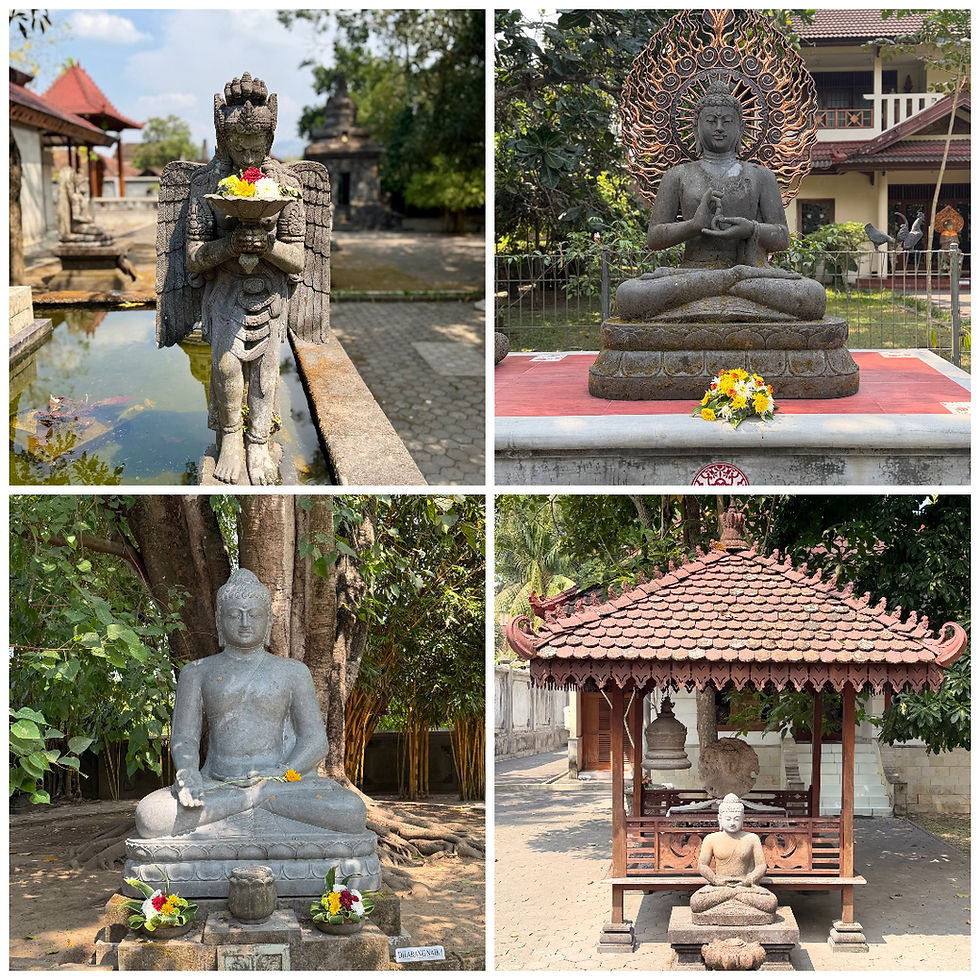
Next up was lunch at Selasar Borobudur, a terrace restaurant located just a few minutes from the famous Borobudur Temple in Central Java. The restaurant overlooks lush greenery and paddy fields, making it a lovely place to relax after spending the morning exploring the temple. It has become a popular stop for tour groups over the years because of its convenient location, quick service and clean facilities.
The restaurant serves all the famous Indonesian local dishes, along with a limited but good selection of international cuisine. We ordered Nasi Goreng Magelangan, Nasi Goreng Udang (shrimp fried rice), Mie Goreng (Indonesian fried noodles), Koloke chicken (which was very sweet), and fresh tender coconuts to drink.
The food arrived quickly, the portions were generous and the prices were very reasonable. The place was packed with tourists. It was probably a favourite stop for tour guides, not just because the food was good and served quickly, but also because of the clean washrooms and its ability to cater to large groups efficiently.
Prambanan temple
After a delicious lunch, we set off for Prambanan Temple, located about 40 km from Borobudur on the outskirts of Yogyakarta. The drive takes around 1 to 1.5 hours, depending on traffic. The magnificent Prambanan temple is a UNESCO World Heritage Site and is the largest Hindu temple complex in Indonesia and is dedicated to the Hindu trinity of Brahma, Vishnu and Shiva. The moment we arrived at the entrance, I was reminded of Angkor Wat. The grandeur of the temple could be felt from a distance. It was easy to see why Prambanan is believed to have inspired the construction of Angkor Wat. This magnificent Hindu temple complex was built nearly 350 years before Angkor Wat, and its timeless beauty speaks for itself. Here too we had a guide booked within our package. Hariharan was our guide, a Hindu born into a Christian household and was the senior most and most experienced guide in Prambanan temple.
The most fascinating part for me was learning how the entire temple was built. It is constructed from volcanic lava stone, with each block interlocking perfectly like giant Lego pieces, without the use of mortar. The precision and engineering behind it are simply mind-blowing, especially considering it was built more than a thousand years ago.
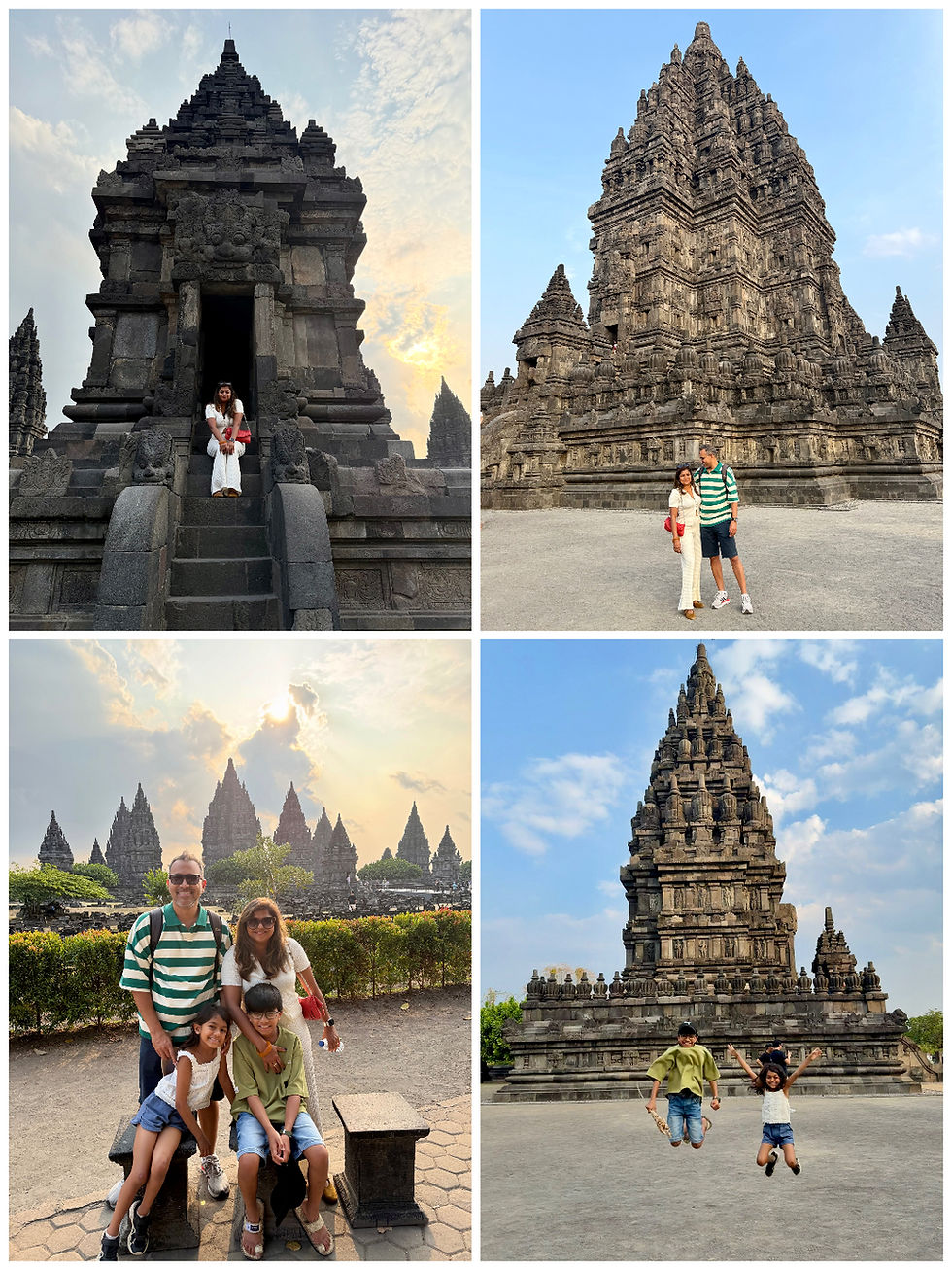
Scattered throughout the complex are sacred shrines and symbolic structures representing the linga and yoni, symbols of Lord Shiva and the divine feminine energy, signifying creation and the harmony between masculine and feminine forces.
Inside the temples, we were greeted by magnificent stone sculptures of Lord Ganesha, the great sage Agastya, Lord Shiva and Goddess Durga standing triumphantly over the buffalo demon Mahishasura, symbolising the victory of good over evil. The Vishnu Temple houses Lord Vishnu, while the Brahma Temple is dedicated to Lord Brahma, completing the divine Trinity.
After a soulful experience, we headed to our resort. We ended the day with dinner at the resort itself after a refreshing swim, where traditional Javanese cuisine was served with music. It was the perfect introduction to the warmth and culture of Yogyakarta.


Day 3 – Into the Depths: Jomblang Cave & Pindul Tubing Adventure
Our final day in Yogyakarta was all about adventure.
We started early at 6:45 am for our cave adventure. Trust me, even leaving a little late means getting stuck in long queues at Jomblang Cave. Since it’s about a 2-hour drive from Malioboro, Yogyakarta, an early start makes the journey much smoother.
For today’s adventure, make sure to carry a change of clothes, an extra pair of socks and a towel. At Jomblang Cave, they provide rubber boots, so you don’t have to worry about your shoes getting muddy. I’d recommend leaving your good shoes behind and wearing rubber slippers instead.
Jomblang Cave
Jomblang Cave is unlike any cave I’ve visited before. After a safety briefing and getting fitted with a harness, you’re lowered nearly 60 metres into a massive sinkhole using a rope system. Once at the bottom, you walk through what feels like an ancient underground forest before trekking for around 20–30 minutes through muddy cave passages to reach the famous ‘Light of Heaven’, where dramatic beams of sunlight pour through an opening in the cave ceiling. The entire experience, including the descent, trek, waiting time and climb back up, takes about 2.5–3 hours. A simple chicken rice lunch is served afterwards before heading to the next adventure.

My take: While Jomblang Cave was an incredible experience, I personally don’t think it’s suitable for elderly travellers like my mum or dad. The cave itself involves walking through thick mud, uneven rocky terrain and slippery sections, which can be quite physically demanding despite the relatively short trek. The descent and ascent are managed safely using a rope system, but it’s the muddy hike inside the cave that can be challenging if you have limited mobility or balance. |
Pindul Cave
About 30 minutes away is Pindul Cave, which offers a completely different experience. Here, the adventure begins with the guide handing out life jackets and giving a safety briefing. You’re then asked to carry your inflatable tube to the starting point before gently floating through the beautiful limestone cave along an underground river. As you drift through the cave, your guide points out the fascinating stalactites and stalagmites, while some sections become completely pitch dark and are navigated only with the help of a torch. Near one of the cave openings, there’s also a spot where you’re allowed to climb onto a rock ledge and jump into the emerald-blue water if you’re feeling adventurous. The cave tubing itself lasts around 45–60 minutes and is suitable even for non-swimmers since everyone wears a life jacket.

But that’s only half the fun! After exiting the cave, you hop onto an open van with your tubes and head about 10 minutes to the Oyo River. From there, you walk along a pebbly, slightly slippery path until you reach the river. Once you throw your tubes into the water, you simply lie back and let the gentle current carry you through stunning limestone cliffs and lush greenery for about an hour. Along the way, you’ll pass small waterfalls that completely drench you, making the ride even more refreshing.

One of the highlights was stopping at a spot where we climbed onto platforms around 5–7 metres high and jumped straight into the river. That was easily the most thrilling part of the entire tubing experience!
Now you know why I insisted on carrying a change of clothes and a towel, you’ll be completely soaked by the end of it!
Price: If booked as a day tour from Yogyakarta, expect to pay around IDR 950,000–1,200,000 (€50–65 / ₹5,300–6,700) per person for a shared group or larger private group, while smaller private tours cost more. If you’re arranging your own transport, the combined entrance fees for Jomblang and Pindul Caves are typically around IDR 700,000 (€38 / ₹3,900) per person, excluding transport.
My Take: I’d happily recommend Pindul Cave tubing to them. It’s a much gentler experience where you simply float along the underground river in an inflatable tube while taking in the beautiful limestone formations. The Oyo River tubing afterwards is equally relaxing, making it a refreshing adventure that’s suitable for most people, including older travellers, as long as they’re comfortable getting in and out of the tube with a little assistance if needed. |

Shopping
We left all our shopping for the last day so we could enjoy the trip without carrying extra bags around.
If shopping is on your agenda, I’d highly recommend doing most of it in Yogyakarta rather than Bali. In general, prices here are often around one-third of what you’ll find in Bali, with a much wider variety to choose from.
The best place to start is Jalan Malioboro, Yogyakarta’s iconic shopping street. Stretching through the heart of the city, it’s lined with hundreds of shops, street vendors, and local boutiques selling everything from souvenirs and handicrafts to clothing, leather goods, spices, and local snacks. At the southern end of the street is Beringharjo Market, the city’s oldest and largest traditional market, where bargaining is expected and you’ll often find some of the best deals.
If you’re after batik, Beringharjo Market is the place to browse. It has one of the largest selections in the city, ranging from inexpensive everyday batik to premium handmade pieces. Just remember to bargain politely, it’s part of the shopping culture, and you’ll often get a better price, especially if you’re buying multiple items.
One store you simply can’t miss is Hamzah Batik (formerly Hamzah Raminten). This iconic multi-storey building on Jalan Malioboro is a one-stop shop for almost everything Yogyakarta is known for. Their batik collection ranges from affordable printed pieces starting at around Rp.100,000 to beautifully handcrafted batik priced at Rp.500,000+. Besides clothing, you’ll also find traditional souvenirs, handicrafts, wooden décor, homeware, local snacks, and gifts. While prices are slightly higher than the traditional markets, the quality, variety, and fixed-price shopping experience make it well worth a visit.

If you’re looking for premium batik, head to Margaria, I’d call it the FabIndia of Yogyakarta. Their collection features authentic batik shirts, dresses, tops, fabrics, and contemporary designs sourced from local artisans and designers. Prices generally start from around Rp.200,000 for shirts and blouses, while dresses and premium collections begin at about Rp.300,000 and go up depending on the craftsmanship.

While wandering around Malioboro, we spent quite a while searching for a fridge magnet to take home and accidentally stumbled upon Terras Malioboro. There are three Terras Malioboro complexes in the area, two near Hamzah Batik and another further along the street. These modern marketplaces bring together hundreds of local vendors under one roof, selling souvenirs, handicrafts, bags, accessories, batik, T-shirts, and just about anything else you might want to take home. We even found matching T-shirts for the kids there. By evening, the place comes alive with live music performances and an outdoor food court serving many of Yogyakarta’s local favourites, making it a great spot to shop and grab dinner at the same time.
Beyond batik, Malioboro is an excellent place to shop for leather wallets, belts, handbags, sandals, handmade wooden décor, masks, puppets, sculptures, locally grown Javanese coffee, herbal teas, vanilla, cinnamon, Indonesian spices, and traditional Wayang puppets.
If authentic handcrafted silver jewellery is on your list, it’s worth making a short trip to Kotagede, the historic silver-making district that’s been home to skilled silversmiths for generations.
And last but not the least, while in Yogyakarta, be sure to try Bakpia, the city’s signature sweet pastry. Bakpia is a small, round, flaky pastry traditionally filled with sweetened mung bean paste, although modern versions come in a wide variety of flavours, including chocolate, cheese, milk, green tea, almond, cashew, durian and black sesame.
One of the best places to sample the original is Bakpia Pathok 25, one of Yogyakarta’s most famous and long-established bakpia producers. Freshly baked bakpia are also available from many specialty shops throughout the city, and you’ll often find a selection in the airport’s duty-free stores if you’d like to pick up some before your flight. Before leaving Yogyakarta, don’t forget to take home a box of Bakpia Pathok, it’s one of the city’s most iconic edible souvenirs and makes a delicious gift or snack.

If you enjoyed reading my blog post and like to support my blog, I’d love it if you gave it a ❤️ and hit SUBSCRIBE for more updates. Feel free to share it with your friends and family too! If you have any questions or want to chat about travel or anything else you'd like to know more about, I’m just a message away.


Comments