


Krakow & Zakopane with Kids: Our Poland Family Trip

Updated: 10 minutes ago
Hey there! As you read through this post, feel free to click on the affiliate links highlighted in BLUE. If you decide to book a hotel or purchase something through them, I’ll earn a small commission, at no extra cost to you. These commissions help keep The Morning Brew running and allow me to create more awesome content. Thanks for your support!
In the summer of 2021, on a slightly crazy impromptu plan, we drove from Vienna to Auschwitz and back, with just one night in between. We weren’t there to sightsee. We simply wanted to stand in that sombre place and understand its history for ourselves. We never made it to Kraków, barely an hour away, and I left knowing I had only seen the darkest chapter of Poland’s story. Ever since, I have wanted to return and get to know the rest of it: its people, its everyday life, and the quiet resilience that seems to run through everything here.

Before planning this trip, I asked friends and acquaintances who had travelled here for advice, and almost everyone gave me the same two tips. The first was to come in autumn, when the crowds thin out and the forests turn gold. The second was to start in the south, with Kraków and Zakopane. Kraków for its old town, its history and its café culture; Zakopane for the Tatra mountains and a slower, highland way of life.
There is far more to Poland than one trip can hold, so I have saved the rest for next time: Warsaw, Poznań in the west, and the Baltic north, with Gdańsk, medieval Toruń and the vast castle at Malbork. For now, this is the story of my first real journey into Poland, through Kraków and the mountains of Zakopane.
Nine days, two cities, one birthday and a lot of warm water: here is how we spent a great amount of time in Krakow and Zakopane in southern Poland with kids.
Poland with Kids Itinerary
Where we stayed
We pick hotels the way we pick most things on family trips: by the water. In Krakow we chose the Mercure because it has a warm pool, sauna, steam room, jacuzzi and gym. Those are the amenities we love most and wanted on hand every day we were in Poland. In Zakopane we stayed at Aparthotel Royal Resort SPA Zakopane, which won us over for the same reason: a warm-water pool.
If a heated pool and a sauna after a day of sightseeing with kids sound like your kind of holiday, filter for them first and choose the neighbourhood second.
Day 1: Arriving in Krakow
We landed at 21:45, collected the rental car and drove about 30 minutes to the hotel, arriving around 23:00. The tip that saved us: eat before the flight and keep snacks in the bag for the kids, because most Krakow kitchens are closed by the time you get in.

The Mercure sits right in the business district, and the Capgemini office is bang opposite the hotel building. We were on Fabryczna, a lively, outdoorsy stretch full of restaurants and pubs. I'm sure it is packed with office-goers on weekdays, and with tourists too, more than at weekends.
Day 2: Main Market Square (Rynek Główny) on foot
After the late check-in, we had a slow morning, then took an Uber into the Old Town and left the car at the hotel (Mercure Kraków Fabryczna City, ul. Fabryczna 13). The ride to the Main Market Square is about 3 km and took around 10 minutes, costing roughly 20 PLN for the four of us. You can also take the tram: the Fabryczna stop is a couple of minutes’ walk from the hotel, and lines 14 and 22 run straight to Teatr Słowackiego (about 7 stops). From there it’s a 5-minute walk to the square. A 30-minute ticket costs 6 PLN per person, so for a family of four the tram works out at around the same price as an Uber. We started at the Main Market Square (Rynek Główny) and saw everything the guidebooks promise.

The first thing you notice is the towering St. Mary’s Basilica and the Cloth Hall in the middle of the square. St. Mary’s is amazing. Inside, the vaulted ceiling is deep blue and covered in gold stars, the walls are richly painted, and I’ve never seen a basilica like it. The highlight is the carved wooden altarpiece by Veit Stoss, the largest Gothic altarpiece in the world. Its panels are opened at 11:50 every day except Sunday, when it opens at 14:10, so time your visit for that. Tourists enter through the side door with a ticket: 20 PLN for adults and 10 PLN for children aged 7 to 18.

Don’t miss the trumpet call (hejnał) from the taller tower of St. Mary’s Basilica, which plays every hour. Legend has it that a watchman spotted the Tatars approaching and sounded the alarm, but was shot through the throat by an enemy arrow mid-tune. That’s why the melody still stops abruptly today. When it ends, watch for the trumpeter waving from the window, and the crowd below waving back.

The Cloth Hall (Sukiennice) is lined with stalls selling amber, wood carvings and souvenirs. Poland has a Sunday trading ban that shuts supermarkets and most shops, so do any proper shopping on Saturday. We also tried an obwarzanek, Kraków’s braided bread ring with salt, poppy or sesame seeds, sold for around 3 to 3.50 PLN (under €1) from blue carts on almost every corner. Just don’t call it a pretzel in front of a local.


Other stops worth fitting in:
Rynek Underground: about 4 metres below the square are the excavated remains of the medieval trading city, brought to life with holograms, touchscreens and short films. It’s interactive and good for kids. Allow about 1.5 hours and book a timed ticket online (45 PLN adult, 35 PLN reduced, 90 PLN family). It’s closed on the second Monday of the month, and free on Tuesdays but with shorter hours.

Florian’s Gate and the Barbican: walk up Floriańska Street to the old city walls and the round brick fortress beyond them.
Dobra Pączkarnia: on the same walk, we stopped here for Polish doughnuts (pączki) as a mid-afternoon treat. They’re about 5 PLN each, and rose jam is the classic filling to try.

Camelot Café: a quirky, cosy spot with tiny tables and creaky floorboards. Order the apple pie (szarlotka) with coffee. It was one of the poet Wisława Szymborska’s favourite haunts.
Szalone Widelce (opposite the Słowacki Theatre): for lunch we had pierogi ruskie (potato and cheese) and pierogi z mięsem (meat). Portions are huge. Their forest-mushroom pierogi are the house speciality if you want a third plate to share. It’s rated around 4.6 from close to 10,000 reviews.

Vodka tasting at Wódka Café Bar: It’s a tiny bar with over 100 vodkas, most of them flavoured. The thing to order is a tasting flight of six small 25 ml shots, around 55 to 65 PLN. Staff will put a flight together for you if you tell them what you like. Good ones to try: Żubrówka (bison grass), chocolate chilli, horseradish, plum, hazelnut and cranberry. The bar gets busy later, so go early, straight after dinner, and decide beforehand how the kids fit in, as it’s a small bar with nothing for them. Take a taxi or tram back to the hotel..
Day 3: Wawel, the dragon and Kazimierz
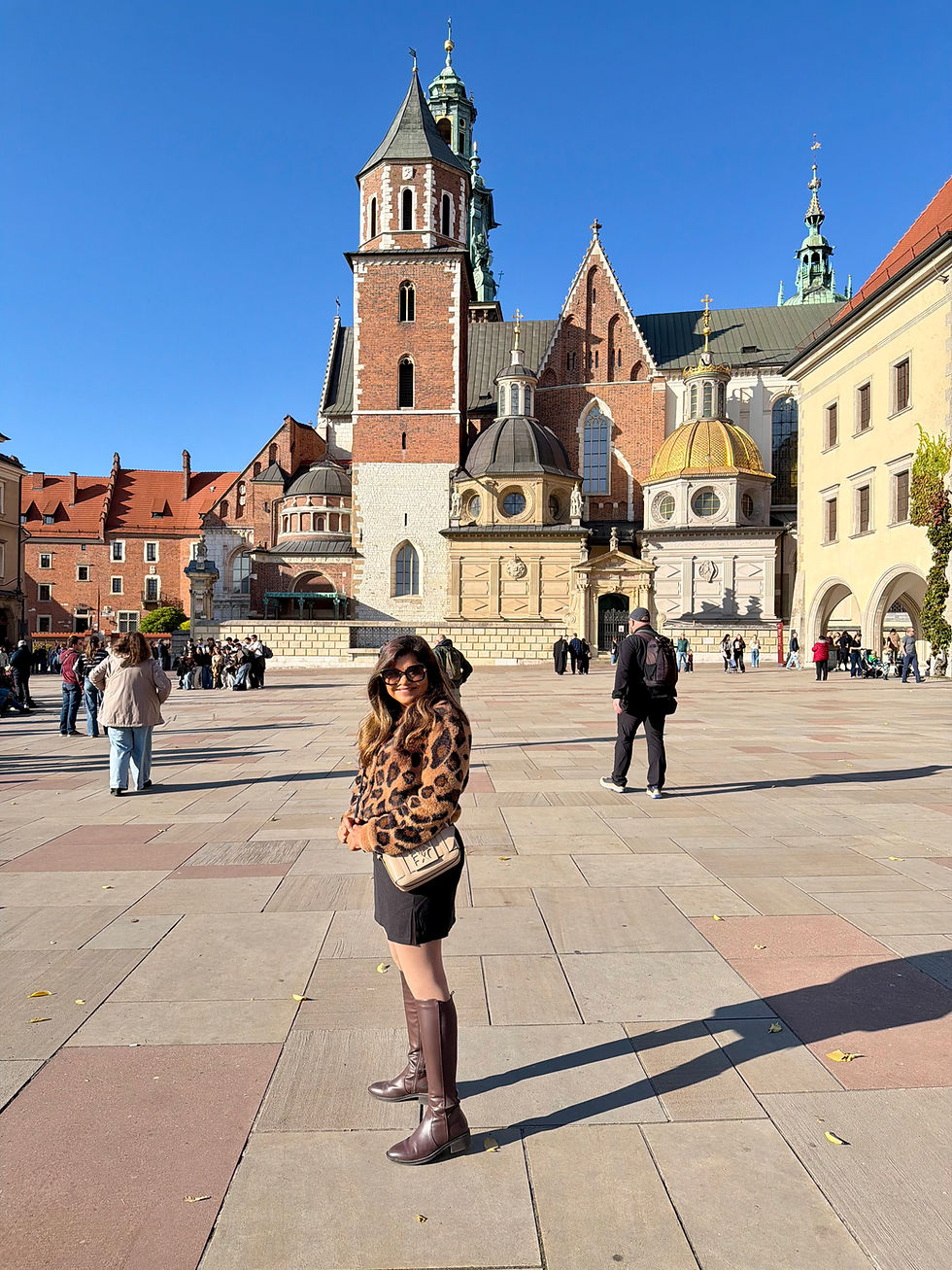
Wawel Castle was excellent, and the interiors are unmissable. We arrived at opening, 09:30, and I would recommend booking both castle tours. Castle I takes you through the Royal Private Apartments, where the kings actually lived: bedchambers and guest rooms with Renaissance wooden ceilings, period furniture and portraits, plus the Porcelain Cabinet. Castle II covers the grand second floor, the State Rooms where the court received guests and the Senate met, hung with the famous Flemish tapestries. The highlight for me was the Deputies’ Hall, whose ceiling is studded with carved wooden heads gazing down at you. The same ticket includes the Ottoman Turkish tents captured at the Battle of Vienna in 1683. The grounds and courtyard are free, but each exhibition has its own timed ticket, so book online in advance at bilety.wawel.krakow.pl.

The Dragon's Den (Smocza Jama), on the other hand, was a sham. It only takes you through the cave to the other side, where it opens onto the fire-spitting dragon statue and the river where the cruises run. It is open 10:00 to 17:00 in October and closes for the winter on 1 November, so skip it unless the kids want to see the dragon.
For a Harry Potter-style lunch stop, walk up Grodzka Street to Dziórawy Kocioł (The Leaky Cauldron) at ul. Grodzka 50, which serves butterbeer, pumpkin juice and "potions", some with dry ice. It fills up at Sunday lunchtime, and Ministerstwo Tajemnic on nearby Kanonicza Street is the backup. Then it is a ten-minute walk to the Collegium Maius clock at ul. Jagiellońska 15, where wooden figures of kings, queens and scholars parade out to music every two hours. Aim for 13:00, with 15:00 as the fallback.

Zakopane
Many people know Poland for Kraków, Warsaw and the Auschwitz-Birkenau Memorial, and some know Gdańsk, Wrocław and Poznań too. But fewer international travelers have heard of Zakopane, a charming ski town at the foot of the Tatra Mountains, Poland's highest range. It's hugely popular with Poles, who flock here year-round, and is often called the "Winter Capital of Poland." It offers hiking, skiing and plenty of natural beauty, and it's one of the most popular day trips from Kraków.

It's roughly 100 km from Kraków, and the drive takes around 2 to 2.5 hours each way, so a day trip is long. You can easily spend 3 to 4 days here. Soak in the thermal baths at Terma Bania in Białka Tatrzańska and Chochołowskie Termy in Chochołów, ride the funicular up Gubałówka for sweeping views of the Tatras, and drive to Dunajec Castle (Niedzica Castle) to explore the castle and the surrounding area. Finish with a traditional Górale (highlander) feast with live folk music and dance, and don't miss the smoked oscypek cheese and the region's wooden architecture.
Day 4: Kiu's birthday at Terma Bania
19 October was Kiu's birthday, and we decided to do what he and we love best. Since it was a celebration for him and for us as parents, we headed to Terma Bania in Białka Tatrzańska, one of the best thermal baths we have explored in Europe. It is about half the price of what we pay for similar places in the Netherlands, with better pools and warmer water. There is even a pool with a bar for the adults, and slides and a water park for the kids.
Getting there
It is on the way to Zakopane, about 1.5 to 2 hours from Krakow via Nowy Targ. We checked out by 08:30 and arrived around 10:30. It is open daily 09:00 to 22:00, and a Monday in late October is one of the quietest days of the year.
The water is geothermal, kept at 34 to 38°C in the indoor and outdoor pools, warm enough to stay outside even on a cold day. For the kids there are three slides that run year-round, an indoor water playground, a family slide, a wave pool and a lazy river outside.
Tickets: buy the no-time-limit ticket rather than the 2.5 or 3.5 hour ones. It is roughly 99 PLN per adult and 79 PLN per child (child rate up to age 13), about 356 PLN for our family. Check termabania.pl for current prices.
Luggage: the car sits in the car park all day with your bags in it, so keep everything in the boot, out of sight.
Lunch: eat at the on-site restaurant so nobody has to get dressed and leave.
We left around 17:30 for Zakopane, about 30 minutes away. Birthday dinner was Churros and Indian food at Zakopane.
Day 5: Niedzica Castle and Zakopane's city centre
On Tuesday we visited Zamek Dunajec w Niedzicy (Niedzica Castle), where the museum is run by the Stowarzyszenie Historyków Sztuki, the Association of Art Historians. The castle tour is short, around 45 minutes to an hour, but it was fascinating to see a centuries-old castle and learn its history. The views from the rooftop were brilliant, so don't skip them.

We spent the rest of the day in Zakopane's city centre, Krupówki, Zakopane’s main pedestrian street, close to our aparthotel. The main pedestrian street is lined with shops, cafes, and stalls selling local wool, wood carvings, leather goods, and oscypek cheese. Great for a slow wander and people-watching.
Day 6: Gubałówka, Zakopane: The Easiest Tatra Views with Kids (and Grandparents)
If there's one thing to do with the whole family in Zakopane, make it Gubałówka. You don't need to hike, drive or plan much. Just hop on the funicular and you're above the town with the Tatras laid out in front of you. The lower funicular station is almost in the centre of Zakopane, near the top of Krupówki Street. From most central hotels it's an easy walk, so you can leave the car behind. If you do drive, parking at the top costs 15 PLN. The ride itself takes only about 3.5 minutes each way, but the views start as soon as you leave the station.

Opening hours and prices
Hours: The funicular runs all year, from 9am until 7pm, 8pm or 9:30pm depending on the season. Hours can change at short notice, and it does close for maintenance, so check pkl.pl before you go.
Price: A round trip cost 42 PLN per adult (about €10 / ₹1,075). Kids and teens up to 26 pay the reduced fare of 34 PLN (about €8 / ₹870), so our family of four (2 adults, kids aged 7 and 11) paid about 152 PLN in total (about €35 / ₹3,890). Children under 4 ride free. Buying online at sklep.pkl.pl is a bit cheaper, at 37 PLN for adults and 29 PLN reduced, and it skips the queue. Prices are higher in summer (June to September) and change by season, so check pkl.pl before you go.
Time needed: A quick visit takes 1–2 hours. With a meal and the activities, allow half a day or more.
Tip: In summer, go early to beat the crowds.
(Euro and rupee amounts are approximate)

It's a whole village up there
We took the funicular up and the views were mesmerizing. Once at the top, we found it was a little village in itself, with cafés, restaurants with Tatra views, and a street lined with stalls selling local handmade goods.
Try the oscypek. This smoked sheep's cheese is the local speciality. One of the stalls grills it hot over a coal burner and serves it with cranberry jam, and it was delicious. Hot boiled corn and mulled wine are sold nearby too, which is perfect on a chilly day.
Visit the "highest beach". A little further on is Poland's highest-located beach, at around 1,120 m. There's no water, but there are deckchairs, a terrace bar for a drink and a podium for the classic panoramic selfie.
Don't skip the adventure zone. This is the highlight for kids. The gravity slide (open April to November) sends carts down a winding track at up to about 23 km/h, with the Tatras in the background. In winter the hill becomes a small ski slope and an illuminated "Land of Light" park.

Where to eat
Widokówka (on top): A traditional wooden highlander-style restaurant, set a little higher than the others for the best view while you eat. It serves regional Podhale food, including kwaśnica (sour cabbage soup), oscypek and grilled meats. Expect about 40–60 PLN per person.

Cafe Gubałówka: On the main square, good for coffee and cake.
Tarasy: Regional dishes, pizza and a kids' menu.
Czarci Jar, Karczma Regionalna (back in town): This one is not on the hill, but it's a great place for dinner after a mountain day. It's a cosy log-cabin tavern by a stream, with a fireplace in the middle of the room. Try the kwaśnica, pierogi, oscypek or the duck. It's at Małe Żywczańskie 11A, slightly outside the centre.
Day 7: Thermal Bath
Termy Bukovina
Termy Bukovina was our plan for our last full day in Zakopane before heading to Krakow, and it meant we ended our stay on a very relaxed note. It was the biggest and most polished of the thermal baths we visited.
What makes it unusual is that it’s built over several levels, each with a different experience. As you enter, there’s the main indoor pool at around 32 to 34 degrees, with two large jacuzzis next to it and a children’s zone with a shallow pool, a wild river and indoor slides. A staircase takes you down to the outdoor pools with views of the Tatra mountains. The warmest of them goes up to 38 degrees. Further down is a cave pool with waterfall cascades and a river current at around 35 to 37 degrees.
The kids had a royal time in the pools while we relaxed under the jet sprays. Honestly, this was the best of the lot. There’s also a separate sauna zone, which is a no-swimsuit area (towel or sheet only).
On price, it wasn’t the most expensive. In low season a 3.5-hour ticket was 89 to 99 PLN for adults and 69 to 79 PLN for children, and a 4-hour family ticket for two adults and two kids started at 249 PLN. Terma Bania and Termy Zakopiańskie charge similar amounts for 2.5 hours, and Chochołowskie is around 85 PLN for 3 hours, so you get more time for your money here. Saunas cost extra, the outdoor slides close in autumn and winter, and there’s no towel rental, so bring your own. It can get crowded in peak season.

If you dont want to drive 25 minutes away from Zakopane, then you can also opt for Termy Zakopiańskie (formerly Aqua Park Zakopane). It is not geothermal, but a proper pool complex right in town. It has a 25m lap pool, kids' mini-pool, slides, wild river, jacuzzis, sauna zone. It is good if you want something walkable without a car, and it's genuinely set up for families with kids of various ages.

Day 8: Wieliczka Salt Mine + Kazimierz
Wieliczka Salt Mine
In the morning, visit the Wieliczka Salt Mine, where you’ll go underground and walk through historic mining tunnels, enormous chambers and salt-carved sculptures. The highlight is St. Kinga’s Chapel, an underground church decorated almost entirely from salt.

🎟️ Tickets:
Book online in advance on the official site (kopalnia.pl / wieliczka-saltmine.com) — this sells out, especially in season, so don't leave it for the day-of.
Tourist Route prices (2026): Standard ~134 PLN, Reduced (child/student/senior) ~112 PLN, Family ticket (2 adults + 2 kids) ~402 PLN. Kids 0–4 go free.
A photography permit is a small optional extra (~10 PLN) if you want to take photos underground.
You don't need to budget separately for a guide. The Wieliczka Salt Mine Tourist Route is mandatory guided, and that guide is already included in the ticket price you paid (the ~€31 standard / ~€26 reduced / ~€95 family ticket). Visitors go through in groups (roughly 20–40 people) led by an official mine guide, and English-language tours run multiple times a day, so there's no extra charge on top for this
Parking → Entrance — no bus needed:
Both official car parks are within walking distance of the entrance, so no shuttle required:
Car Park 2 "Daniłowicz" — the closer of the two, right next to the Daniłowicz Shaft (the main tourist entrance). Just a short walk in.
Car Park 1 "Tężnia" — slightly further, near the Graduation Tower, but still an easy, well-signposted walk to the entrance (a few minutes).
Kazimierz, the historic Jewish district
Most visitors to Kraków tick off the Cloth Hall and St. Mary's Basilica on the Main Market Square, but Kazimierz, just south of the Old Town, is just as essential. Founded in 1335 by King Casimir the Great, it was a separate town until it was merged into Kraków in 1800. In 1495, King John I Albert relocated Kraków's Jewish community here, and the district became the centre of Jewish life for centuries. Before WWII, around 65,000 Jews lived in Kraków, roughly a quarter of the city's population.

Today, Kazimierz is home to several historic synagogues, including the Old, Remuh, High and Isaac synagogues, as well as two old Jewish cemeteries, Remuh and the New Cemetery. During the war, the Nazi ghetto was set up across the river in Podgórze, and many of Kazimierz's Jewish residents were later deported from there. The neighborhood is also known for its lively restaurants and cafés, making it a great place to explore and eat.
Steven Spielberg filmed his Academy Award-winning Schindler's List in Kazimierz, telling the story of Oskar Schindler, the businessman who saved around 1,200 Jews during the Holocaust. Much of the film was shot in Kazimierz, the historic Jewish Quarter, which stood in for the Kraków Ghetto. The real ghetto was actually located across the river in Podgórze. The camp scenes weren't filmed at the actual Płaszów site, which is now a memorial and protected area. Instead, Spielberg had a replica of the camp built in the nearby Liban Quarry, a few kilometres from the real thing. Schindler's real Enamel Factory in Zabłocie is now a museum about Kraków under Nazi occupation, though the film's factory scenes were shot at other locations. |
If anyone's short on gifts, this is also the moment to grab amber jewelry, pierniki (gingerbread), or oscypek cheese to bring home.
Extra — Morskie Oko / Tatra Mountains
Iconic lake + mountain scenery
This is the day I would adapt around your grandmothers. You can drive to the Palenica Białczańska parking area, but cars cannot continue all the way to Morskie Oko. From there, the usual route is a long walk, but you can potentially take a horse-drawn carriage toward Włosienica, leaving only the final section to the lake. The trail is officially rated as accessible May through October, and the walk from Palenica Białczańska is a well-maintained, mostly paved route (~9km each way, 2-2.5 hrs at an easy pace). So round trip to the lake and back: ~4.5–5 hours, plus time at the lake itself for photos/rest, call it 5–6 hours total. Late October is actually a lovely time for it, the crowds thin out significantly compared to summer, and the road/trail stays open. Parking at Palenica Białczańska is also best arranged in advance.

Extra - Góral/Highlander culture Feast
A cozy Zakopane evening with a live highlander band, bonfire, hearty regional food, and plenty of dancing. Surrounded by mountains, you'll enjoy traditional music, tasty local dishes, and mountain humor that keeps the laughs going all night. The band plays popular regional songs, leads easy group dances, and teaches everyone to sing along. Between songs, your host shares stories and jokes about everyday life in the mountains. It's all paired with a hearty spread of local food and drinks, served by the bonfire or in a traditional wooden shelter.
A particularly easy option is Karczma Zapiecek, where the restaurant says a Highlander band performs every evening from around 18:00. If you want something more immersive, you can instead book a dedicated Highlander feast with dinner, live music and dancing, but I would confirm that the exact October 21 performance is operating before booking.

🍽️ Restaurant + show: Karczma Zapiecek — This doubles as your traditional dinner and Highlander entertainment. Try kwaśnica (sour sauerkraut soup, usually cooked with pork ribs), oscypek (smoked sheep’s-milk cheese, often grilled and served with cranberry jam), pierogi (filled dumplings) and grilled regional meats.
🍽️ Your food journey
The restaurants are chosen so the food changes with the regions you’re visiting: classic Polish food in Kraków, Jewish/Polish cuisine in Kazimierz, and traditional Highlander food in Zakopane. That way, the restaurants become part of the cultural experience rather than just places to eat.
🥟 Vegetarian Polish dishes worth trying before you go:
Pierogi are Poland’s favourite comfort food, half-moon dumplings, boiled or pan-fried and served with fried onions, butter or sour cream. Order a mixed plate to try a few kinds, such as ruskie (potato and white cheese, named after the historical region of Ruthenia, not Russia), z mięsem (minced meat), z kapustą i grzybami (sauerkraut and wild mushroom) and the sweet z serem (sweet white cheese), often eaten as dessert.

Krokiety — crepes rolled around a cabbage-and-mushroom filling, breaded and fried.

Red barszcz - Red barszcz (beetroot soup) is a clear, slightly sour broth, often served in a mug. Try it with uszka (small mushroom-filled dumplings).

Zupa pomidorowa (tomato soup, often served with rice or noodles) and zupa grzybowa (wild mushroom soup) are popular starters, but both are often made with meat stock, so vegetarians should ask before ordering.

Szarlotka — Polish apple cake, a sweet way to end any meal.

Highland cheeses on the way to Gubałówka
On the street leading up to the funicular, stalls are piled high with smoked highland cheeses. The best known is oscypek (smoked sheep’s-milk cheese), best eaten warm off the grill with cranberry jam. For the traditional kind, look for the “owcze” (sheep’s) label.

Żurek (sour rye soup) is one of Poland’s most traditional dishes, made with fermented rye flour, which gives it a gentle sour tang. It usually comes with sausage, potato and sometimes a boiled egg, making it filling enough for a light lunch on its own.

Zapiekanka (open-faced toasted baguette) is Poland’s classic street snack: half a long baguette topped with mushrooms and melted cheese, then finished with toppings of your choice and a drizzle of sauce. It’s cheap, filling and easily big enough to share.

If you enjoyed reading my blog post and like to support my blog, I’d love it if you gave it a ❤️ and hit SUBSCRIBE for more updates. Feel free to share it with your friends and family too! If you have any questions or want to chat about travel or anything else you'd like to know more about, I’m just a message away.


Comments