


Mumbai Meri Jaan: A Local's Guide to the City I Love

Updated: Oct 8
Disclaimer: This post reflects my personal experiences and opinions as a Mumbaikar. All information was accurate to the best of my knowledge as of October 2026, but prices, opening hours and availability can change, so please check before you visit. This post is not sponsored, and I have no affiliation with any of the places mentioned. Some images are AI-generated for illustration and are labelled as such.
Mumbai, the City of Dreams. Every Bollywood film tells you the same story: a city of busy lives, where everyone is chasing something and nobody stops. And it's true. People here know what it takes to struggle and rise, from one-room kholis to sea-facing mansions, and in one of the most crowded cities on earth, the word "stop" simply doesn't exist. Mumbai never sleeps. Yet somewhere in all that sweet madness, Mumbaikars find their small joys and turn them into everyday rituals: a cutting chai early in the morning, the daily train hustle to work, steaming vada pav on a rainy evening, cheering for India at Wankhede, sharing a colourful gola with someone special on Marine Drive, or just sitting on a pavement watching the kaali-peeli taxis go by.

This is Mumbai Meri Jaan, a local's guide to the things to do in Mumbai, with a few stories you won't find in any guidebook. And what better way to begin a Mumbai local guide than with the Mumbai local itself.
Lifeline of Mumbai: The Mumbai Local
Mumbai local is lifeline for millions and if you haven’t experienced navigating through the crowded compartments jostling for space, it’s high time you do. Get off your cushioned leather seats of your swanky car and take a surreal ride on one of our railway dibbas to your next destination. When the armpits sweat, passengers are squished together, push comes to shove, the rush hour chaotic environment becomes your daily reality and you get magically thrown off at your station, that’s when you would’ve truly experienced the challenging and overwhelming yet resilient Mumbai local journey. It’s called dhakka-mukki :)

Chhatrapati Shivaji Maharaj Terminus: Mumbai's Grandest Station
Chhatrapati Shivaji Maharaj Terminus (CSMT) is one of the busiest railway stations on the harbour and central line, representing the spirit and vibrancy of Mumbai. It is also testament to the durability of its structure, considering huge crowds walk through its British styled doors even today. Its architectural style is an impressive blend of Victorian Gothic and traditional Indian. No wonder it’s a UNESCO World Heritage site.

Learn the Art of Saying No from the Mumbai Autorickshaw wala.
If you want to learn the art of saying NO, then let me introduce you to the Mumbai autorickshaw wala. You say ‘Bhaiya Ghatkopar?’, the answer is a negative nod of the head. ‘Bhaisaheb Bandstand?’ The answer is ‘Nahi’. I love their attitude, they do what they have to do. They might not make their bohni for the day (the first earning for the day), but they won’t budge if they don’t want to go your way. The autorickshaw is the quickest and easiest public transportation to hail in Mumbai. It fits 3 passengers snug in the back seat, an additional 3 children on the lap if allowed and 1 person in the front with the driver! That’s how we do our jugaad in Mumbai ;)

The Vada Pav Exchange Rate
A few new Indian home-run kitchens in the Netherlands have started selling vada pav (a deep-fried spiced potato ball stuffed in a bun) for roughly €2 a piece. Quite reasonable by Dutch standards, ain't it? "Tumchi satakli aahe ka?" (Have you gone mad?) That's a whopping ₹220 for a vada pav in Indian rupees. I'd get at least 10 vada pavs for that kind of money back home. Selling at around ₹20 a piece, Vada Pav is still Mumbai's favourite street food and tops the charts for the best eats in the city. It's lunch for many, a snack that goes perfectly with evening chai, an easy takeaway for large get-togethers, or, if you're anything like me, something you just pick up because you happened to pass a stall selling them piping hot.

Makhan Maar Ke: The Sardar Pav Bhaji Experience
I've seen people more shocked than amazed when the chef drops half a 500 g block of Amul butter onto the tawa and mixes it into the bhaji. When Mumbaikars say "makhan maar ke" (with lashings of butter), Sardar Pav Bhaji takes it literally, and then some. Running since 1966, this legendary street food joint became so famous for its style of pav bhaji that it has had queues ever since. The initial shock slowly turns into craving, and once you bite into that butter-soaked pav, your senses give in completely and your diet plans quietly leave the building.

Colaba's Two Living Legends: Leopold and Mondegar
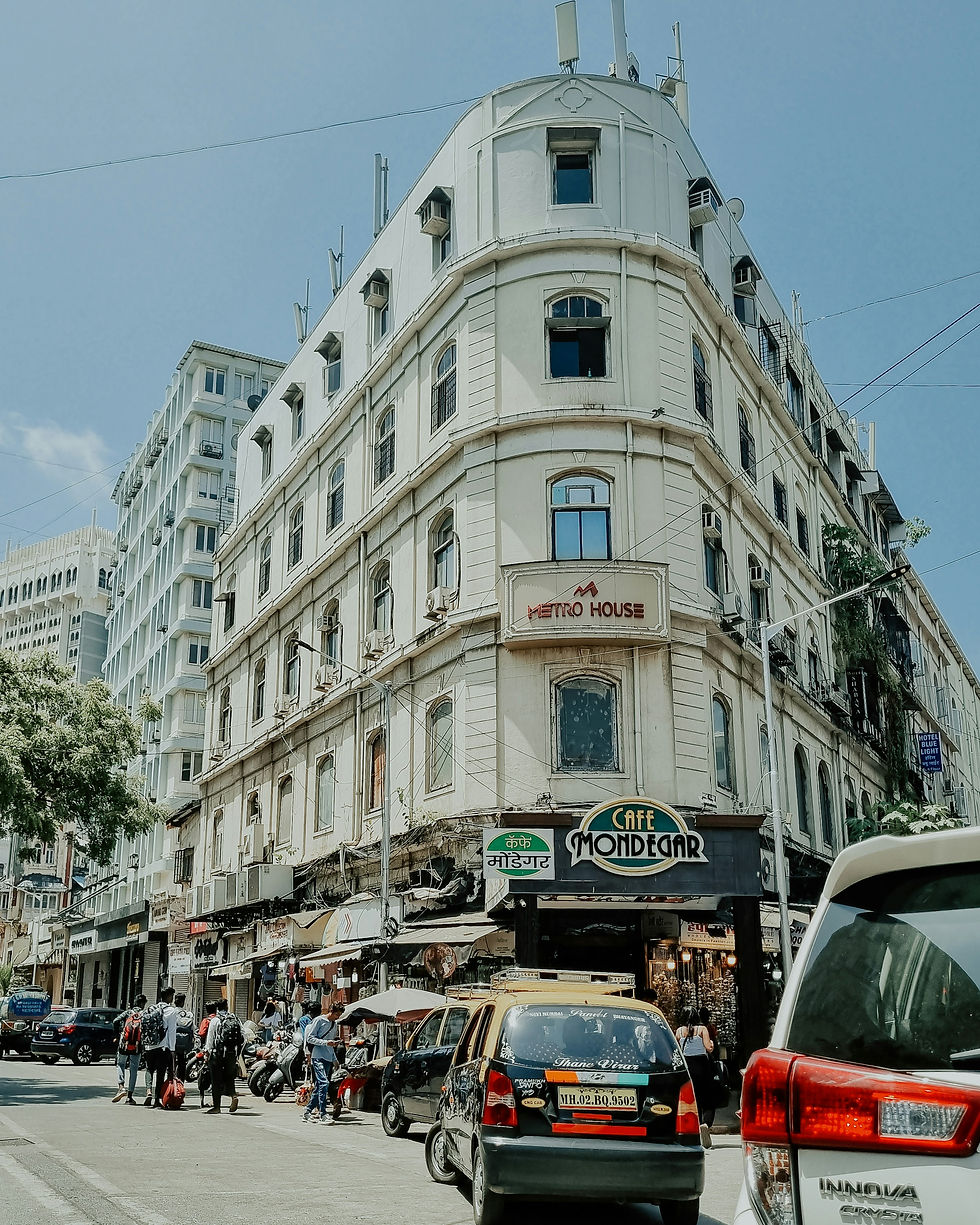
Two of the most iconic spots in town, Leopold and Mondegar aren't just cafés, they're an emotion. Every townie has a story from here, and half the cool kids in Colaba probably had their first date at one of these tables. Leopold Cafe opened in 1871, making it one of the oldest cafés in Mumbai, and its old-world charm and vintage décor are a vibe of their own. Order a chilled beer and a plate of chicken chilli dry, and you're doing it right. Leopold was also one of the places targeted in the 2008 Mumbai attacks. It reopened within days, and the bullet marks are still on its walls, a quiet reminder of the city's resilience.
A short walk away is Mondegar, running since 1932, its walls covered in Mario Miranda's cartoons of Mumbai life, with a jukebox that has played everything from Bollywood to rock for generations. Locals and tourists still pack both places. If you want to unwind, catch up with friends and soak in old Bombay over food and drinks, this is where you go.
Marine Drive: The Queen's Necklace
Known as the Queen's Necklace, Marine Drive curves for about 3.6 km along the Arabian Sea, from Nariman Point in the south to Girgaum Chowpatty in the north. The name comes alive after dark, when its streetlights glitter like a string of pearls along the bay. Lined with Art Deco buildings that are part of a UNESCO World Heritage Site, it's the heart of Mumbai's skyline. Come for the sunsets in summer, or watch the monsoon waves crash against the sea wall and tetrapods that guard the city from the sea. Hawkers sell piping hot chai, joggers and walkers fill the promenade, and couples sit hand in hand on the wall. Landmark hotels like the Ambassador, the Trident and the Oberoi look out over it all.

The Sizzler, Made in Mumbai
Here's something most people don't know: the sizzler, that smoking hot iron plate of grilled meat or veggies, rice or noodles and sauce that arrives at your table hissing and steaming, was invented right here in Mumbai. Firoz Erani created it in 1963 after seeing sizzling steaks in California, and Kobe and Yoko later turned it into a city-wide obsession. For the last three decades, Fountain Sizzlers, named after Flora Fountain just around the corner, has been the go-to spot for sizzler lovers in Fort. Try their Classic Chicken Shashlik, I say.

Catch of the Day: Mumbai's Seafood
Long before Mumbai was a city, it was seven islands, home to the Kolis, the fishing community who are its original residents. Seafood isn't just a cuisine here, it's in Mumbai's DNA. Start with a crispy bombil fry (Bombay duck, which is actually a fish), a spicy plate of Koliwada prawns, or a surmai fry with rice. For the full experience, head to a Malvani or Mangalorean restaurant: Gajalee and Mahesh Lunch Home are local favourites, and Trishna in Kala Ghoda is famous for its butter garlic crab. Another of our favourites is Highway Gomantak in Bandra East, the place to go for a no-frills fish thali. Crispy bombil, fried surmai, fish curry and rice all arrive on one plate, with a glass of solkadhi on the side.

Two tips from a more experienced Mumbai local :
If you're an early riser, catch the morning fish auctions at Sassoon Dock in Colaba, one of the city's oldest docks.
Skip seafood during the monsoon, when fishing pauses for the breeding season.
Haji Ali: Mumbai's Floating Shrine
Set on a tiny islet off the coast at Worli, the Haji Ali Dargah is Mumbai's floating wonder. The white-walled shrine houses the tomb of the Sufi saint Pir Haji Ali Shah Bukhari and draws visitors of every faith. It's reached by a narrow causeway of about 500 m from Haji Ali junction, opposite Heera Panna, with the sea on both sides. Time your visit with the tide: at low tide you can walk across, but at high tide the path disappears under the waves and the dargah seems to float on the water. Along the way, hawkers and stalls sell flowers, chadars and snacks to the steady stream of pilgrims and visitors.

A Few Seconds at Siddhivinayak
My parents moved to Bengaluru soon after I got married, after spending a good 26 years in Mumbai. Through all the noise and change of those years, one thing stayed constant for them: darshan at Siddhivinayak. Their faith runs so deep that even now, whenever they visit Mumbai, they make sure they are up early on a Tuesday and at the temple door to offer their prayers. Inside, they join a sea of devotees inching towards the small, ornate sanctum, all for a few seconds' glimpse of Lord Ganesha. For them, those few seconds are enough to feel truly blessed.

Street Style Before It Was Cool: Linking Road and Colaba Causeway
Long before Zara, H&M and Bershka opened their doors in India, the latest trends were already on the streets of Bandra and Colaba. Linking Road and Colaba Causeway have always been where Mumbai goes to shop for fashion without the big-brand price tag. Many stalls sell export surplus straight from the factories that supply international labels, so if you dig, you'll find gems. I once pulled a branded dress out of a pile on Linking Road, and its design was years ahead of anything in the shops back then. Colourful juttis, flowy dresses, hats, bags and accessories spill out of every stall. Bargain hard, and you'll go home with some of the best buys of your trip.

Chai, Caramel Custard and Conversation: Mumbai's Irani Cafés
Hands down, the best caramel custard in Mumbai is at an Irani café. These old-world cafés were opened by Zoroastrian families who came from Iran over a century ago, and many are still run by the same families today. I've had my share, from the little café near Heera Panna to an old favourite in Bandra, and each one feels like stepping back in time. Order a bun maska with Irani chai, a plate of dhansak, or, at Britannia & Co. in Ballard Estate, the famous berry pulao. No fancy restaurant can compete. But the real magic is the hospitality.

At Britannia, it was the late Boman Kohinoor, who well into his nineties would walk up to every table, ask about your life, share stories of his own and make sure you promised to come back. He passed away in 2019, but that warmth still lives on in Mumbai's Irani cafés, where the uncle or aunty at the counter always has time for you. If you can't get to Britannia, there's Kyani & Co., pouring chai since 1904, and Yazdani Bakery in Fort, where the brun maska comes straight out of a decades-old oven.
Juhu Beach: Some Classics Never Get Old
I'm a millennial, and while my generation might reach for rooftop bars and brunch spots, I still believe that if you want the real essence of Mumbai, you need to experience the classics. Juhu Beach is one of them, a place that makes Mumbai truly Mumbai. Picture a long stretch of sand, kites in the sky, families out for an evening walk, and food stalls serving pav bhaji, bhel puri and ice gola as the sun sets over the Arabian Sea. It's loud, crowded and full of life, and that's the point. Just enjoy the sea from the shore; the water here isn't meant for swimming.

Wankhede: Where Legends Are Made
The heartbeat of Mumbai cricket, Wankhede Stadium is where legends are made. This is where India lifted the 2011 World Cup with Dhoni's winning six and where Sachin Tendulkar said goodbye to Test cricket in 2013. When Mumbai's passion comes out in full force, the energy in the stands is electric. There's no better way to watch cricket's biggest stars in action than from these seats, whether it's an international match or the Mumbai Indians at home in the IPL. The roaring crowds, the chants, the sixes and fours, the strangers hugging you after a last-over win: for a few hours, 33,000 people become one big family, and you leave hoarse, happy and already planning your next match. Book early, as big games sell out fast.

More Than a Slum: Dharavi
Fly into Mumbai and one patch stands out from above: a dense sea of rooftops, many covered in blue tarpaulin to keep out the monsoon. This is Dharavi, one of Asia's largest informal settlements and also one of the busiest small-business hubs in the city. Behind its narrow lanes are thousands of workshops producing everything from pottery to garments to recycled goods. It's especially known for leather: the shops along 90 Feet Road sell well-made belts, bags, wallets, shoes and jackets at a fraction of mall prices. Wander a little further to Kumbharwada, the potters' quarter, where families have been shaping clay for generations.

The Gateway of India and Taj Mahal Palace
Few places say "Mumbai" like the Gateway of India. Built in 1924 to mark a British royal visit, it later saw the last British troops leave India in 1948, a monument to the start and end of an era, overlooking Mumbai Harbour. Right beside it stands the Taj Mahal Palace, which opened in 1903 and actually predates the Gateway by two decades. With its red dome and grand façade, it's one of the most photographed hotels in the world, and even if you're not staying, a cup of tea at one of its cafés is a very Bombay treat. Today the Gateway is also where your sea adventures begin. Hop on a ferry to the Elephanta Caves, a UNESCO World Heritage Site, or cross the harbour to Mandwa for the beaches and forts of Alibaug. Or simply take a leisurely boat ride around Mumbai Harbour and see the city from the water, with the Taj and the Gateway behind you. Ferries are limited in the monsoon, so check before you go.

Closing Thoughts
What makes all these things to do in Mumbai truly special isn't the places, it's the people. Walk down Mohammed Ali Road on a Ramzan night, join the crowds at Girgaum Chowpatty for Ganesh visarjan, or wander through Bandra's Hill Road and Chapel Road at Christmas, and you'll see people of every faith and background celebrating together. The langar at the Dadar gurudwara feeds anyone who walks in, Jain families seek blessings at Walkeshwar on Mahavir Jayanti, and lakhs of people queue for Lalbaugcha Raja, whatever their religion. Mumbai isn't perfect, but in all its chaos it makes room for everyone, and that spirit is what makes Mumbai, Mumbai.
And this is by no means an exhaustive list. I haven't even got to the Taraporewala Aquarium, the dabbawalas who deliver thousands of home-cooked lunches across the city every day, the red-shirted porters at CSMT, Mumbai's best kept secret Banganga Tank, the antiques of Chor Bazaar, the old Irani cafés, or the madness of Ganesh Chaturthi. That's for another day. Until then, from a Mumbaikar now living a long way from home: go, get lost in it, and you'll understand why we call it Mumbai Meri Jaan.
If you enjoyed reading my blog post and like to support my blog, I’d love it if you gave it a ❤️ and hit SUBSCRIBE for more updates. Feel free to share it with your friends and family too! If you have any questions or want to chat about travel or anything else you'd like to know more about, I’m just a message away.


Too good Amy!!