


Temple Marathon in Siem Reap: A Complete Guide to Angkor’s Must-See Temples

Updated: Jun 16
Hey there! As you read through this post, feel free to click on the affiliate links highlighted in BLUE. If you decide to book a hotel or purchase something through them, I’ll earn a small commission, at no extra cost to you. These commissions help keep The Morning Brew running and allow me to create more awesome content. Thanks for your support!
From years of manifesting to finally witnessing Angkor Wat with my own eyes.
We’d been dreaming of Angkor Wat for years. Every time we planned it, something got in the way, flight prices suddenly skyrocketing, the kids being too young for long temple days, or the unbearable heat most of the year. This time, we stopped waiting for conditions to be perfect. We went. Even the Cambodia-Thailand tension tried to make us rethink it, but we trusted our timing and our gut. With Arya (6) and Kiu (10) a bit older now, we believed they could handle two days of temple hopping, no cartoons, no books in between, just real-world adventure. And honestly, they surprised us.
Moreover, because of the Cambodia–Thailand border tensions near Preah Vihear Temple, many tourists chose to cancel their trips. In reality, Angkor Wat and the temples around Siem Reap are hundreds of kilometres away from the border and were not affected at all by the situation. However, the news still discouraged some travellers, which meant the usual crowds were noticeably thinner.
Just imagine, visiting in December, one of the best months of the year, and finding the temples almost empty! We could walk around leisurely, take our time exploring, and enjoy the monuments without the usual rush or crowds. It really felt like having parts of the temples almost to ourselves. Sometimes opportunity shows up in the most unexpected circumstances!

So, we made this journey to Cambodia happen. This part of our journey was not just about architecture or history. It was physical, emotional, and deeply grounding. From long temple days and jungle-covered ruins to floating villages and traditional dance performances, Siem Reap revealed layers of Cambodia that felt stuck in time and profoundly human.
While this blog focuses on temples, it also goes beyond them sharing experiences from night markets, Pub Street, massage parlours, street food corners, Apsara performances, and the everyday moments that made this journey truly enriching.
A little history..
Siem Reap is special in many ways, one of them being the beautiful blend of Hindu and Buddhist traditions seen across the Angkor temples. The early Khmer kings were strongly influenced by Indian religious ideas, art and architecture, and many of the temples were originally built as Hindu temples dedicated to gods like Shiva and Vishnu. Over time, especially during the reign of Jayavarman VII, Buddhism became more prominent and several temples were converted or adapted for Buddhist worship.
9th century to 1431: Angkor period.
The golden age of the Khmer Empire, with Angkor Wat and Angkor Thom.
The most significant era began in 802 AD, when King Jayavarman II declared himself a divine king and founded the Khmer Empire, marking the start of the Angkor period. Over the next 600 years, powerful kings such as Suryavarman II, who built Angkor Wat, and Jayavarman VII, a devoted Buddhist who built Angkor Thom, Bayon, and many hospitals and roads, shaped Cambodia’s golden age. This period is known for its massive temple complexes, advanced engineering, and the peaceful coexistence of Hindu and Buddhist beliefs.
Siem Reap Angkor Temples Guide
Your journey into Angkor’s history begins the moment you arrive in Siem Reap. At the old Siem Reap International Airport, visitors are welcomed by the Balaha statue, a mythical flying horse from Buddhist stories that symbolises protection and compassion. Welcome to the spiritual world of Angkor! This Siem Reap Angkor Temples Guide will help you explore the most important temples and experiences in the region.
Day 1 - Drive Down to Siem Reap
We left Phnom Penh at 8:30 a.m., ready for the long drive to Siem Reap. Right from the start, I noticed so many pagodas, and even some buildings had pagoda-style rooftops. As the city faded behind us, the traffic thinned and the countryside took over. On National Road 6, we passed green rice fields, small villages, stilt houses, and water buffalo grazing by the road. More Buddhist pagodas and local markets appeared along the way, giving a real sense of rural life in Cambodia on wheels.
By midday, we stopped in Kampong Thom for lunch. The town is quiet but welcoming. We tried local dishes and enjoyed a short break before continuing.

After lunch, the drive continued across wide rice plains, canals, and small villages. Life here moves slowly, and the scenery is peaceful, with coconut trees reminiscent of southern India. Along the way, it’s possible to feel Cambodia’s history, including areas once affected by the Khmer Rouge, though today it’s mostly farmland and villages.
As we neared Siem Reap, the landscape changed completely from agricultural lands and small markets to commercially grand properties, resorts and busy and beautiful restaurants. Clear signs of tourism began to appear, signaling that the temples and adventures ahead were just around the corner.
Siem Reap
Siem Reap is a city in northwestern Cambodia, best known as the gateway to the ancient temples of Angkor. It lies close to the border with Thailand and about 320 km from the capital city, Phnom Penh. The city sits just south of the vast Angkor Archaeological Park, which is home to the famous Angkor Wat and many other temples built during the Khmer Empire.
Siem Reap moves at a much slower rhythm than Phnom Penh. One moment you’re standing before a thousand-year-old temple carved with gods and epics, and the next you’re watching children play in dusty lanes, monks walk barefoot at dawn, or locals setting up stalls for another evening in town. Today, Siem Reap has grown into a lively tourist hub with markets, restaurants and cafés, while still serving as the base for exploring the temples. Talk about contrasts!
Embassy Angkor Resort and Spa
What an incredible property! The moment I walked in, I instantly liked it, the ambience felt almost unreal. The place is so spacious, sprawling beautifully across a large area that gives you room to breathe and just soak it all in. There’s an Olympic-size pool and a state-of-the-art gym, a quiet reading space with books and a glass-enclosed dining area that lets the sunlight shine through. The resort is quite modern and luxurious yet it blends a timeless charm to it very effortlessly.

We stayed in a villa with our own private pool and an indoor tub, and honestly, it felt like our own little world. The staff were beyond amazing, so warm and attentive that it genuinely felt like home. They even have a tuk-tuk service ready to drop you off and pick you up from the city centre whenever you want.

After a refreshing swim and a hearty meal, we were all set to head out to the Old Market and Pub Street in Siem Reap, energized, happy, and ready to explore.
If you’re planning your stay in Siem Reap and want to explore different hotels or resorts similar to ours, you can compare prices and availability here: BOOK THROUGH THE LINKS BELOW 👉 Find hotels in Siem Reap on Expedia |
If you’re travelling from Europe and prefer booking through a European hotel platform, you can also compare options here: |
Angkor Temple Pass Guide: Tickets, Prices and Where to Buy
To enter the temples in the Angkor Archaeological Park, visitors need an Angkor temple pass issued by Angkor Enterprise. The most common options are:
The 1-day pass ($37), which is valid only for the day of purchase.
The 3-day pass ($62), which can be used on any three days within a 10-day period.
The 7-day pass ($72) valid for any seven days within 30 days.
Most visitors choose the 3-day pass, as the park is vast and the heat can make it difficult to cover many temples in a single day.

Tickets can be purchased online or at the official Angkor Enterprise ticket center. The main ticket office is located on Road 60 in Krong Siem Reap, between the airport and the temples, and it is open daily from 4:30 AM to 5:30 PM. Payments are accepted in USD cash or major credit cards, and staff usually assist visitors in English, Khmer, Chinese and Japanese. The only official place to buy Angkor temple passes online is the Angkor Enterprise website (angkorenterprise.gov.kh). If you are travelling with a pre-booked guide or tour, they will often arrange the tickets for you in advance as well. Online purchase allows you to upload your passport photo beforehand and receive a QR code confirmation, which means you can skip the ticket counter entirely and head straight to the temple checkpoint.
Busy season is November to March, when queues can be long. Buying the ticket online in advance saves time.
It’s important to note that the Angkor pass covers Angkor Wat and over 45 temples within the main park, and it now also includes Beng Mealea, which previously required a separate ticket. However, some sites outside the Angkor complex still require separate entry tickets, such as Koh Ker ($15), Phnom Kulen National Park (around $20), and Preah Vihear, which has its own pricing.
Guide Services
If you’re looking for a reliable guide or tour company that can arrange transportation anywhere within Cambodia and organise a private Angkor tour for you and your family, then Siem Reap Shuttle Tours is a great option. They handled our transportation and guided temple visits smoothly, making the whole experience easy and comfortable. They also do group tours.
Siem Reap Shuttle Tours arranged a 2-day private temple tour for our family (2 adults and 2 kids) with a private minivan and an English-speaking guide.
First Day of Tour: Siem Reap Inner Circuit - Angkor Wat, Bayon, Angkor Thom, errace of the Elephants, Baphuon, Ta Prohm and Phnom Bakheng (sunset)
Second Day of Tour: Grand Circuit - Banteay Srei, Pre Rup, East Mebon, Ta Som, Neak Pean and Preah Khan
Third Day of Tour: Kbal Spean (River of a Thousand Lingas)
The tour included private transport, guide, water and face towels. Temple passes, meals and personal expenses were not included.
Contact Information of Siem Reap Shuttle Tours
Website - https://www.siemreapshuttle.com
Address: Sivutha Blvd, Siem Reap, Cambodia 17250
Phone Number: +855-98 55 55 18 +855-78 55 55 18
Email: booking@siemreapshuttle.com
Working Hours: Mon - Sun : 9.00 AM - 5.00 PM
Siem Reap has many amazing activities beyond temple visits, from floating village tours to Apsara dance shows and street food experiences. If you want to pre-book tours or activities in advance, you can explore options here: |
Day 2 - Siem Reap Inner Circuit
The Angkor Wat Small Circuit (Inner Circuit) is a roughly 17 km loop that covers many of the park’s most famous temples and usually takes about 8 hours to complete. We ended up spending around 10 hours, mainly because we had kids with us and took things at a slower pace with plenty of breaks.
The route typically begins with sunrise at Angkor Wat, although we opted for a much more relaxed start around 8 am. From there the circuit usually includes a quick stop at Thommanon Temple, followed by Angkor Thom (South Gate), Ta Prohm (often called the Tomb Raider temple), the Terrace of the Elephants, Baphuon, and Bayon. It also includes Banteay Kdei, a smaller and less restored temple somewhat similar to Ta Prohm, though we decided to skip that one.
The circuit often ends at Phnom Bakheng, which is known for its panoramic views over Angkor Wat at sunset. However, the temple closes at around 5:30 pm, and reaching the top involves a 25-minute uphill walk, so timing it right is important.

Our private van from Siem Reap Shuttle picked us up at 8:30 AM, absolutely the right choice for travelling with kids. No rushing, no guilt, no "others are waiting". We could move at our rhythm.
The temples in Cambodia can be visited wearing shoes, which is quite a stark contrast to temples in India where footwear must usually be removed before entering. The reason behind this is that most temples in Angkor archaeological park, like Angkor Wat or Bayon are historical monumnets and heritage sites, not active temples, like those in India. Millions of tourists visit Cambodia's temples every year, so wearing shoes just makes it safe and easier to walk over large stone structures, steep stairs and long temple corridors. In contrast, in India, many temples are still used as active temple sites, where rituals are performed and prayers are offered. In Hindu and Buddhist traditions, removing footwear is a sign of respect and purity before entering a sacred space, which is why shoes are not allowed inside. In fact, in Angkor temples you still have to remove shoes if you enter an active prayer shrine within the complex. |
Angkor Wat - The Mighty Beginning
Built by: Suryavarman II
Date: Early 12th century (around 1113–1150 AD)
Main Deities: Vishnu (Hindu), later converted into a Buddhist temple
Arriving here made my dream come true, and also quickly reminded me that the city is far more than its most famous view. Angkor Wat, built in the 12th century and originally dedicated to Lord Vishnu before gradually becoming a Buddhist temple, is the kind of place that instantly makes you feel small, but in the most humbling, awe-inspiring way. It’s not just beautiful, it’s powerful. And yes, it stands as the largest religious monument in the world. I had goosebumps walking along the wide sandstone causeway towards the central towers. The vast moat on either side makes the walk feel very dramatic.
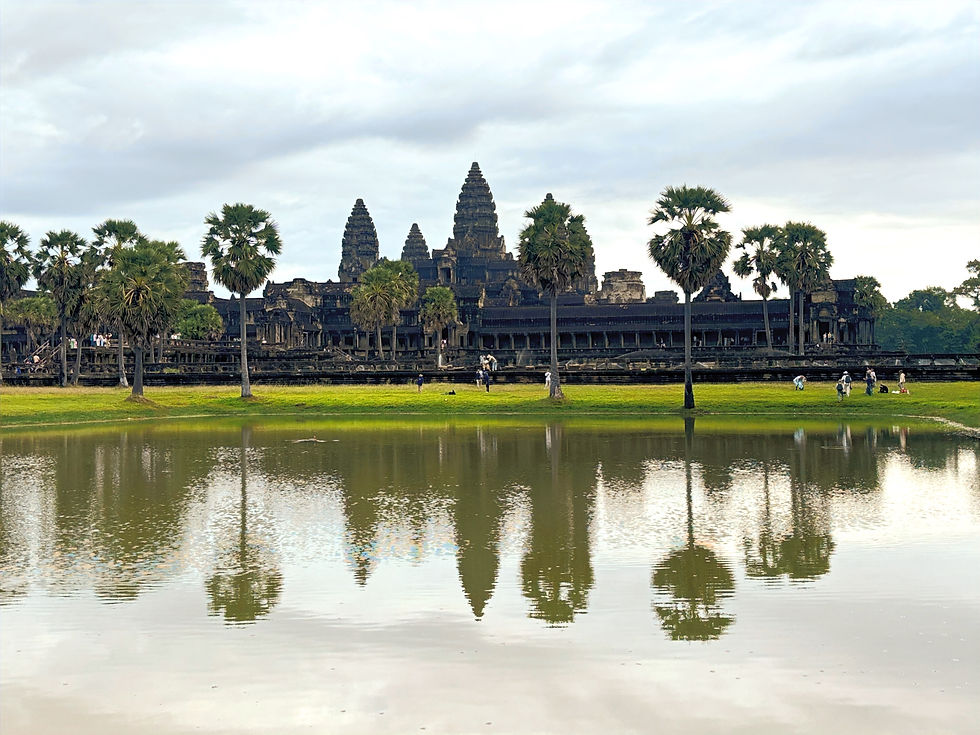
The temple was built by Suryavarman II, the Khmer king who envisioned it as both a state temple and eventually his mausoleum. He was so visionary that he ensured that the architecture of the temple reflected the strengthening and grandeur of his empire. Every corridor and every spire is built with detailed intricacies.
The long gallery walls are covered with detailed stone carvings that depict stories from Hindu mythology. One of the panels shows the great battle from the Mahabharata (The Battle of Kurukshetra) and it stretches along a large part of the gallery, all carved in stone, roughly 900 years ago! The galleries also include scenes from the Ramayana (The Battle of Lanka) and other mythological stories (The Churning of the Ocean of Milk) and King Suryavarman II’s royal procession.
If you take a guided tour, which you really should, the experience becomes completely different. Otherwise, it can feel like you’re just staring at walls and carvings without understanding what they mean. The guide’s narration brings the stories to life and suddenly the temples start to make sense. Kiu could recall many of the stories as well, because they were the same ones his thatha (grandpa) had told him earlier.
The main places in Angkor Wat at are definitely the gallery of decapitated Buddhas, courtyards like ancient stepwells, a stone sundial that still points true. And through all of it, our guide Phirum narrated history like he lived it. Even the kids listened, wide-eyed. That alone felt like a win.
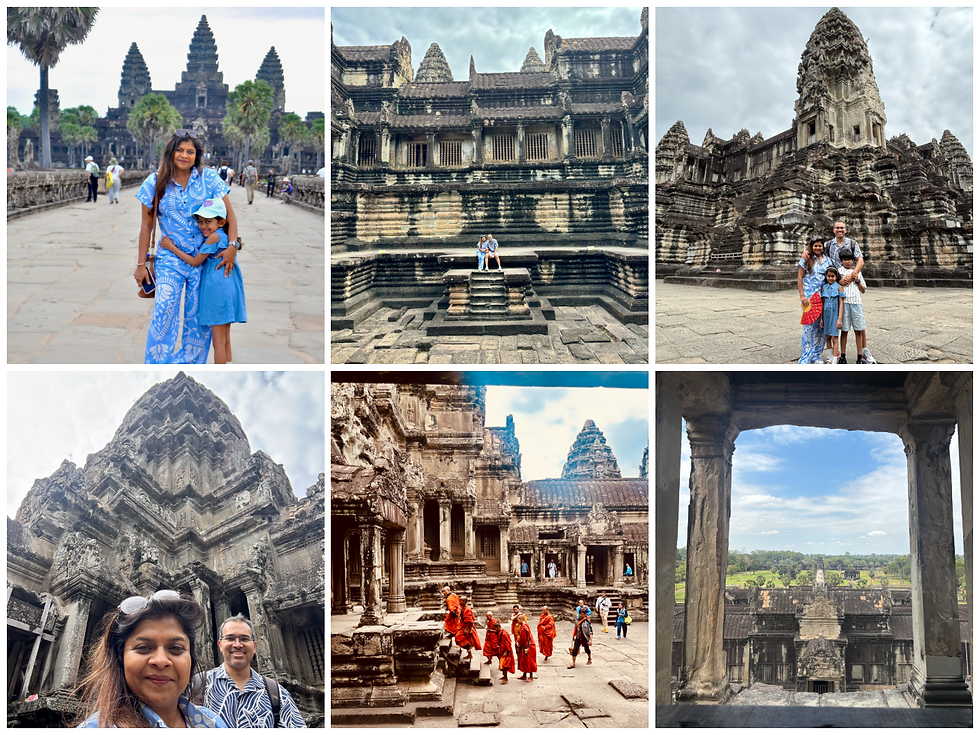
We spent around 2 to 2.5 hours here, and it still didn’t feel like enough. The temple is open daily from 5:00 AM to 5:30 PM, especially for those chasing that iconic sunrise shot. We didn’t and I’ll tell you why later.
And as for the famous Angkor Wat sunrise?
It’s something almost every visitor talks about, and I’m sure it must be magical to witness. But with the kids travelling with us, waking everyone up at 5 AM just to catch the sunrise felt a bit too ambitious. I could probably have done it on my own, but for this trip it felt more meaningful to experience the temples together as a family. Instead, we chose to start the day at a relaxed pace and explore the temples when we were all fully energised. For me, the joy was in wandering through the corridors, admiring the architecture and learning the stories behind the carvings, rather than rushing through the morning just to catch a single moment.

Of course, the sunrise at Angkor Wat would have been beautiful. But I’ve also heard that the spot gets quite crowded, with hundreds of people gathered around the reflection pools, cameras clicking away. I have a photo of the sunrise as a reminder of how stunning it must look. Maybe one day I’ll experience it in person, if the gods will it. Until then, I’m quite happy waking up to the sound of my kids chatting away, rather than to the alarm clock for a sunrise chase.
Note: This is particularly useful if you plan to watch the famous Angkor Wat sunrise. Since sunrise is around 5:45 AM, visitors usually need to pass through the checkpoint by about 5:15 AM, while the ticket office only opens at 4:30 AM. Having your ticket ready in advance makes the early start much easier. Buying the ticket online beforehand saves you from joining the half-asleep queue at dawn, especially during the busy months from November to March. |
Thommanon Temple
Built by: Suryavarman II
Date: Early 12th century (around 1113–1150 AD)
Main Deities: Shiva and Vishnu (Hindu)
Next on our temple marathon was the Thommanon Temple, I found it to be a beautiful and peaceful temple, smaller than many others in Angkor but very well preserved. The temple is known for its detailed sandstone carvings of apsaras and scenes from Hindu mythology.

Even though it is not as large as Angkor Wat, it had a special charm and gave me a quiet moment to appreciate the history and craftsmanship of the Angkor civilization.
Angkor Thom - The City of Gods
Built by: Jayavarman VII
Date: Late 12th century (around 1181 AD)
Main Deities: Primarily Buddhist (Avalokiteshvara), with later Hindu influences
Leaving Angkor Wat, we entered Angkor Thom, the last capital of the Khmer Empire. And the entry itself? Wow.

You drive over a long stone bridge, and on either side, statues line the balustrade, an army of gods (Devas) and demons (Asuras) locked in a cosmic tug of war. This is the legendary Churning of the Ocean of Milk (Samudra Manthan) brought to life in stone. One side pulling the serpent Vasuki, the other anchoring it, recreating the story of gods and demons churning the cosmic ocean to obtain the nectar of immortality.
I never thought I’d be inside a myth I’ve grown up hearing.
At the end of this bridge stands a giant Buddha-faced gateway, an entrance that feels so heavenly, that you feel like you are truly entering heaven! This whole area was once was a living city, markets, palaces, prayers, everyday life going on as usual.

Ta Prohm - The Jungle Temple
Built by: Jayavarman VII
Date: 1186 AD (late 12th century)
Main Deities: Buddhist (Prajnaparamita), dedicated to the king’s mother
Ta Prohm was built in the late 12th to early 13th century by King Jayavarman VII as a Buddhist monastery and university. The central shrine was dedicated to Prajnaparamita, the Buddhist goddess of wisdom, whom the king associated with his mother. At its peak, the temple complex supported thousands of monks, priests, dancers and workers, making it a busy religious and learning centre.
After the Khmer Empire declined in the 15th century, Ta Prohm was mostly abandoned, and that’s when the jungle started taking over. The fig, banyan, and kapok trees you see today have grown over the walls and towers over the past few hundred years. Their massive roots wind through the stone like natural sculptures, gripping the temple and creating the dramatic 'temple swallowed by the jungle' look it’s famous for. This combination of ruins and jungle is what made it so iconic, including being used as a filming location for Tomb Raider.

Yes, this is the famous Tomb Raider temple and our guide proudly showed us the exact frame where Angelina Jolie stood. The kids recreated poses like little action stars and they had a blast.
Outside the temple complex, we met survivors of the Cambodian genocide, many handicapped, playing music and singing. They weren’t begging. They were sharing their culture with dignity. We listened, contributed, and left feeling grateful. The temples show you ancient history, but moments like this show you living history.
Terrace of the Leper King
Built by: Jayavarman VII (likely)
Date: Late 12th century
Main Deities: Associated with Yama, the Hindu god of death and justice
We entered the Leper King Terrace, an elevated platform with a number of interesting statues. The name 'Leper King' comes from a mysterious statue once found on the terrace, although historians believe the figure likely represents Yama, the Hindu god of death and justice, rather than an actual leper king.

The terrace is also lined with dancing figures, guardian statues, and mythological carvings. Some are in a procession, others stand at the corners, giving the terrace a fitting ceremonial feel for back in the day, the terrace would house the seat of the King to effortlessly view the ceremonies, festivals, wrestling events on display. The details are incredible, the faces, the posture, and it’s amazing that they’ve lasted for centuries.
Baphuon
Built by: Udayadityavarman II
Date: Mid-11th century (around 1060 AD)
Main Deities: Shiva (Hindu), later converted into a Buddhist temple with a large reclining Buddha
Next, we walked to Baphuon, a huge three-level temple mountain built in the 11th century, originally dedicated to Shiva. The steps are steep, and climbing to the top gives a good view of Angkor Thom. The temple is impressive because of its size.
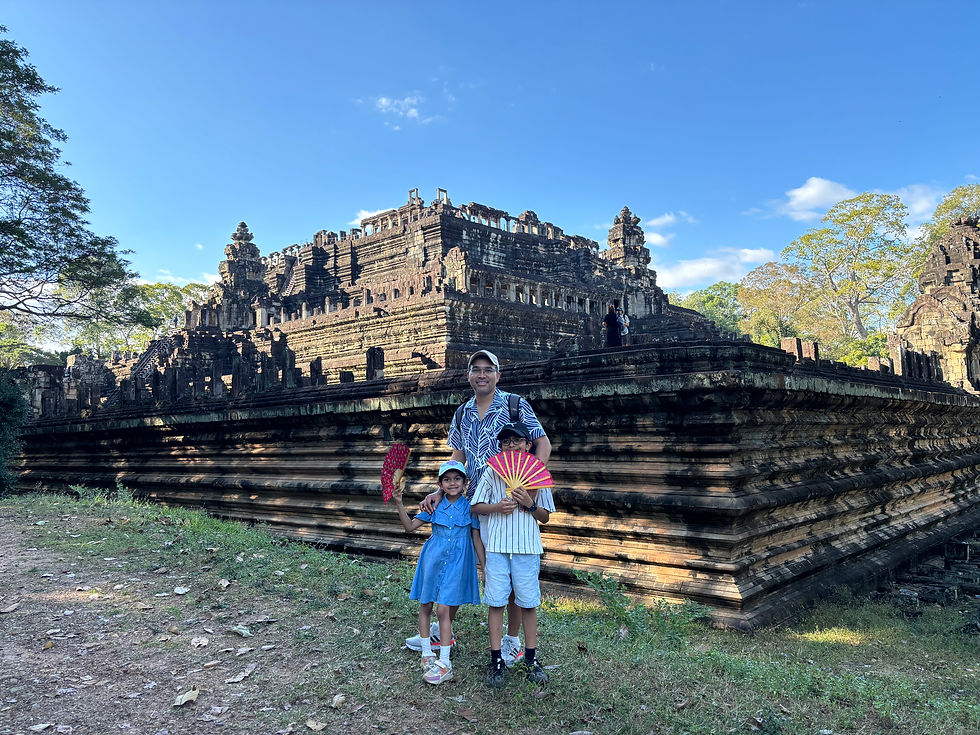
On the way from Baphuon to Bayon, the kids were completely entertained by a group of monkeys and their babies. They were jumping around the trees and stones, squeaking and playing, and Arya and Kiu couldn’t stop looking at the newest born infant in hand of a big mother monkey. This small encounter with wildlife kept them energized for another hour of walking.
Bayon
Built by: Jayavarman VII
Date: Late 12th – early 13th century (around 1180–1210 AD)
Main Deities: Buddhist (Avalokiteshvara), with later Hindu influences added after the king’s reign.
Finally, we reached Bayon, our unexpected favourite! The central temple of Angkor Thom. It’s famous for its over 200 smiling stone faces, believed to be Avalokiteshvara, the Bodhisattva of compassion.
And then there’s the question that inevitably comes to mind: how was this built? Hundreds of massive stone blocks, intricately carved faces stacked high into towers, all created without modern machinery. How many artists worked here? How long did it take to perfect those serene expressions? What tools did they use to carve such detail? The craftsmanship is astonishing, and the mystery of its construction only adds to the wonder.
Bayon is made up of many towers clustered closely together, forming a maze of galleries, courtyards, and corridors. And no matter where you look, you seem to spot another smiling face looking down at you.

The outer walls are covered with detailed artistic depictions showing scenes of daily life, of marketplaces, fishermen, cockfights, soldiers marching to battle, including battles between the Khmer Empire and the Chams, and even ordinary families going about their routines.

Phnom Bakheng - No Sunset. No Sunrise. No Regrets.
Built by: Yasovarman I
Date: Late 9th century (around 889–910 AD)
Main Deities: Shiva (Hindu)
We were supposed to end the day at Bakheng Hill for sunset, but after 20,000 steps, multiple temples, and humidity hugging us like a blanket, NOPE. The kids were exhausted, we were exhausted, and even our guide gently said the sunset here isn’t as magical as it sounds. After a long day of temple hopping, we simply weren’t in the mood for another hike just to catch the sunset.
To reach the temple, you have to walk uphill for about 20–25 minutes from the base of Bakheng Hill. The path is a steady climb through the forest, and while it’s not extremely difficult, it can feel quite tiring after spending the whole day exploring temples under the Cambodian sun.

At the top sits Phnom Bakheng temple, one of the oldest temples in the Angkor area. It’s a pyramid-style temple built on a hill, and the main reason people come here is for the panoramic sunset views over the Angkor landscape. Because of the popularity of the sunset view, the site has a visitor limit and usually closes around 5:30 pm, so many people start the climb in the late afternoon to secure a spot at the top.
We returned to our hotel, jumped straight into the pool, let the water rinse the dust and fatigue off our bodies, got dressed, and headed out to the pub street, tired, hungry, happy.
Day 3 - Grand Circuit
This day too we had booked for the 8 hour temple tour, this time of the outer ring or Grand circuit consisting of Banteay Srei, Preah Ruh, East Mebon, Ta Som, Neak Paon and Preah Khan temples.
Preah Rup
Built by: Rajendravarman II
Date: 961 AD (10th century)
Main Deities: Shiva (Hindu)
We started with Preah Rup, one of the most beautiful temples I’ve visited. The whole temple decor is built on the premise of three stupas dedicated each to Vishnu, Brahma and shiva gods. It has an upper level, the climb to which is steep so there is an alternate stairway built for families with kids that doesn’t have that much inclination as the original one built. From the top of Pre Rup, you get a beautiful view over the surrounding jungle canopy ,we even caught a distant glimpse of Angkor Wat rising above the trees. The first and the second images below depict the lower terrace with the steps rising behind us and the upper terrace with the surrounding forest view. The most noticeable sculptures of this temple are shown in the third and fourth images below. The below two pictures are of a devata (female deity) carving, focus being on her detailed jewelry and headdress. And the other is an image of the guardian lions placed at the corners of the upper terraces, standing watch over the temple steps.

Banteay Srai
Built by: Yajnavaraha, a Brahmin scholar and counsellor to Rajendravarman II
Date: 967 AD (10th century)
Main Deities: Shiva (Hindu)
Another beautiful temple complex which is an important temple in the grand circuit. The Banteay Srai was unique in its architecture because it felt like a traditional house with doors opening into courtyards and every door adorned with a statue of a god or goddess.
Banteay Srei is often called the "jewel of Angkor" because of its incredibly detailed carvings. Unlike most Angkor temples that are built from grey sandstone, Banteay Srei is made of pink sandstone, which makes the carvings stand out beautifully. Many people find its carvings to be the most intricate in the entire Angkor complex.

Neak Pean
Built by: Jayavarman VII
Date: Late 12th century (around 1180–1190 AD)
Main Deities: Buddhist (Avalokiteshvara)
Next we visited Neak Pean, a unique temple located on a small island in the middle of a large pond within the Angkor complex. We walked along a long wooden walkway across the water and wetlands to reach the temple, which made the approach really beautiful. The ancient stone structure stood right in the middle of the pond surrounded by water and greenery, and its reflection on the calm surface of the pond was seen so clealy. Built in the 12th century during the reign of King Jayavarman VII, Neak Pean was believed to be a healing temple with pools representing different elements. These four pools were believed to represent the four classical elements, water, earth, fire and wind. It is fascinating how King Jayavarman VII commissioned temples that reflected deeper ideas of cosmology, healing and compassion in the Angkor Golden era.
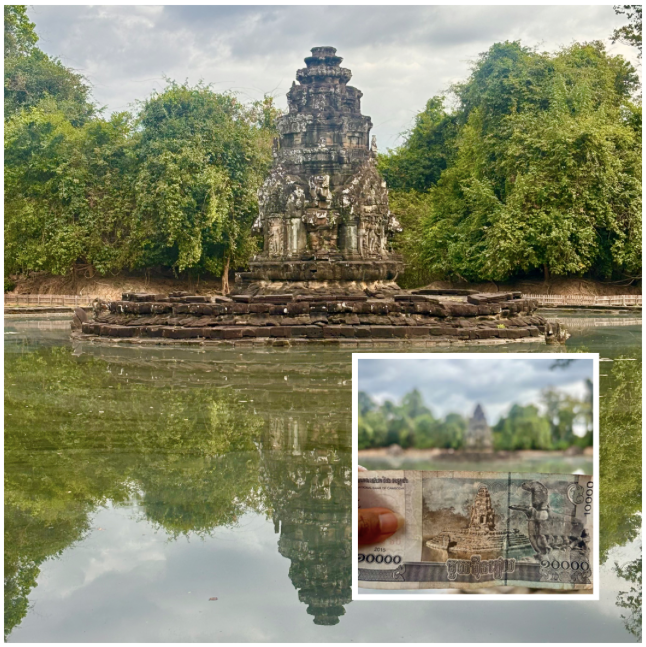
Interestingly, Neak Pean is also featured on the Cambodian 1000 riel note.
Ta Som
Built by: Jayavarman VII
Date: Late 12th century (around 1180–1190 AD)
Main Deities: Dedicated to the king’s father, associated with Bodhisattva Avalokiteshvara (Buddhist), with later Hindu influences.
Ta Som temple is surrounded by jungle and hence the air feels cooler when you step in. It is known for the stone lion guardians and naga (serpent) bridge at the entrance. Even though it is smaller than many other Angkor temples, this temple shows how it can blend beautifully with nature.

One of the most memorable things we saw at Ta Som was the huge tree growing over the eastern gate of the temple. Its massive roots had wrapped themselves around the stone doorway, almost swallowing parts of the structure. At some point the tree had to be partially chopped or trimmed, as the roots were starting to damage the temple stones.
Preah Khan
Built by: Jayavarman VII
Date: 1191 AD (late 12th century)
Main Deities: Primarily Buddhist (Bodhisattva Avalokiteshvara), with later Hindu influences including Shiva and Vishnu.
This was the last temple we visited in Angkor. By then we had already seen many impressive temples, but Preah Khan still stood out because of how big and maze-like it is. Walking through it felt a bit like exploring old jungle ruins, with long corridors, broken walls and trees growing around the stones.

King Jayavarman VII built the temple after his victory over the Cham invaders and dedicated it to his father. It wasn’t just a temple at the time. It also functioned as a large monastery and learning centre, where thousands of monks, scholars and workers once lived. What we found interesting about Preah Khan was how large and spread out it is. You walk through doorway after doorway and courtyard after courtyard, not really knowing what you’ll find next.
Another interesting thing about Preah Khan is the mix of Buddhist and Hindu influences in the carvings and shrines. Over the centuries, the temple went through religious changes. When Buddhism became dominant, some Shiva lingas were removed or damaged. Later, when Hinduism returned to prominence, many Buddha statues were defaced or destroyed.
You’ll see apsaras, garudas and other mythical figures carved into the stone walls across the temple. The temple still looks quite natural and a little wild today. Since 1991, the World Monuments Fund has been helping conserve the site while keeping its original character intact.
Day 4 -Kbal Spean (River of a Thousand Lingas)
That morning we set off from Embassy Angkor Hotel for Kbal Spean, often called the 'River of a Thousand Lingas'. The drive took about 1 to 1 hour 15 minutes north of Siem Reap, into the foothills of the Phnom Kulen mountain range.
From there, we discovered that you cannot drive directly to the carvings. Cars can only go as far as the parking area at the base of the trail, so the rest of the journey had to be done on foot. We took the forest trail of about 1.5 km, walking through the jungle for around 30–40 minutes uphill, before reaching the river.

When we arrived, the sight was incredible. Beneath the flowing water were hundreds of ancient carvings that seemed to float in the river itself, stone lingas and figures carved directly into the riverbed centuries ago. The carvings date back to the 11th–12th centuries during the Khmer Empire and are mainly dedicated to the Hindu god Shiva, with some depictions of Vishnu as well.
The reason the walk is necessary is because the carvings are located directly in the riverbed high in the jungle, so there is no road access beyond the trailhead. After spending time exploring the site, we made the 20–30 minute walk back down the trail to the parking area.
The entire excursion took about two to three hours, after which we drove back to Embassy Angkor Hotel to rest and recharge, saving our energy for one last evening of shopping and street food around Pub Street before leaving Siem Reap the following day.
If you want to explore beyond the Angkor temples, a day trip to Phnom Kulen National Park is a fantastic experience. This tour takes you to the sacred River of a Thousand Lingas, the giant Reclining Buddha at Preah Ang Thom, and the beautiful Kulen Waterfall, where you can even swim. The tour usually includes hotel pickup in Siem Reap around 8:00–8:30 AM, lasts about 8–9 hours, and costs around $45–$50 per person, often including lunch. |
Apsara Performance
I genuinely believe that the best way to understand a place is either by walking its streets, soaking in every bit of history, chatting with locals to get a glimpse of their present lives, or by indulging in a cultural folk show that celebrates traditional music and dance, giving you a peek into what life used to be like.

In Cambodia, with apsaras carved into almost every temple wall, it felt almost mandatory to experience an Apsara dance show for ourselves. So we booked one through GYG, my trusted partner for activities in pretty much every city I travel to. It cost €18 per person for both the dance performance and dinner. They told us someone would pick us up at 6:30 PM, and the whole thing would last around 2.5 hours, super convenient and perfectly timed.
The Apsara dance show was expected to be really good, but we honestly didn’t expect the dinner to be this grand! In other countries we’ve visited, similar cultural shows with dinner usually feel like just a formality, with average food at best. But here, the whole experience felt special, the venue itself was fantastic, like a large restaurant and auditorium combined, with fine dining-style seating and a lavish buffet featuring both Khmer dishes and international cuisine. The food was excellent and really highlighted the depth of Cambodian flavors.

The Apsara dance performances were absolutely gorgeous, rich with culture and tradition, and such a pleasure to watch. Even our tuk tuk ride was perfectly on time and felt very safe, which made the entire evening smooth and stress-free.
The performance usually takes place in a theatre-style restaurant in the city, where guests enjoy a Khmer buffet or set-menu dinner while watching classical Apsara dances that tell stories from Cambodian mythology. The experience typically starts with hotel pickup around 6:30 PM, lasts about 2 to 2.5 hours, and costs around $22 per persondepending on the option you choose. Recommended Tour - Apsara Dance Show & Dinner with Hotel Pick-up |
Day 5 - Kampong Phluk Floating Village
Our visit to Kampong Phluk Floating Village turned out to be one of the most important days of our trip, not because it was exciting or touristic, but because it made us pause and reflect.

Apart from the dinghy ride, which felt slightly commercial, the day was quiet and underwhelming in a way that mattered it wasn’t about entertainment, but about witnessing real lives shaped by the lake. Seeing how families live, work, and adapt to the changing waters of Tonlé Sap felt like mindful tourism, the kind that stays with you long after the day ends.

I’ve written a full blog post on this experience titled “Humbled by the Kampong Phluk Floating Village Experience in Cambodia” read more to know more.
A great way to see life on Tonlé Sap Lake, this tour takes you through the stilt houses and flooded forests of Kampong Phluk by boat. The experience lasts about 6 hours, includes hotel pickup from Siem Reap, and costs around $20–$30 per person. With 7,000+ reviews, it’s one of the most popular tours in the area. Recommended Tour: From Siem Reap: Kampong Phluk Floating Village Tour by Boat |
Street Shopping & Street Food
If you have the time and inclination, spending half a day in Siem Reap wandering through the streets, sampling local street food, browsing the markets and stopping for a massage is absolutely worth it. After three exciting days of temple-hopping and encounters with the celestial apsaras, a slower day of leisure and relaxation feels almost essential for anyone visiting Siem Reap.
Pub Street
Pub Street is basically one street in Siem Reap Old Town that is abuzz with life until the wee hours of the night. It is the main nightlife hub of Siem Reap, with neon lights, music, restaurants and pubs spilling onto the street from both sides. By evening the street becomes pedestrian-only, making it easy to stroll through and take in the lively atmosphere. Many places advertise happy hour cocktails for as little as $0.50–$1, attracting travellers looking for a relaxed but energetic night out. Staff stand outside their restaurants inviting passersby in, enthusiastically calling out their cuisines and recommending their best drinks and dishes. Just beside the street are the Angkor Night Market and Old Market, which makes it convenient for some late-night shopping in between dinner and drinks.
The street is always full of activity. You’ll see decorative lights and flower displays, small tents showcasing artworks, and crowds of people simply wandering around trying to figure out what is happening at each corner. It feels lively and chaotic in an exciting way, and it is such a contrast to the serenity and calm surroundings of the temples you spend the day exploring. Tuk-tuk drivers wait at the entrances and exits of the street, ready to take visitors back to their hotels once the night winds down.
Pub Street is officially called Street 08, Krong Siem Reap, Cambodia, located in the Old Market (Psar Chas) area, a short walk from the Siem Reap River and about 15 minutes from the Angkor temple complex.

Recommendations around Pub Street:
Temple Balcony Restaurant & Bar - Known for its Apsara dance performances on the terrace while guests enjoy traditional Khmer dishes.
Angkor What? Bar - One of the most popular party bars on Pub Street and a favourite with backpackers and late-night crowds.
Khmer Kitchen Restaurant - A well-known spot for authentic Cambodian dishes such as fish amok, lok lak and Khmer curries.
The Red Piano - A well-known Pub Street bar where Angelina Jolie reportedly spent time during the filming of Tomb Raider, famous for its 'Tomb Raider' cocktail.
Explore Siem Reap’s night markets and local food stalls on this 3–4 hour evening street food tour, tasting authentic Khmer dishes and snacks. Includes hotel pickup and costs about $35 per person, with 300+ reviews and a 4.9/5 rating. |
Old Market
After dinner, we decided to explore the markets around the Old Town area, which are just a short walk from Pub Street. Our first stop was Psar Chas (Old Market), one of the oldest markets in the city and still buzzing with activity well into the night. Most of the stalls here stay open until around 10:30–11:00 pm, making it perfect for a leisurely post-dinner stroll.
The market is a maze of narrow aisles lined with small shops selling all kinds of souvenirs and handicrafts. Shelves are stacked with colourful pashminas, silk scarves, handmade bags, Buddha figurines, wooden carvings and Khmer artwork. You’ll also find plenty of elephant-print trousers, palm-leaf baskets, silver jewellery and small stone sculptures inspired by the Angkor temples. I picked up a really beautiful set of 3 serving trays made of ceramic stone. Bargaining is expected, so it’s quite common to stop, compare prices and chat with the shopkeepers before settling on something to take home.

A great introduction to the city, this 2-hour guided walking tour takes you through the Royal Gardens, pagodas, local markets, and charming colonial streets while learning about Cambodian culture and daily life. The tour costs around $6 per person and has 500+ reviews. |
Riverside Night Market
From there we wandered towards the riverfront where the Riverside Night Market was in full swing. This market stays open a little later, usually until around midnight, and has a more relaxed open-air vibe. Stalls line the riverside walkway selling souvenirs similar to the Old Market, but the highlight here is the street food.
Food stalls were serving up a tempting mix of local snacks and sweet treats. We saw plenty of grilled skewers, fried noodles, spring rolls, banana pancakes, mango sticky rice, fresh fruit smoothies and coconut ice cream. Small plastic tables and chairs are set up along the riverside, where people sit with their food and watch the night crowd pass by. It turned out to be the perfect way to end the evening.

We tried the rolled ice cream. It was interesting to watch how the vendor made it by spreading the flavoured cream on a cold plate, mixing it with fruits, and then shaving it off and rolling it up into thin little curls of ice cream. The rolls were then neatly placed in a cup and topped with fruits and sauces. It was quite fun to watch the whole process before finally digging in.
Explore Siem Reap’s vibrant night markets and local food stalls on this 3–4 hour evening tour, tasting authentic Khmer dishes and adventurous snacks like fried insects. The tour includes hotel pickup and a tuk-tuk ride around the city, with stops at markets and local eateries. Recommended Tour: Street Food Experience by Tuk-Tuk |
Foot Massage
It’s quite striking how vibrant the massage business is in Siem Reap. We were surprised to see so many spas spread across the city, catering to tourists and locals alike. Many of them are simple establishments, often a long hall with massage beds lined up one after another, where therapists invite passersby in for a quick and affordable treatment. The prices are hard to believe: a foot massage costs around €4 for 30 minutes and about €8 for an hour.
Most of these places offer a range of services such as head and shoulder massages, body massages, manicures and pedicures, but foot massages are by far the most common. After walking around the temples all day, it’s easy to see why they are so popular with visitors.
We decided to do a bit of research and chose a well-known place called Sokkhak Spa, located near Pub Street. Compared to many street-side massage places, this spa felt more polished and professional. The setting was calm, clean and well organised, and the massage itself was excellent, exactly what we needed after long days exploring the temples.

Around the city you’ll also see fish spas, where small fish nibble at your feet as a form of exfoliation. It’s quite a novelty and draws curious crowds, though we decided to give that one a pass. Massage culture in Siem Reap has become an essential part of the tourist experience. Because the Angkor temple complex involves a lot of walking, many visitors end their day with a quick massage before dinner or a night out on Pub Street. The city now has everything from simple street massage shops to luxury spa resorts, making it easy for travellers to find something that suits their budget and comfort level.
A Note to Future Tourists
People often say, "Don’t wait until you retire to travel,",and Siem Reap is one of the places that proves it true. Siem Reap gave us far more than a temple tour, it gave us perspective. This journey reminded us that sometimes the trips we postpone the longest become the ones we need the most. If you’ve been waiting for the "right time" to visit Angkor Wat, take this as your sign: go when you can, go with an open heart.
Visiting the temples here isn’t just sightseeing, it’s a physical journey. Expect long walks between complexes, uneven paths, and more stairs than you ever imagined. Angkor Wat, Bayon, Ta Prohm, each one demands energy, balance, and a fair bit of stamina. Travel while your legs are strong and your knees still cooperate. Visit places like Angkor when climbing temple steps still feels exciting instead of exhausting. Make those memories now, take the detours, explore every corner, and enjoy the journey while you can. And after a long day of walking through temples and markets, there’s always a relaxing foot massage in Siem Reap waiting for your tired feet. 😊
Extra Time – Kep
If you have an extra day or two, Kep is a peaceful coastal town worth visiting. Kep Beach is clean and calm, perfect for swimming. At the Kep Crab Market, local vendors cook freshly caught crab for about $10–$12 per plate, and the air smells of pepper and sea salt. A 30-minute boat ride takes you to Rabbit Island (Koh Tonsay), where turquoise water, hammocks, and beachside seafood huts create the perfect end to a Cambodian adventure.
Tour Company (Siem Reap)Organised by Siem Reap Shuttle 📞 +855 98 555 518. Most full-day tours cost $25–$40 USD per person and include hotel pickup, guide, and bottled water. |
If you enjoyed reading my blog post, I’d love it if you gave it a thumbs-up 👍🏼 and hit subscribe for more updates. Feel free to share it with your friends and family too! If you have any questions or want to chat about travel or anything else you'd like to know more about, I’m just a message away.


Comments