


Inside Cambodia’s Royal Palace and Silver Pagoda, Phnom Penh

Hey there! As you read through this post, feel free to click on the affiliate links highlighted in BLUE. If you decide to book a hotel or purchase something through them, I’ll earn a small commission, at no extra cost to you. These commissions help keep The Morning Brew running and allow me to create more awesome content. Thanks for your support!
Planning a trip to Cambodia and have Phnom Penh on your itinerary? Then the Royal Palace and Silver Pagoda are absolute must visits. This blog post is designed to help you plan your visit with all the essential tips and things to keep in mind before you go. More importantly, the palace complex is packed with fascinating buildings, and knowing what you’re looking at and why it matters makes the experience far more rewarding. Makes sense? I thought so 🙂
Let's get inside Cambodia’s Royal Palace and Silver Pagoda, Phnom Penh!
But first, a little history!
In the 1860s, King Norodom moved Cambodia’s capital from Oudong back to Phnom Penh and began building the Royal Palace of Cambodia as the new home of the monarchy. Over time, it became the centre of royal life and ceremonies. Within the palace grounds is the Silver Pagoda, built to protect Cambodia’s most sacred Buddhist treasures. Its silver floor and revered Buddha statues reflect how closely the country’s royal history and religious traditions are linked. What makes the Silver Pagoda special is that it is one of Cambodia’s only temples to survive under the Khmer Rouge. It is not just a place of worship but one of the most spiritually and culturally significant spaces in Cambodia.
Royal Palace (Preah Barom Reacheaveang)
The Royal Palace of Cambodia, also known as Preah Barom Reacheaveang, remains the official residence of King Norodom Sihamoni. Since 1993, Cambodia has followed an elective monarchy system, making it one of the few countries in the world where the king is elected. Built in the 1860s, the palace is a fine example of traditional Khmer architecture with its golden guilds and and decorative apsara figures. It stands as a strong symbol of Cambodia’s monarchy and cultural heritage. It is located in the heart of Phnom Penh, along Sothearos Boulevard, close to the Tonlé Sap and facing the Mekong River.

The Royal Palace of Cambodia is easy to reach on foot, by tuk tuk, or by taxi, but visitors should know that although the palace has several gates, only one is open to tourists. We ended up walking almost the entire perimeter of the palace, roughly 1.5 to 2 kilometres, before finding the correct entrance.
On the eastern side, the Victory Gate faces Sothearos Boulevard, close to Hun Sen Park and the riverside near the Mekong and Tonlé Sap. This gate is reserved for royalty and VIPs and remains closed to the public. The northern gate is along Street 240, a quieter stretch known for cafés and boutiques. This is the funeral gate, opened only after the death of a monarch. In 2013, the body of King Norodom Sihanouk was brought out from here to begin the funeral procession through the city. On the western side, facing Sisowath Quay along the riverfront, is the historically known executing gate, which once served a grim purpose and is now closed.
Finally, the southern gate, located near Street 184, is easy to spot as it faces a busy area with tuk tuks, vendors, and visitor signage. This is the commoners’ entrance and the only gate open to tourists today, providing access to the palace grounds and the Silver Pagoda.
Good To Know:
|
Recommended Tours: If you’re short on time, this is a great half day private tour that covers Phnom Penh’s highlights, including the Royal Palace, the National Museum, and Wat Phnom. I’d recommend booking it in advance via GetYourGuide for a smooth and well organised experience: BOOK HERE. If you’re planning your trip to Phnom Penh, this 8- hour tour is a great option. It includes visits to the Royal Palace, the Killing Fields, and more. I recommend booking in advance via GetYourGuide for a smooth and well organised experience: BOOK HERE. |
We started our day early at 9 AM to beat both the crowds and the rising afternoon heat. Just after entering the palace gates, a young female guide approached us offering her services, but we chose to explore on our own since we had read up beforehand. That’s when I realised I had clearly missed the dress code memo. A quick fix later, I ended up buying a Cambodian printed T shirt for US$3, along with my US$10 entry ticket to access the official palace grounds.

We entered via one of the main ceremonial entrance gates - the Southern Gate or the 'Commoners' Gate'. There was a portrait of King Norodom Sihamoni above the gate and supposedly it is commonly displayed within palace grounds as a symbol of the monarchy. Rather than a single building, the Royal Palace is a large complex made up of several structures, including reception halls and museums. Areas open to visitors are clearly separated from the private residential quarters still used by the royal family.
Throne Hall (Preah Tineang Tevea Vinichhay)
The first major structure we encountered was the Throne Hall, an imposing building used for royal ceremonies, coronations and official events. It is the most important ceremonial structure in the palace. The palace grounds are stunning, with yellow‑and‑white traditional Khmer architecture. The idea was to represent the peaceful coexistence of Cambodia’s two major religions, with yellow symbolizing Buddhism, the country’s primary faith today, and white representing Hinduism, which dominated during the Angkorian period. The grounds have manicured gardens dotted with bougainvillea flowers, the building facade is adorned with apsara figures which reminded me of all the apsara carvings on the temple walls in Siem Reap.

We climbed a long flight of stairs to reach the rectangular hall, which has multiple doors along its periphery. There are 5 doors to the front of the hall. The one in the center is reserved for royalty.

Visitors are not allowed to step inside, so the hall can only be viewed from the doorways. The throne is mainly used during coronations and important royal ceremonies and remains unused most of the time.

The 59-meter-high tower is the main tower of the Throne Hall. The gold and green colors are used to showcase royalty, prosperity, and spirituality. The 59-meter height makes the Throne Hall stand out as the most important building in the palace. Below, along the roofline, finely carved apsaras appear to dance across the structure. The carved apsaras represent beauty, grace, and protection. If you look at the top of the spire, it features four faces of Brahma. The four calm faces look in all directions, symbolising wisdom and watchfulness over the kingdom.

Napoleon III Pavilion
If you walk south of the Throne Hall, you’ll come across a unique iron structure known as the Napoleon III Pavilion. Built entirely from cast iron, this pavilion was originally constructed in France (some say Egypt) and later gifted to Cambodia in parts during the 19th century. It was reassembled within the palace grounds and stands out in great contrast from the surrounding yellow-white-gold Khmer architecture. It is such a misfit, yet it is a symbolic representation of Cambodia’s historical ties with Europe.

Hor Samran Phirun (Pavilion of Heavenly Rest)
From the elevated Throne Hall building, we saw the Hor Samran Phirun, a ceremonial structure that sits directly opposite it across the main courtyard. Like the Throne Hall, this building is also closed to visitors. It plays an important role during royal ceremonies, especially coronations, as it is traditionally where the King prepares before proceeding to the Throne Hall. It is basically a royal resting place or royal waiting room before processions. What caught my eye were the ornate Khmer rooflines and gold detailing, which make it one of the most striking structures within the palace complex.

Preah Reach Damnakchan Pavilion (Royal Residence Pavilion)
The Preah Reach Damnakchan Pavilion is part of the private residential area of the Royal Palace. It is used as a living and resting space for the King and is not meant for ceremonies or public events. It is not open to visitors.

Hor Samritvimean (Pavilion of Regal Treasures)
Hor Samritvimean (Pavilion of Regal Treasures) houses important royal regalia used during coronations and major royal ceremonies.

The items you see are meant for court ceremonies, processions, and royal symbolism, which is why many pieces are highly decorative, gilded, and ornate. You will also find the attire of King Sihamoni, which he wore for his coronation on October 14, 2004.


Preah Tineang Phochani Dancing Hall
The Preah Tineang Phochani Dancing Hall is an open air ceremonial hall inside the Royal Palace. In the past, it was used for classical Khmer dance performances held for the royal family and the public. Even today, it is used during important ceremonies where traditional dances are performed.

The pavilion is open on all sides, making it easy for large crowds to watch performances from the courtyard. It is slightly raised and topped with a traditional Khmer roof with gold detailing. On ceremonial days, the pavilion is lit up at night, which makes it stand out beautifully within the palace grounds.
Preah Tineang Chan Chhaya Pavilion
Unlike the Preah Tineang Phochani Dancing Hall, which is located deeper inside the palace grounds and used mainly for court and indoor royal performances, the Chan Chhaya Pavilion faces the public side of the palace. Chan Chhaya is an open air pavilion designed so performances can be viewed by people gathered outside the palace walls, especially during national and royal celebrations.

Silver Pagoda (Wat Preah Keo Morakot)
Within the complex is the famous Silver Pagoda (Wat Preah Keo Morakot), included with palace entry. Its name comes from its floor of over 5,000 solid silver tiles, each weighing about 1 kilogram, althoguh hardly anyhting is visible today because of the carpet covering the floor. It houses many national treasures and sacred Buddha icons. One must remove their shoes beofre entering the Pagoda.
Please note that all inscriptions and explanations inside the pagoda are in Khmer and not in English. If you want a better understanding of the artifacts displayed in the cabinets, it is best to hire a guide at the entrance itself. |
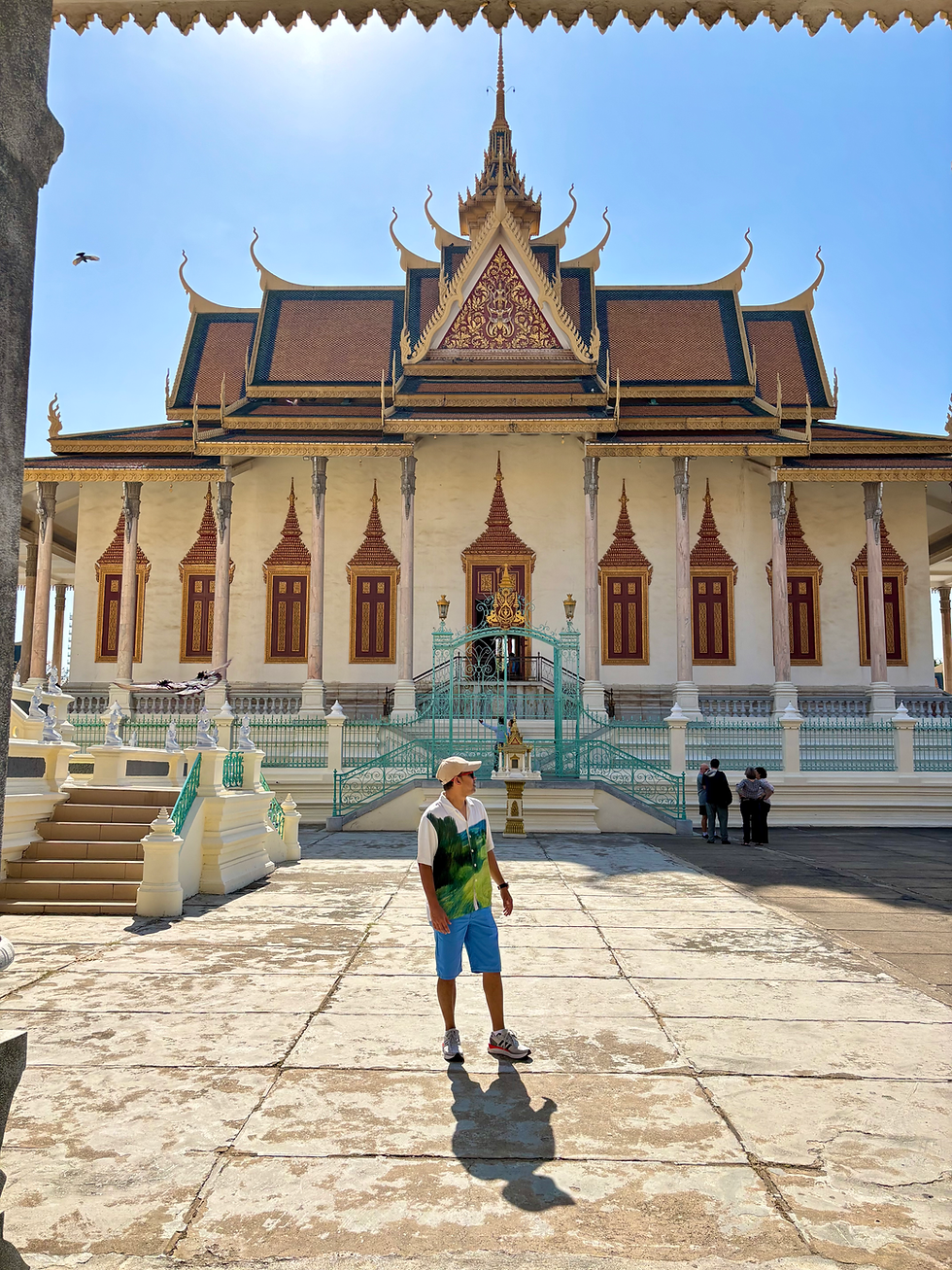
Inside the pagoda, lies the life sized solid gold Buddha statue, encrusted with more than 9,000 diamonds, with one diamond alone weighing around 90 carats, including a prominent diamond on the chest. It represents Maitreya, the Buddha of the future, and is one of the most valuable religious objects in Cambodia. It sits inside the Silver Pagoda alongside the famous Emerald Buddha, which is just the name but its actaully not emerald. The statue is carved from green baccarat crystal, which gives it its emerald like appearance. It sits on a high pedestal inside the pagoda and is one of the most sacred Buddhist objects in Cambodia. Photography inside the pagoda itself is strictly prohibited to preserve the interior and relics. We paid our respects and exited the Pagoda to explore the surrounding environs which hold four distinctive stupas.
Reamker Murals at the Silver Pagoda
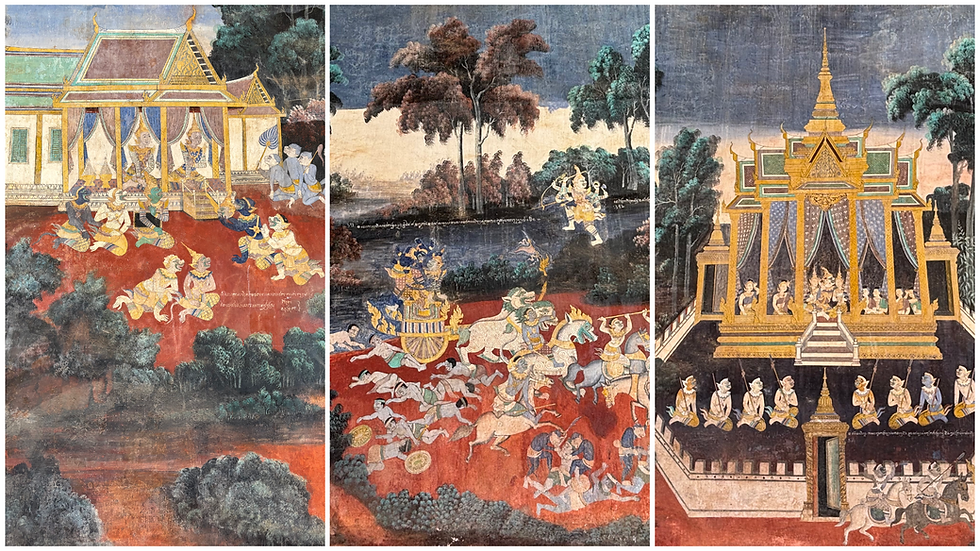
Inside the Silver Pagoda, walls display traditional Ramayana‑style murals, offering insight into ancient stories and symbolism. The long mural gallery lines the inner courtyard walls as you turn left from the entrance to the silver pagoda. As an Indian, it was interesting to see the depictions of Ramayana from an Cambodian aspect. They depict scenes from the Reamker, the Cambodian version of the Ramayana, showing episodes with gods, demons, royal processions, and epic battles. Painted in traditional Khmer style, the murals are meant to be viewed as a continuous story while walking around the pagoda
Mondapa of Satra and Tripitaka Library
The Mondapa of Satra and the Tripitaka Library are small but important buildings within the Silver Pagoda complex. They are used to store and protect sacred Buddhist texts, including the Tripitaka ("Three Baskets"). They might be simple from its facade but these buidlings are highly important in preserving Cambodia’s Buddhist teachings.

Stupas
Four intricately decorated stupas, built as memorials to members of the royal family, are clustered around Wat Preah Keo. Each stupa is uniquely designed, reflecting the status and era of the royal it commemorates.

Entrance to Preah Sihamoni's Expo
After visiting the Silver Pagoda compound, you pass through a series of exhibition hall, art galleries, a typical Khmer House on the way to the exit. These display royal carriages, traditional Khmer folk dance costumes and masks, silverware, artefacts for royal procession, along with live music and weaving demonstrations.


Roung Damrei Coffee & Fresh Fruit (Elephant in Royal Palace)
At the exit of the Silver Pagoda, there is a small café where visitors can take a short break after walking through the palace grounds. Roung Damrei Coffee & Fresh Fruit is a great spot for refreshing fruit shakes and iced drinks, with the mango shake being especially good after a long walk.

Final Thoughts
To wrap it up, a visit to the Royal Palace and Silver Pagoda is far more than just ticking off another landmark in Phnom Penh. It’s a walk through Cambodia’s royal history, religious traditions, and living culture. Taking the time to understand what each building represents adds real depth to the experience and turns a simple sightseeing stop into something much more meaningful. If you’re in Phnom Penh, don’t rush this visit. Go early, walk slowly, and let the palace tell its story.
If you enjoyed reading my blog post, I’d love it if you gave it a thumbs-up 👍🏼 and hit subscribe for more updates. Feel free to share it with your friends and family too! If you have any questions or want to chat about travel or anything else you'd like to know more about, I’m just a message away.


Comments