


What to Do in Nairobi in 3 Days (With Kids Too!)

Updated: Sep 25, 2025
Hey there! As you read through this post, feel free to click on the affiliate links highlighted in BLUE. If you decide to book a hotel or purchase something through them, I’ll earn a small commission, at no extra cost to you. These commissions help keep The Morning Brew running and allow me to create more awesome content. Thanks for your support!
After a long night in Mumbai, wading through rain-flooded streets, dragging myself past security, and waiting at Terminal 1 well past midnight, I was already running on empty. Even the Hoegaarden I had ordered sat abandoned, that's how tired I was. The rain hit the big glass windows, red runway lights blinking in sync with the planes outside, and I sat with my feet pressed against the suitcase, half-asleep but quietly excited.
This time it wasn’t just another trip. Egypt and Morocco had already been ticked off, but Nairobi felt like the real heart of Africa. Six hours on an IndiGo flight, and I would wake up in a city I had only imagined, one where skyscrapers and the rhythm of the streets are as alive as the savannah and the wildlife beyond.
I had three full days here before heading to the Maasai Mara, and I couldn’t wait to see how the city would unfold. This was the start of my three days in Nairobi, the perfect prelude before the wilderness.
Table of Contents: What to Do in Nairobi in 3 Days (With Kids Too!) Flight Options, Fares & First Impressions |
Nairobi in 3 Days
I knew Nairobi from Sidd, who had traveled there for work before. I had heard about its National Park with wild neighbors right at the city’s edge. I knew about Kibera, Kenya’s largest slum. I knew Nairobi was a city where people dressed sharp, full of style, and where the energy was always buzzing. But now, I wanted to move beyond just knowing. I wanted to see with my own eyes the chaos and the charm that make Nairobi what it is.

Nairobi is the capital and largest city of Kenya, with a population of over 4 million people, making it one of the most densely populated cities in East Africa. The Indian Gujarati and Punjabi community form a small but influential minority, deeply rooted in the city’s history through businesses and trading companies established during the British colonial era. What truly makes Nairobi the heart of Kenya is its unique mix, the modern skyscrapers standing beside traditional Maasai markets, cultures blending from all over the country, and wildlife roaming just minutes away from the city center. Could it get any better?
Best Time to Visit
For the best time to visit Nairobi, the dry months from June to October and again in January and February are ideal, as the weather is pleasant and animals are easier to spot around water sources. These months also make it easier to plan day trips to the Nairobi National Park, the Giraffe Center, or even further out to the Maasai Mara, since the roads are less muddy and game drives more rewarding. If you don’t mind a little rain, the shoulder months of March to May and November can also be beautiful. The city is lush and green, prices are lower, and there are fewer tourists.
Flight Options, Fares & First Impressions
It was a direct flight from Mumbai on IndiGo. The ticket was meant for 2:00 am but airline delays pushed take-off to 3:45 am. In hindsight, we should’ve just paid more for a more reliable flight like Kenya Airways instead of waiting around. We booked about a month in advance, which is late for safaris, but got a decent deal. Current IndiGo fares are usually around USD 175–200 one way, and a return ticket in August averages USD 380–560 (€350–520). Kenya Airways also flies direct, though usually a bit more expensive at USD 400–650 (€370–600).

Coming into Mumbai’s Terminal 1 wasn’t great, wet roads, long queues, immigration and security felt endless. But things smoothed out when we landed in Nairobi. Immigration was quick, baggage came reasonably fast, and Jomo Kenyatta Airport looked clean and basic. Washrooms were well kept; café/restaurant options weren’t obvious, but that could be because I was tired.
Our hotel, Sarova Stanley, had arranged airport pick-up. The driver was super friendly, transfer was quick (about 17–20 minutes), and they charged us about €28 / USD 30 for the ride. Many safari companies offer the same, or you could arrange your own transfer.
⭐ Don’t try your luck with random taxis after a long flight. Book a reliable one-way transfer from Jomo Kenyatta International Airport and arrive in Nairobi calm and ready to explore. Choose from a 3-seat sedan to larger vans or minibuses depending on your group size, the ride takes about 40 minutes to an hour depending on traffic, and your driver will be waiting with a “meet & greet” sign right after customs. Plus, many bookings come with free cancellation up to 24 hours in advance. Book it here
Where To Stay?
We stayed at the Sarova Stanley, right in the heart of the city surrounded by shops and offices. It’s one of Nairobi’s oldest hotels and still carries that old-world charm with all the modern comforts. What I loved most was how flexible they were with timings, early check-ins, late check-outs, making it easy to match with travel schedules. Spacious rooms, a rooftop pool, and a choice of restaurants made it a very comfortable base. Prices are usually around USD 150–220 per night.

If you’re looking for luxury, the Nairobi Serena Hotel is a classic choice. Set near Central Park, it offers five-star service, elegant rooms, fine dining, a spa, gym, and pool. It’s well known for its high standards of comfort and security, making it a peaceful escape right in the middle of the city. Expect to pay between USD 220–350 per night.
For a budget-friendly stay, Hotel Boulevard near the CBD is simple but convenient. Rooms are basic yet comfortable, and the garden and pool make it a nice spot to relax after exploring. Prices are around USD 60–100 per night.
Another good mid-range pick is Lotus Inn and Suites, a smaller modern hotel with neat, functional rooms. It’s quiet, comfortable, and offers good service without being too expensive, usually between USD 70–120 per night.
I always use Booking.com for good hotel / travel deals. Feel free to use my link if you want.
Day 1
Jomo Kenyatta International Airport
We landed at Jomo Kenyatta International Airport, a simple, no-frills airport that keeps things straightforward. Immigration was quick, baggage came through on time, and everyone we met was kind and friendly. Outside, our driver Simon was waiting in a minivan to take us into the city. He greeted us Jambo.

⭐ Relax in style after your flight! Enjoy premium lounge access at Jomo Kenyatta Airport. Book it here.
Asante → Swahili for “Thank you.” Jambo → Swahili greeting, often used like “Hello.” (though locals more commonly say “Habari” or “Mambo”). Karibu → In Swahili means “Welcome” or “You’re welcome.” |
Our hotel, Sarova Stanley, is a 5-star heritage property in downtown Nairobi, right on Kimathi Street. The area is lively, lined with cafés, shops, and offices, and just a short walk from landmarks like Kenyatta Avenue and the Nairobi National Archives. We were basiclly in the midst of the city's rythmn!
The drive in gave us a first impression of Nairobi itself, well-planned highways built with Chinese support, stretches of green on either side, and a skyline of modern glass towers. Nairobi has a stylish, polished character to it, and people carry themselves with the same elegance you’d expect in any European city. Stylish. Modern. Sleek. That’s Nairobi.

At the hotel, the staff welcomed us with warm towels and a chilled lime juice, a gesture that immediately set the tone. We settled into our ultra-luxurious room, rested for a bit, and then my alarm nudged us awake for lunch. A light salad and soup later, we called an Uber, easily available in Nairobi, and headed to the Giraffe Center, about 45 minutes from downtown.
Uber and other ride-hailing apps (like Bolt, Little Cab, etc.) are widely used in Nairobi. Many locals and visitors rely on them because they’re usually cheaper, safer, and more convenient than hailing random taxis on the street. The main thing to watch out for is petty theft, especially phone snatching through open car windows in traffic. As long as you keep your windows rolled up and avoid holding your phone near the window, Uber is a convenient and safe option for both locals and visitors. |
Kibera, Kenya's Largest Slum
We were running on very little sleep, but we couldn’t miss the chance to meet our endearing spotted friends. Enroute the Giraffe center which is located in nature preserve of Duma road, we passed through the city limits. It was an eye-opening experience, so different from the way Africa is often showcased in Western media. We drove past Kibera, Kenya’s largest slum, and I couldn’t help but notice that even here there was a sense of structure and order, far from the image I had expected. In Nairobi, many people move on foot along paths that aren’t formally paved but are wide enough to walk with ease, while unchecked traffic flows on the main streets, filling the air with pollution. Most of these people form the backbone of the city’s workforce, employed in the many service offices that keep Nairobi running.

⭐ Take a 3-hour guided tour of Kibera Slum in Nairobi with local guides. See daily life up close, hear real stories, and get a fresh perspective. Book it here
Giraffe Centre
The entry at the Giraffe Center was well organized, we first washed our hands, read the instructions, and then bought our tickets (1500 KES for adults and 750 KES for kids) before heading to the feeding station. Each of us received a coconut shell filled with treats, which we were supposed to offer one piece at a time using our thumb and index finger, never the whole shell. Before we deep dive into the feeding aspect, allow me to introduce to you the Giraffe Center. The Giraffe center is a regentration sanctuary committed to nurturing the ‘near threatened’ Rothschild girafte. There are about 2,098 Rothschild giraffes remaining in the wild worldwide (IUCN, 2018). They are managed by the African Fund for Endangered Wildlife (AFEW) Kenya.

Rothschild’s giraffes, also called Nubian giraffes, are endangered because of habitat loss, poaching, and competition with livestock, which has left their populations small and scattered, with only about 2,500 left in the wild. They are mostly found in Kenya, in places like Lake Nakuru and Ruma National Parks, and in northern Uganda’s Murchison Falls. What makes them stand out from other giraffes are their lighter patches with creamy lines, their white ‘stocking-like’ legs, the extra oscines on their heads (usually five instead of two), and their height, they can grow up to six meters, making them some of the tallest giraffes.

Now, the feeding bit. It was a joy to feed them treats. The staff did warn us about this one particularly aggressive female who had a habit of nipping at kids’ fingers, likely because of bad experiences with children teasing her before. I was extra cautious with Arya and Kiu around her, but the other giraffes, a majestic male and a playful two-year-old, were gentle and eager, happily eating from our hands and returning for more. In total, the center has 11 giraffes, including a newborn just two days old, who stayed hidden with its mother most of the day and only stepped out at closing time, which was a real treat to see. Though the crowd could have been managed a little better, the excitement was contagious, for both people and giraffes. It turned out to be a warm, joyful experience for kids and adults alike, and we left with plenty of enthusiasm, great videos, and beautiful memories of the Rothschild’s giraffes.
Website: www.giraffecentre.org
Opening time: 9 AM to 5 PM
Entry Fees: USD15 (KSh 1,500) per adult and USD7.50 (KSh 750) per child (ages 3–12), while children under 3 enter free.
At the Giraffe Centre in Nairobi, enjoy feeding the giraffes but keep a safe distance as they can headbutt if you get too close. Always feed with an open palm, watch your belongings since they’re curious nibblers, and sanitize your hands afterward. For the best experience, go early in the morning or one hour before closing time and always follow staff instructions. |
⭐ Spend a day exploring Nairobi’s wildlife — visit the National Park, Elephant Orphanage & Giraffe Center for unforgettable encounters. Book it here
Dining at CJ’s
CJ’s is a buzzing restaurant with an upper and lower deck, aired in sunlight coming through the glass ceilings, chandeliers giving it a very glam look and a spacious atmosphere. We took a table at the upper deck and ordered some delicious food from the menu, mostly western like tacos, barbecue chicken wings, passion fruit juice, veg club sandwich, piri piri fries and a butter squash soup. Everything that came on the table was delicious!

Day 2
Nairobi National Park
Sidd had visited Nairobi National Park back in 2014. It was his very first safari in Africa and set the stage for what to expect on all our future adventures. I still remember seeing his photos and feeling a mix of meh and happiness. Meh that he had experienced it before me, but thrilled that he hadn’t missed the chance.

This time, with Lake Nakuru and the Maasai Mara on our agenda, we skipped Nairobi National Park and chose to focus on the city itself. But if Nairobi is your main stop, this is an absolute must-do! Imagine lions, rhinos, giraffes, and zebras roaming free with the city skyline as the backdrop. It’s the only capital city in the world that has a fully fledged national park right at its doorstep.
The park is about 117 square kilometers and located just 7 km from the city center, making it super easy to visit. Safaris here usually run in the early morning (6:00 am – 11:00 am) or afternoon (3:00 pm – 6:00 pm) when animals are most active. You can book directly online through the Kenya Wildlife Service (KWS) website, pay your park entry fee at the gate, or simply ask your safari company to include it in your itinerary. Many hotels in Nairobi can also arrange half-day game drives.
If you’re short on time and can’t make it to the Mara, Nairobi National Park gives you that first taste of the wild, and it’s one you won’t forget.
Nairobi Animal Orphanage sits inside the entrance area of Nairobi National Park. It’s a smaller facility where injured, orphaned, or rescued animals (like lions, cheetahs, hyenas, monkeys, and some birds) are kept in enclosures for treatment, rehabilitation, or education. It’s more like a mini-zoo experience compared to the wild, open feel of the park. |

⭐ If you’ve got half a day in Nairobi, this one’s a gem. Nairobi National Park 5-Hour Guided Game Drive with Free Pick-Up gives you a wildlife safari right outside the city. Book It Here.
Sheldrick Elephant Orphanage
If you have a whole day in Nairobi, the Sheldrick Wildlife Trust is a place you absolutely must visit. This is where orphaned baby elephants, rescued from the wild, are nurtured and raised until they are ready to be reintroduced to their natural habitats. Watching them drink their milk bottles, splash around in mud, and play with each other is nothing short of heart-melting. For kids, it’s a wonderful chance to learn how elephants are cared for, understand why protecting wildlife matters, and even “adopt” an elephant to follow its journey back to the wild.

The Orphanage visit is tied to Nairobi National Park, so you need to factor in the park entry fee as well, which makes it best enjoyed as part of a full-day outing. That way, you not only get the unforgettable one-hour window with the elephants but can also combine it with a game drive in the park. It is a rare chance to see rhinos, lions, and giraffes with the city skyline in the backdrop. If time allows, it’s one of Nairobi’s most rewarding experiences.

Timings: Daily 11:00 am – 12:00 noon (closed Dec 25). Arrive by 10:30 am.
Sheldrick Trust Entry: US$20 per adult / US$5 per child (non-residents); KSh 2,000 adult / KSh 500 child (residents).
Nairobi National Park Fee (mandatory): US$43 per adult / US$22 per child (non-residents).
⭐ Spend 6-8 hours visiting Nairobi’s Elephant Orphanage and the Giraffe Center. Get close to rescued wildlife, learn their stories, and enjoy feeding giraffes up close. Book it here.
The Sheldrick Wildlife Trust’s Nairobi Nursery is where orphaned baby elephants are rescued, cared for, and prepared to return to the wild. Visitors can book a one-hour visit (11am to 12 noon, except Christmas) to watch the babies enjoy their milk feed and mud bath, while learning their stories and how the Trust protects wildlife. There are two separate fees: an entry donation to the Trust and a mandatory Nairobi National Park entry fee charged by the Kenya Wildlife Service (even if you are only visiting the Nursery). Guests should arrive early, wear comfortable clothes, bring water, and note that there are no cafés or Wi-Fi at the nursery. You can also adopt an orphan during your visit. |
Night Vibes in Nairobi
If you’d like to explore the Nairobi nightlife, you must first know that Nairobi comes alive with food and music. Disco buses with blaring DJ music and flashing lights are seen rolling all over the city transporting people. If that’s not your scene; then you can head out either to The Alchemist, a vibrant outdoor space with food trucks and live DJs, Nairobi Street Kitchen for a more urban vibe, or Beit é Selam for a modern Ethiopian-Kenyan fusion dining experience.
Day 3
A Visit to the GPO
Rahul (My BIL) has picked up his old hobby of stamp collecting again, so our day began with a short 10-minute walk from Sarova Stanley to the Nairobi General Post Office on Kenyatta Avenue. The concierge had warned us to be careful, keep valuables tucked away, watch out for pickpockets, and avoid random strangers striking up conversations. Luckily, we reached without any trouble. The stamp counter at the GPO usually opens around 9:00 am, and we were guided straight there. Because of a power cut, the room was pitch dark, and the staff member knocked on a heavy iron door before a big, cheerful lady let us in. She welcomed us into the dim office, where they carried on business under the light of a torch as if it were completely normal. It felt almost funny flipping through stamp books like that, but the collection itself was impressive. Rahul bought the Big Five set for 440 KES, the Northern Rhino for 250 KES, and a few others for his collection. Arya and Kiu happily chose postcards of the Great Migration and a leopard, 150 KES each.

Timings:
Monday to Saturday: 8:00 AM to 5:00 PM
On weekdays they often split service into morning (8:00–1:00) then break, then resume in the afternoon (around 2:00–5:00)
Nairobi National Museum
After heading out to the natural light of the day, we ushered an uber and made wait to the Nairobi National Museum. This day was all about soaking in the capital’s culture and history. The museum is the perfect way to understand Kenya’s story, from its wildlife and fossils to its art and heritage. At the museum, we bought the combo tickets for the museum and the snake park.

Like everything else in Kenya, if you are interested in wildlife, so shall you be interested in the artifacts of the museum. With two floors spanning the Great Hall of Mammals, Birds of East Africa, Hominid skulls, Cycle of life, History of Kenyan men and women, there is much information for kids and adults to explore in a good 2 hours.
One fascinating feature is the statue of Sudan, the last Northern White Rhino of Africa and its story that’s important for the world to know. After spending much time in the museum, we helped ourselves to the snake park close by.

Timings: Open daily from 8:30 AM to 5:30 PM.
Entry fees: Ksh 1,200 (~ USD 9) per adult and Ksh 600 (~ USD 4.50) per child, or you can buy a combined ticket with the Snake Park for Ksh 1,500 (~ USD 11) per adult and Ksh 1,000 (~ USD 7.50) per child.
Nairobi Snake Park
The snake park was not that greatly maintained but it had so many varieties of reptiles, that it was fascinating to explore every exhibit. An entire section also constituted the aquarium of fishes found in Kenya. From Nile river crocodiles to the venomous Mambas, little turtles to big brown tortoises, vipers and pythons, and countless non-venomous snakes kept us all entertained. We hired a guide at the entrance itself who could give more information on these beautiful magnificent creatures. Shonel was knowledgeable about the reptiles, amphibians and fishes that were kept there. The most interesting part of the park was the open quadrangle where amidst a few trees and bushes lie the most venomous snakes of Kenya, but they couldn’t slither upwards as the walls were made slippery. And thank them for that! Otherwise we wouldn’t have braved that opportunity of seeing them in the open like that. After a good one hour here, we head to CJ’s, close to the City market which was just a 3 minutes walk to our hotel.
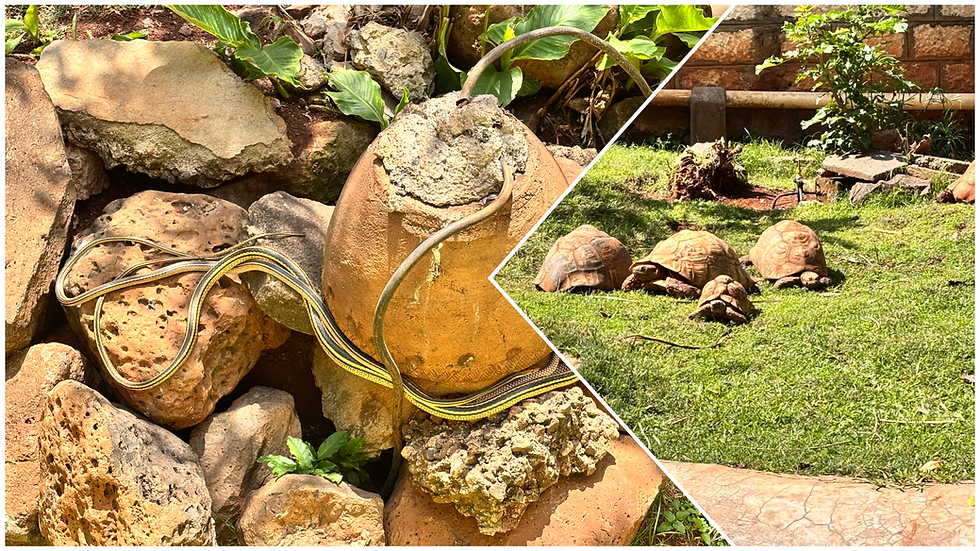
Timings: Open daily from 8:30 AM to 5:30 PM
Entry fees: Citizens KSh 200 adults / 100 children, Residents KSh 400 / 200, Non-residents KSh 1,200 / 600.
Bomas of Kenya
We wanted to visit the Bomas of Kenya, famous for its cultural dances, music, and traditional homesteads from different tribes, but unfortunately it was closed during our trip. If you want to dive into Kenya’s soul through dance, culture, and crafts, this is a must-do. The cultural centre is just about 10 km from Nairobi’s CBD, and the experience includes lively performances of traditional dances, music, acrobatics, and folklore from Kenya’s diverse ethnic groups. You can also wander through replicas of tribal homesteads (bomas) with thatched huts, livestock areas, and granaries. It is a great place for kids to explore and learn about Kenya’s cultural diversity.

Timings: Daily afternoon cultural shows usually start at 2:30 pm, but it’s best to arrive by 2:00 pm to settle in
Cost: Around USD 48 per person for a standard tour
Duration: 2–3 hours including the show and homestead walk
Treasure Hunting at the Maasai Marlet & City Market
We had planned to visit the Maasai Market, Nairobi’s largest open-air market known for its traditional and modern African crafts, but it was closed on Monday. The market moves to different venues on different days, like the High Court parking lot, Village Market, or near the Nairobi Law Courts. Since it wasn’t open, we instead went to the City Market, which was just a short walk from our hotel.

Timings:
Usually open from 8:00 am to 6:00 pm at each location.
Closed on Mondays.
The city market was a treasure trove of Kenya’s finest handmade goods. From thicket baskets to bead purses, maasai masks to maasai shawls and tools, keychains, magnets, clothes, jewellery, batuk paintings, animal figurines and many more. It was a huge godown full of souvenirs to take back home! Loved every minute spent there but I must say it was equally stressful thanks to the bargaining with the experts out there. Remember a thumb rule to make everything a third of the price being offered and that’s when you can get a good deal. I would ideally head to the Maasai Market in Nairobi which is the largest flea market and an experience in itself, however on Mondays it was closed, so we headed to the second best place. It was sundown already and we had to make a move to the hotel. On the way we stopped at Naivas, a supermarket chain in Nairobi where many locals bought their produce. We picked up some fine coffee and tea as recommended by Alex. Something to linger the taste of Kenya after we are head back home.
Timings:
Open every day from early morning until evening, roughly 6:00 am to 9:00 pm.
On Saturdays, specific stall hours are 8:00 am to 4:00 pm
⭐ Explore Maasai Market for Unique Souvenirs — shop crafts, support local artisans, learn the art of bargaining, and walk away with meaningful keepsakes. Book it here
Things to buy: Kenyan Coffee (Africa Kahawa No.1 and Out of Africa), Purple Tea which is unique to Kenya, lighter than black tea but full of antioxidants, Maasai Shúkà (Shawls/Blankets), Kikoy & Kitenge Fabrics (versatile cotton wraps and bright printed fabrics), Bead Jewellery from Maasai Village or Maasai Market in Nairobi, look out for Akamba leather goods like sandals, belts, bags, local hot sauces like African Bird’s Eye Chili, Makonde carvings and Kamba woodwork masks, woven sisal baskets known as Kiondo baskets, bowls, figurines, and animal sculptures, batik prints and traditional fabric/canvas art etc. |

We stayed overnight in Nairobi, after dining at the exquisite Thai restaurant in Sarova Stanley. Fatigued from the entire week’s itinerary, we head to sleep for a couple of hours. Our flight was early next morning.
The Kenyatta International Conference Centre (KICC) Rooftop offers great panoramic views of Nairobi and is worthwhile if you have some extra time. |
⭐ Escape the city and go on a half-day game drive through Nairobi National Park — lions, giraffes, and more just beyond the skyline. Book it here.
⭐ Join a 3-hour walking tour of Nairobi’s historic and modern highlights — culture, architecture, stories. Book it here
Closing Thoughts
Nairobi surprised me in more ways than I expected. In just three days, we fed giraffes, learned about conservation at Sheldrick, explored the city’s history at the museum, shopped in bustling markets, and even caught a glimpse of daily life in Kibera.
It’s a city of contrasts. Stylish people, buzzing streets, cultural diversity, and nature right at the doorstep. Nairobi is an experience in itself, a perfect prelude before heading out into the wild.
If you enjoyed reading my blog post, I’d love it if you gave it a thumbs-up 👍🏼 and hit subscribe for more updates. Feel free to share it with your friends and family too! If you have any questions or want to chat about travel or anything else you'd like to know more about, I’m just a message away.
If you’d like to support my blog, even a small contribution would go a long way in helping me keep sharing these travel stories. Wishing you safe travels and magical moments wherever the road takes you!


Comments